
Why Justin Holbrook Deserved Dally M Coach of the Year
The Dally M system needs an overhaul...
1 Oct 2026·4 min read·by Taj Soupidis
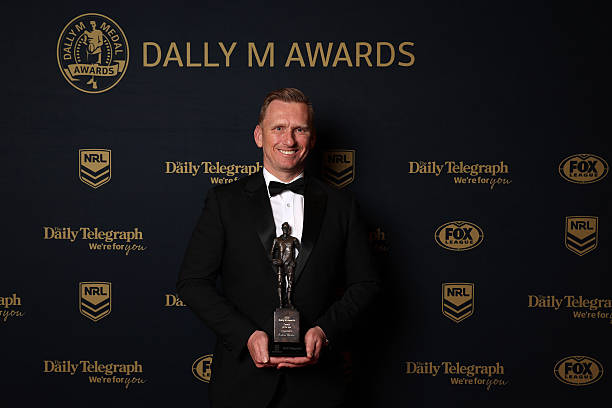
Photo: Getty Images
Andrew Webster deserves enormous credit for what he achieved with the Warriors in 2026.
But if the question is "which coach produced the most remarkable season", Justin Holbrook should have been holding the Dally M Coach of the Year award.
Instead, Webster was crowned Coach of the Year on Wednesday night, beating Holbrook and Kristian Woolf for the honour.
The frustrating part isn't that Webster won. It's that the voting system meant Holbrook's most extraordinary achievement of the entire season couldn't even be considered.
Webster was outstanding — but so was Holbrook
Let's make one thing clear: this isn't an argument that Andrew Webster didn't deserve recognition.
He absolutely did.
The Warriors finished second in the regular season, winning 18 of their 24 matches and scoring a competition-high 728 points. They also dealt with significant injuries, including season-ending ACL injuries to Tanah Boyd and Roger Tuivasa-Sheck, while Luke Metcalf and Jackson Ford also spent significant periods on the sidelines.
Webster kept the Warriors competing near the top of the ladder despite repeatedly having to adjust his team. That is excellent coaching. But Holbrook's achievement was on another level.
Newcastle had finished last in 2025. Twelve months later, the Knights finished seventh, won a finals game, eliminated the second-placed Warriors in Auckland and then knocked out the reigning premiers Penrith Panthers to reach the Grand Final.
They are now one win away from becoming premiers. That transformation doesn't happen by accident.
From the wooden spoon to the Grand Final
The most obvious argument for Holbrook is simply where Newcastle started. The Knights were the NRL's wooden-spooners in 2025.
Holbrook arrived for his first season as head coach and immediately changed the trajectory of the club.
Newcastle finished the regular season seventh with 14 wins from 24 games finishing in their first finals appearance since 2023.
They did it despite a season that continually tested their depth. Kalyn Ponga played only 15 regular-season games. Bradman Best played 14. Marquee recruit Dylan Brown suffered a season-ending ACL injury in Round 21. Dylan Lucas, Jacob Saifiti and Trey Mooney were also lost for significant parts of the season.
Then came the finals.
This is where the argument becomes impossible to ignore
The Dally M voting system assesses the Coach of the Year award after Round 27.
That means the finals don't count which is stupid. Holbrook's Knights therefore weren't judged on what they did against South Sydney, the Warriors or Penrith.
That is a massive problem when you're trying to identify the best coaching performance of an entire NRL season.
Newcastle beat South Sydney in the elimination final. Then they travelled to Auckland and beat the second-placed Warriors 12-10. Then they faced Penrith in the preliminary final and won 22-14 despite losing Phoenix Crossland to a send-off.
Suddenly a team that finished last the previous year was in the Grand Final.
The Knights have become only the second team in the modern NRL era to go from the wooden spoon to the Grand Final the following season.
The other was the 2010 Sydney Roosters. That is not simply a good coaching season. It is one of the most remarkable turnarounds the competition has seen.
Holbrook also changed Newcastle's identity
The biggest thing Holbrook deserves credit for isn't simply the ladder position. It's the way Newcastle played.
The Knights became aggressive, connected and dangerous with the ball. Ponga flourished.
NRL.com reported that he finished the regular season with 14 try assists and 12 line breaks, while describing Newcastle as one of the competition's most exciting teams.
That matters because Holbrook wasn't simply squeezing an extra few wins out of the same team. He fundamentally changed what Newcastle looked like.
The Knights went from a team that had finished last to one capable of beating the competition's best teams when the pressure was at its highest.
This isn't an argument against Webster
This distinction is important. Webster's Warriors were arguably the best regular-season story in the competition.
They finished second. They scored the most points. They overcame an enormous injury toll. They had to use five different halfbacks during the season, according to analysis published during the finals.
Webster deserves enormous credit for that. But his Warriors then lost both of their finals matches and exited the competition in straight sets.
Holbrook's Knights, meanwhile, won three consecutive finals games and reached the Grand Final. That doesn't erase what Webster achieved.
It simply makes the question of who coached the more remarkable overall season much harder to answer in his favour.
The Dally M rules are the real issue
Ultimately, the biggest problem isn't Andrew Webster. It's the timing. The Dally M Coach of the Year award is effectively a regular-season award.
That made sense when the winner was supposed to be judged on the 27-round regular season.
But if the award is called Coach of the Year, why shouldn't the most important games of the year count? Who cares if the Warriors finished second if they were just going to blow out and piss away their season.
Holbrook's most impressive coaching moments came after the voting had closed.
Those performances tell us something about Holbrook's coaching that simply wasn't available to voters when they made their decision.
The Daily Telegraph and Nine have both raised the same issue following Wednesday night's awards, arguing that the voting process should be changed so the finals can be considered. That is probably the fairest conclusion.
Andrew Webster can be a deserving Dally M winner under the current rules while Justin Holbrook can still be the coach who deserved the award.
Those two statements aren't contradictory. Webster had the better regular season. Holbrook produced the more extraordinary overall season. If the award is coach of the season then why doesn't the coach of the season win. The system makes little sense.
When a coach takes a wooden-spoon team to the Grand Final in his first year, beating the second-placed team and the reigning premiers along the way, it is difficult to argue that his work wasn't the standout coaching achievement of 2026.
The Dally Ms simply stopped counting before we got to see it.
Comments (0)
Sign in to comment, like or dislike.
Loading…