
Jarome Luai, Shaun Johnson Among Referee Critics: Every Big Decision Analysed
Were Samoa right to be angry, or do the facts tell another story?
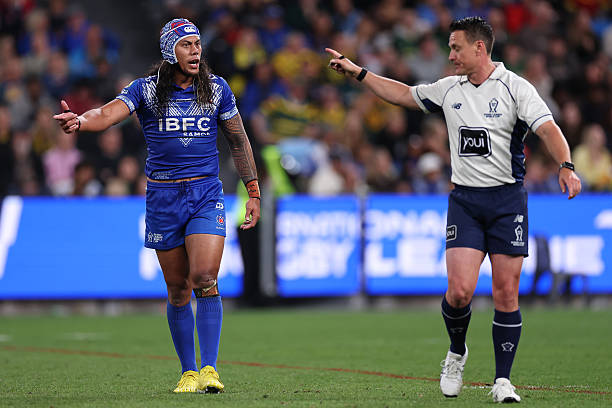
Photo: Getty Images
Australia's 44-12 victory over Samoa secured the Kangaroos a place in the Rugby League World Cup final, but the scoreline was not the only talking point to emerge from a fiery semi-final at Allianz Stadium.
Referee Adam Gee and the Bunker came under scrutiny throughout the contest, with several decisions leaving Samoa frustrated and reigniting debate about the consistency of officiating in international rugby league.
Jarome Luai was among the Samoan players visibly questioning the officials, while former New Zealand international Shaun Johnson provided pointed commentary on the broadcast.
Spencer Leniu's sin-binning, two disallowed Samoan tries and a series of contentious calls became major talking points.
The debate was not limited to the Samoan camp, either. Sydney Roosters coach Trent Robinson publicly questioned one of the Bunker's most important decisions, while veteran rugby league journalist Steve Mascord also highlighted several flashpoints.
Trent Robinson leads criticism of controversial disallowed try
The most significant controversy arrived in the first half when Samoa appeared to have scored through Stephen Crichton following a Jarome Luai kick.
Francis Manuleleua chased the high ball and challenged Reece Walsh, with the ball coming loose before Crichton collected it and crossed the try line.
The on-field decision initially favoured Samoa, but the Bunker intervened and ruled that Manuleleua had knocked the ball forward during the aerial contest.
The try was overturned, leaving Samoa without what would have been a crucial six points.
At the time, Australia led 16-2. A successful try and conversion would have reduced the deficit to 16-8 and given Samoa a genuine opportunity to get back into the contest.
Instead, Australia scored again through Reece Walsh just two minutes later, extending the lead to 20-2.
The decision attracted criticism from Trent Robinson, who was part of Channel 7's coverage.
“I really believe that should have been a try,” Robinson said.
The Guardian also questioned the decision, describing the Bunker's conclusion as relying on blurry frames and noting that the call helped blunt Samoa's comeback.
This was arguably the most consequential refereeing decision of the night. The key question was whether Manuleleua's contact with the ball constituted a knock-on before it reached Walsh.
The difficulty with the decision is that an aerial contest can produce complicated changes in the ball's direction. The Bunker needed to establish whether the ball had been propelled forward by Manuleleua rather than simply deflected during the contest.
Manuleleua originally appeared offside from the kick, with the bunker ruling that it would support the on-field call, suggesting the call was every tight.
However, he knocked the ball on in the contest. I believe offside would've been called if there was no knock on in the contest, and the Bunker was just moving to the easier call to avoid criticism.
VERDICT: Correct call
The early Crichton decision that helped Australia take control
Another important moment came during the opening stages. Samoa had started positively, with Stephen Crichton kicking a penalty goal in the fifth minute to give his side a 2-0 lead.
However, Crichton was subsequently ruled to have lost possession in a challenge with the Australian defence. The decision handed Australia a scrum and an attacking opportunity.
Tom Dearden capitalised, producing a dummy and breaking through the Samoan defensive line to score.
The Guardian described the decision against Crichton as harsh, suggesting the video referee's ruling shifted the momentum of the match.
This was an important early call because it changed possession and gave Australia the opportunity to attack from a scrum.
Australia still had to execute the opportunity, and Dearden did exactly that. But Samoa would understandably have been frustrated to lose possession after making a strong opening.
Cameron Munster did have his hand in and around the ball, but when he removed it there was no stripping action, which would've been a Samoa penalty.
VERDICT: Correct call
The second disallowed Samoa try
The first disallowed try was not the only Bunker decision to attract attention.
Later in the match, Samoa believed Hamiso Tabuai-Fidow had crossed for another try, only for the effort to be ruled out following a review involving contact with Liam Martin.
The Guardian specifically highlighted the disallowed Tabuai-Fidow effort as another decision that went against Samoa.
The decision came during the second half, when Samoa were attempting to build some momentum and find a way back into the contest.
This decision deserves attention because it was another occasion when Samoa believed it had earned points but the Bunker intervened.
There was contact to Liam Martin's head, and the onus is always on the attacking player to get through the line without any obstruction.
VERDICT: Harsh but correct
Spencer Leniu sent to the sin bin after confronting Adam Gee
Perhaps the most heated moment of the evening came just before half-time.
After Bradman Best scored Australia's fifth try, Spencer Leniu became involved in an exchange with referee Adam Gee.
The Samoan forward approached the referee and was subsequently sent to the sin bin for dissent.
Shaun Johnson provided a detailed explanation during Channel 7's coverage, saying:
“Spencer made a beeline for Adam Gee and said something to him.”
Johnson also suggested Leniu's apparent money gesture as he left the field could have been an expression of frustration about the perceived fairness of the officiating.
“I can’t help but think he’s probably alluding to a point of asking how Adam Gee is officiating a game where Australian is involved in against Samoa,” Johnson said.
He added that the gesture suggested Leniu did not feel the match was being officiated fairly.
However, Johnson was also critical of Leniu's response and made it clear that the forward had handled the situation poorly.
“He’s an emotional player but he got this wrong,” Johnson said.
“No player can approach a ref unless you’re the skipper. But not in this manner whatsoever.”
Luke Keary also commented on the frustration inside the Samoan camp, describing Junior Paulo's half-time discussion with Gee as an “animated discussion”.
Andrew Voss observed that Samoa had gone beyond simply being frustrated, saying:
“Sadly they’ve lost their way in this one.”
Interestingly, the frustration was not limited to Samoa. Voss also spotted Australian captain Isaah Yeo having words with Gee as the players left the field.
The sin-bin decision itself is easier to understand than some of the Bunker controversies.
Referees need to maintain control of the game, particularly when emotions are running high. Players cannot simply approach officials aggressively or repeatedly challenge their authority.
Leniu's frustration may have been understandable, but approaching Gee in that manner put his team in an even worse position.
Samoa were already trailing 26-2 at half-time. Losing a forward for 10 minutes after the break made the task even more difficult.
Johnson's comments were particularly interesting because he acknowledged the possibility that Leniu felt the game was unfair while also making it clear that the forward's response was unacceptable.
VERDICT: Unknown what was said, so N/A at this stage
Jarome Luai's involvement and the tackle on Jack Bostock
Luai was another central figure in the growing tensions.
The Samoa captain was involved in the confrontation that followed a dangerous lifting tackle on Australian winger Jack Bostock.
The incident sparked a melee between players, with Reece Walsh and Francis Manuleleua among those involved in the aftermath.
Luai was placed on report for the tackle, while Gee brought both captains, Luai and Isaah Yeo, together as tensions escalated.
Luai was also seen walking after Gee as Leniu left the field following his sin-bin.
The exchanges continued into the second half, with Harry Grant appearing unhappy with Luai during another confrontation.
The decision to place Luai on report was significant because it allowed the incident to be reviewed after the match.
A lifting tackle is a serious matter, particularly when a player is placed in a dangerous position. The officials were entitled to examine the tackle and determine whether it met the threshold for further action.
However, the incident also demonstrated how quickly the game was becoming difficult to control.
There were confrontations between players, arguments with officials and repeated interruptions. While Samoa were understandably frustrated, their reaction increasingly became a distraction from the football.
Jermaine McEwen was also pushing his face into the turf after the tackle which doesn't help their case.
VERDICT: Correct call
The penalty count: another part of the debate
One of the statistics that emerged from the match was the penalty count.
Samoa finished with eight penalties conceded compared with Australia's four.
That meant Samoa conceded twice as many penalties as the Kangaroos, adding to the pressure they were already experiencing.
The first half was particularly damaging, with Samoa conceding five penalties before the break.
The penalty count became part of the wider argument about the way the match was officiated, particularly given the two disallowed tries and the sin-binning of Leniu.
The penalty count alone does not prove that a referee has favoured one team.
Samoa's discipline was a genuine problem throughout the match. Errors, penalties and emotional reactions repeatedly handed Australia opportunities to build pressure.
However, when a team has two tries disallowed and its players are repeatedly questioning decisions, the penalty count inevitably becomes part of the wider discussion.
It is also worth noting that Australia were penalised four times. This was not a match in which the Kangaroos were completely untouched by the officials.
Steve Mascord highlights the flashpoints
Rugby league journalist Steve Mascord also identified several moments that contributed to the controversy.
His post-match analysis highlighted the disallowed try, Leniu's sin-bin and the confrontation between Harry Grant and Luai.
Mascord also raised an incident involving a ball being thrown towards a Samoan player in backplay before Best's try, although this was not one of the major decisions officially detailed in the match report.
His assessment was that the semi-final had been full of flashpoints, despite Australia's eventual comfortable victory.
So, did Adam Gee and the Bunker get the big decisions right?
Australia were outstanding. They completed nearly 90 per cent of their sets, matched Samoa physically and allowed their opponents only one line break.
The Kangaroos also punished Samoa's mistakes and scored eight tries, with Reece Walsh producing a hat-trick.
Samoa's discipline was a major issue, and Leniu's sin-bin was a consequence of his own actions rather than an automatic consequence of the earlier Bunker decisions.
For me, Samoa can complain about the laws and rules of the game potentially being too harsh. But they know this his how the game is officiated now, and based on the rules the game was officiated well overall.
Samoa lacked discipline and started to fire up once the game had slipped from their grasp. They have nobody to blame but themselves for the defeat, and they looked to scapegoat the officials, rather than taking accountability for their errors.
Comments (0)
Sign in to comment, like or dislike.
Loading…