
International Rugby League Blowouts: How Can the Game Become More Globally Competitive
This World Cup has multiple teams who can challenge Australia for the title, but big gaps in quality are still obvious despite a 10-team tournament
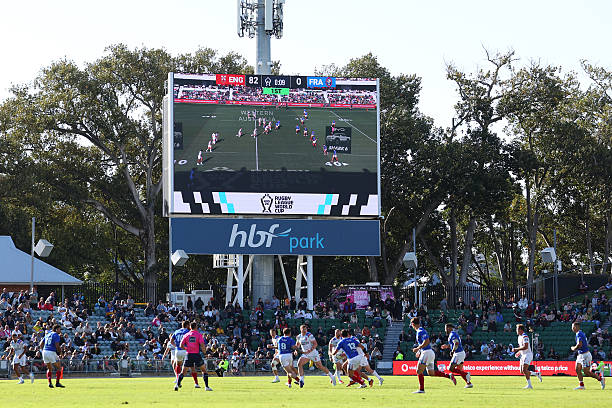
Photo: Getty Images
Rugby league's international game has made significant progress in spreading talent across more nations, but a history of one-sided World Cup matches raises an uncomfortable question: is the sport growing globally, or simply redistributing elite players without developing the teams around them?
International rugby league is facing a familiar problem at the 2026 World Cup. While the tournament has delivered compelling contests between established powers and emerging contenders, heavy defeats have once again exposed the enormous gap separating the strongest nations from the rest.
England's 82–0 victory over France, Samoa's 64–6 win over Papua New Guinea and Australia's 78–0 demolition of England in the women's competition have renewed questions about whether international rugby league is doing enough to make the World Cup genuinely competitive.
These results do not necessarily mean international rugby league is going backwards. The emergence of Samoa and Tonga as serious contenders demonstrates that the international game can become more competitive when nations receive sustained investment, regular fixtures and access to elite talent.
However, the continued frequency of blowouts suggests that making more players eligible to represent different countries is only part of the solution.
If international rugby league wants to become a truly global sport, its challenge is no longer simply getting more nations onto the field. It is ensuring those nations have the resources, preparation and development pathways to compete.
A problem that has followed the World Cup for decades
The Rugby League World Cup was first held in France in 1954, featuring Australia, Great Britain, France and New Zealand. The tournament was designed to establish an international championship for a sport whose leading competitions were concentrated in Australia, Britain and France.
Australia quickly established itself as the dominant force. The Kangaroos have won the men's World Cup 12 times, while Great Britain has won it three times and New Zealand once. Australia's sustained success reflects the depth of its domestic competition, professional infrastructure and talent pool.
The disparity between the leading nations and developing teams is not a new phenomenon. International rugby league has repeatedly struggled to balance the appeal of a genuinely global tournament with the reality that some countries have far greater playing resources than others.
The 2000 World Cup, which expanded to 16 teams, produced several significant mismatches. The United States, Russia, Morocco and other emerging teams struggled against established opponents, while the tournament attracted criticism over the standard of some matches.
The 2013 and 2017 tournaments demonstrated that expansion could still produce compelling rugby league. Ireland, Scotland, Italy and other nations were given opportunities to compete on a major stage, and the knockout stages provided memorable contests.
The strongest argument for expansion was that international exposure could help countries grow their player bases and attract investment. The counterargument was that participation alone did not guarantee meaningful competition.
The 2021 tournament, played in England in 2022 after its pandemic-related postponement, illustrated both sides of that debate.
Samoa's remarkable run to the final demonstrated what could happen when a nation combined elite NRL talent with strong team cohesion. Yet other matches featured overwhelming scorelines, including England's 94–4 victory over Greece and Australia's 84–0 win against Scotland.
The lesson was not that smaller nations should be excluded. It was that a World Cup featuring more teams needed a stronger plan for developing them between tournaments.
Have eligibility changes helped or hurt competitiveness?
One of the biggest developments in international rugby league has been the evolution of player eligibility rules.
Under International Rugby League regulations, players can qualify to represent a country through birthplace, the birthplace of a parent or grandparent, or qualifying residency. The rules also govern how players can move between national teams.
These provisions have allowed players with family connections to different countries to represent nations beyond their country of birth.
For Pacific nations in particular, the rules have been transformative. Players developed in Australia's NRL system can represent Tonga, Samoa, Fiji and other countries connected to their heritage, bringing professional experience and elite-level skill to international teams.
The impact has been especially visible in the rise of Tonga and Samoa. Both have become increasingly competitive against Australia, New Zealand and England, with Samoa reaching the 2022 World Cup final.
That progress challenges the argument that heritage-based eligibility automatically undermines international rugby league. In many cases, it has made matches at the top end of the sport more competitive.
The difficulty arises when the same system benefits some developing nations far more than others.
A country with a large diaspora represented in the NRL can potentially assemble a squad of elite professionals. Another nation with limited domestic participation, few professional players and little access to funding may struggle regardless of its eligibility opportunities.
The result is a widening distinction between nations that can draw on established professional talent and those still attempting to build a sustainable player base.
Eligibility rules also have limits. They do not allow players to represent any nation of their choosing without qualification, and the rules for switching between Tier 1 and Tier 2 or Tier 3 nations contain restrictions. They should not be treated as a substitute for domestic development.
The challenge is to retain the benefits of heritage representation without allowing it to become the principal strategy for improving national teams.
The problem goes beyond player eligibility
The quality of international rugby league is influenced by far more than which country a player represents.
Professional nations benefit from regular high-level competition, extensive coaching networks, sports science, medical support and access to experienced administrators. Smaller rugby league nations often have considerably fewer resources.
Preparation is another major issue. Lebanon coach Michael Cheika highlighted the difficulties faced by nations that struggle to arrange warm-up matches before a World Cup. Without regular international fixtures, teams have fewer opportunities to develop combinations, test tactical systems and expose inexperienced players to elite competition.
This creates a cycle that is difficult to break. Countries need competitive matches to improve, but they need to improve before they can consistently compete in those matches.
There are also concerns about the modern game's increasing speed. The six-again rule and faster play-the-ball sequences can place enormous physical demands on teams that lack the depth and conditioning of the leading nations. When one side has superior fitness, technique and interchange options, the score can quickly become one-sided.
That does not mean the rules should be changed simply to make weaker teams more competitive. The aim should be to help developing nations reach the required standard rather than artificially restrict stronger teams.
How can rugby league make future World Cups more competitive?
There are several practical measures that could help close the gap without abandoning the global ambitions of the tournament.
1. Establish a proper international calendar
The first priority should be a more consistent international window.
Australia, New Zealand and Pacific nations have benefited from the Pacific Championships, which provides regular competition and gives players meaningful international experience.
A comparable structure involving England, France, Lebanon and other European nations could provide a similar pathway in the northern hemisphere.
An annual international window would allow developing teams to organise fixtures well in advance, prepare properly and build combinations over multiple seasons.
It would also make international rugby league more visible to supporters, rather than treating the World Cup as the only major opportunity for many nations to compete.
2. Invest in domestic development, not just national squads
The long-term solution to international mismatches is a larger pool of locally developed players.
International Rugby League and national governing bodies should prioritise coaching education, junior competitions, referee development and school-based participation in emerging nations.
Funding should also help countries establish sustainable domestic competitions and create pathways into professional systems.
Heritage-qualified professionals can provide an immediate boost, but locally developed players are essential to maintaining progress once those stars retire or become unavailable.
A stronger domestic system would give national teams greater depth and reduce dependence on a relatively small group of overseas-based professionals.
3. Create meaningful qualifying and development competitions
Qualification for future World Cups should reward sustained progress while maintaining a pathway for emerging nations.
Regional competitions could be structured around promotion, relegation or qualification opportunities, allowing developing teams to face opponents of a comparable standard before progressing to the highest level.
A well-designed system would give countries realistic short-term goals while preserving the possibility of reaching a World Cup.
The aim should not be to exclude weaker nations from international rugby league. It should be to create a competitive pathway in which teams are regularly challenged at the appropriate level.
4. Review eligibility rules without abandoning heritage representation
Eligibility rules should be assessed on whether they promote the integrity and development of international rugby league.
One option would be to maintain heritage-based representation while requiring stronger development commitments from national governing bodies. This could include investment in junior participation, coaching programmes and domestic competitions.
Another possibility would be to provide greater support for emerging nations to identify and develop eligible players before major tournaments, rather than relying on last-minute recruitment.
Any changes must be carefully designed. Tightening eligibility too aggressively could undermine the growth achieved by Pacific nations and penalise players who have genuine family and cultural connections to their chosen country.
The goal should be to complement heritage representation with a stronger foundation of local development.
5. Make tournament formats serve competitive balance
The men's 2026 World Cup has been reduced to 10 teams, compared with the 16-team format used at the previous tournament. The change was intended to improve the standard and significance of matches.
Yet reducing the field cannot solve the problem by itself. Tournament organisers should continually review qualification standards, group structures, fixture scheduling and the time available for preparation. They should also assess whether teams are getting enough meaningful games against opponents of comparable ability.
A smaller tournament may produce fewer mismatches, but it can also reduce opportunities for emerging nations. The challenge is finding a balance between competitive quality and the sport's long-term global ambitions.
A World Cup should be a starting point, not the entire plan
International rugby league does not need to abandon its ambition to expand. Nor should it automatically treat every heavy defeat as evidence that a nation does not belong on the international stage.
Samoa and Tonga have shown that the competitive landscape can change dramatically when elite players, strong coaching and national pride come together. Their progress is one of the sport's greatest success stories. But the same progress cannot be assumed to happen everywhere.
For a more competitive World Cup, rugby league needs to build on its eligibility system with regular international fixtures, investment in domestic pathways and a clearer development structure for emerging nations.
The ultimate measure of success should not simply be how many countries participate. It should be how many countries can realistically compete.
Until that happens, international rugby league risks continuing to produce two different tournaments: a compelling contest between the leading nations and a series of mismatches for everyone else.
The sport has already demonstrated that the gap can be narrowed. The next challenge is making that progress sustainable across the international game.
Comments (0)
Sign in to comment, like or dislike.
Loading…