
To Sing or Not To Sing: The Debate Dividing Australia
The decision by several Australian players to remain silent during “Advance Australia Fair” has reignited a familiar debate about patriotism, Indigenous identity and what it means to represent your country
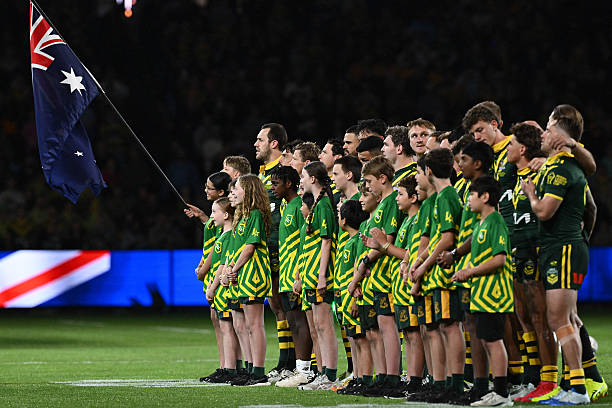
Photo: Getty Images
The decision by several Australian players to remain silent during “Advance Australia Fair” has reignited a familiar debate about patriotism, Indigenous identity and what it means to represent your country.
But does standing silently show a lack of national pride, or is the controversy exposing a much bigger question about who gets to define Australian identity?
The Rugby League World Cup was supposed to be about the best players in the world competing for international glory. Instead, before Australia had even completed its opening match, the focus shifted to something that happened before kick-off.
Several members of the Kangaroos appeared not to sing “Advance Australia Fair” before Australia's tournament opener against New Zealand, prompting criticism from commentators and fans. Latrell Mitchell, Bradman Best and Keaon Koloamatangi were among the players identified in reports covering the backlash.
The reaction was immediate. Some critics argued that players representing Australia should sing the national anthem as a basic expression of respect for their country. Others defended the players' right to remain silent, arguing that patriotism cannot be measured by whether somebody sings a song.
The controversy has also brought Cameron Munster into the discussion after he defended the Australian players amid the criticism, while Reece Walsh's emotional response to the anthem offered a contrasting image of what representing the country can mean to an individual.
Suddenly, a sporting ritual that usually lasts only a few minutes had become a national conversation.
But this is not a new debate in Australian rugby league. It has been building for years, particularly around Indigenous players and the relationship between the national anthem, Australia's colonial history and the country's modern identity.
The question is no longer simply why some players do not sing. It is whether singing should be treated as a requirement of representing Australia and whether remaining silent tells us anything meaningful about a player's loyalty to the country.
Why are Australian players being criticised?
The current controversy centres on the moments before Australia's World Cup matches, when the national anthem is played and the players stand together in their green and gold jerseys.
For many supporters, the anthem is an important part of international sport. It represents the country, its people and the opportunity to compete on the world stage.
Seeing the players sing can be an emotional moment, particularly for fans who regard representing Australia as one of the highest honours in rugby league.
That expectation helps explain the reaction when players appear not to participate.
Some commentators have argued that representing the national team comes with responsibilities beyond playing well. In their view, the anthem is a collective expression of national pride, and players should participate in the same way they are expected to wear the jersey with respect.
The criticism has gone further in some quarters, with calls for players who do not sing to face consequences or even be excluded from future national teams.
However, there is an important distinction between observing that a player did not sing and claiming to know why.
A player might choose not to sing for personal, cultural or political reasons. Others may simply prefer to stand quietly during an anthem with no significant reason at all. Unless an individual has explained their position, it is not possible to confidently attribute a motive to them.
That matters because the debate can quickly turn from a discussion about an action into a judgment about someone's character.
The players have been selected to represent Australia because of their rugby league ability. Whether they should also be expected to demonstrate patriotism through a particular public ritual is a separate question.
The argument for singing: representing the country means something
There is a reasonable explanation for why some supporters feel strongly about the anthem.
International rugby league is different from club football. Players are not simply representing a team, a city or a group of supporters. They are wearing the colours of a country and competing against other nations.
The anthem is one of the most visible expressions of that responsibility.
For fans who have followed the Kangaroos for decades, the sight of the team standing together before a Test match can be a source of immense pride. It connects generations of players and supporters, and it marks the occasion as something bigger than an ordinary sporting contest.
From this perspective, singing is not necessarily about agreeing with every aspect of Australia's history or politics. It is about acknowledging the opportunity to represent the country as it exists today.
Supporters who hold this view may argue that no country has a perfect history, but that national symbols can still represent a shared future. They may see the anthem as something that belongs to all Australians, including those who want to improve the country rather than reject it.
There is also an argument about the responsibility that comes with wearing the national jersey. Elite athletes are public figures, and their actions before a major international match can carry meaning beyond their personal intentions.
For some fans, singing together is a simple gesture of unity. When players do not participate, they may interpret that silence as a rejection of the collective identity the team is supposed to represent.
But interpretation is not proof of intention. A fan may see disrespect where a player sees a personal decision, and that difference lies at the centre of the argument.
The other side: patriotism cannot be measured by a song
Those defending the players argue that singing a national anthem should not be treated as a test of loyalty.
A person can care deeply about their country without agreeing with every national symbol or choosing to express their feelings in the same way as everyone else.
That is particularly relevant in Australia, where the meaning of the national anthem has been debated for decades.
For some Indigenous Australians, the lyrics of “Advance Australia Fair” are connected to a history of colonisation and exclusion.
From that perspective, remaining silent can be a way of expressing discomfort with a national symbol that does not fully reflect their experience of Australia.
This is not necessarily a rejection of the country or its people. It can instead be a demand for a broader understanding of national identity; one that acknowledges Indigenous history and the experiences of communities that have not always felt represented by traditional national symbols.
Academic research into the 2019 rugby league anthem protests found that Indigenous players' actions were connected to wider concerns about the relationship between national identity, colonial history and the recognition of Aboriginal Australians.
The research also highlighted that the debate was not simply about individual players refusing to sing, but about who gets to shape the symbols used to represent the nation.
The central argument is straightforward: if the anthem is supposed to unite Australians, its meaning and lyrics should be open to discussion when some Australians feel excluded by them.
Critics of the players may disagree with their decision, but the fact that a person feels uncomfortable singing the anthem does not automatically mean they lack pride in their country.
Equally, not every player who remains silent should be assumed to be making a political statement. The reasons can differ from person to person.
This debate pre-dates this World Cup
The current backlash is part of a much longer history of anthem protests in Australian rugby league.
In 2019, Indigenous players chose not to sing “Advance Australia Fair” before the Indigenous All Stars match and State of Origin fixtures. Their actions attracted widespread attention and criticism, but the players also publicly explained their concerns.
South Sydney's Cody Walker was among the most prominent voices. He spoke about the anthem not representing him and his family, while fellow Indigenous player Josh Addo-Carr expressed support for the argument that the song should better recognise Indigenous Australians.
The protests were not simply spontaneous moments of silence. They formed part of a broader discussion about the place of Indigenous people in Australian society and the symbols used to express national identity.
The issue had already surfaced during the NRL's 2017 Indigenous Round, when an alternative version of the anthem was presented with amended lyrics. The changes included replacing “young and free” with “peace and harmony”.
The proposal prompted its own debate. Supporters viewed the alternative lyrics as an opportunity to make the anthem more inclusive, while critics questioned whether changing a national symbol was appropriate.
The NRL's later decision to remove the national anthem from the 2020 All Stars fixture, replacing it with other ceremonial elements, showed that sporting organisations could respond to these concerns rather than treating the traditional format as untouchable.
The significance of those events is that the current World Cup debate is not happening in isolation. It is part of a continuing conversation about whether the anthem reflects every Australian's experience and what national representation should look like.
Reece Walsh's emotional moment showed another side of the anthem
One of the most striking images from Australia's opening match was Reece Walsh becoming visibly emotional during the national anthem.
Walsh later explained the significance of seeing his family and described the emotion associated with representing Australia, drawing on his Māori and Indigenous heritage.
His reaction offered a reminder of why the anthem matters so much to some athletes.
For players who have worked throughout their lives to reach the international stage, standing before a World Cup match can represent the culmination of years of sacrifice. It can be about family, community, personal achievement and the people who helped them reach that point.
Walsh's response and the silence of other players were different public expressions during the same ceremony. One does not necessarily invalidate the other.
The anthem can carry profound personal meaning for one player and a more complicated meaning for another. Some may sing loudly, some may stand quietly and some may choose to make a deliberate statement.
It is possible to recognise Walsh's emotion without using it as a standard against which every teammate must be judged.
The difference is important. A national anthem does not have to mean exactly the same thing to every member of a team for those players to compete together.
Should players be required to sing?
This is perhaps the most difficult question raised by the controversy.
Should representing Australia come with an expectation that players sing the national anthem? Or should the decision remain entirely personal?
Those arguing for compulsory participation may see it as a reasonable expectation attached to representing a national team. They may believe that singing is a basic ceremonial responsibility, similar to respecting the flag or observing the formalities of international competition.
However, there is a difference between asking players to stand respectfully during an anthem and requiring them to sing its words.
Singing is an expression of personal participation. A person can stand quietly without disrupting the ceremony or preventing others from expressing their pride.
Introducing punishments for not singing would also raise practical questions. How would officials determine whether a player was deliberately refusing to participate? Would every player be judged by the same standard? Would the rule apply to players who do not know the words, have religious or personal objections, or simply prefer silence?
More importantly, would forcing participation create genuine unity, or merely produce the appearance of it?
A player can be ordered to sing, but that does not mean the words will carry any personal meaning.
There is also a risk that punishing silence could turn the anthem into a loyalty test, encouraging people to judge players' character without understanding their individual reasons.
That does not mean supporters must agree with every protest or accept every argument made in the name of personal choice.
It means there should be a distinction between expressing disagreement and treating non-participation as proof that someone is unworthy of representing the country.
When does sport become political?
Sport has never been completely separate from politics, even when organisers attempt to keep the focus on competition.
National anthems, flags, international rivalries and ceremonial traditions all connect sport to ideas about identity and belonging.
Major sporting events are among the few occasions when millions of people watch representatives of their country participate in a shared ritual. That visibility gives athletes influence, whether they seek it or not.
Some fans believe sport should provide an escape from political arguments. They want to watch the best players compete without every pre-match ceremony becoming a national controversy.
Others argue that sport has always reflected society and that athletes should be free to express their views, particularly when those views relate to their own experiences.
The anthem debate sits directly between those positions.
For supporters who want sport to remain separate from politics, a player remaining silent can look like an unnecessary distraction.
For those who believe sport can provide a platform for social discussion, that silence may be an important expression of personal conviction.
Neither interpretation changes the fact that players are individuals with their own histories and beliefs.
The challenge for the public is to distinguish between a player's sporting responsibilities and the expectation that they conform to a particular political or cultural expression.
Representing a country does not mean every athlete must agree on every national issue. A national team can contain people with different backgrounds, beliefs and experiences while sharing the same objective on the field.
Conclusion: the anthem is only the beginning of the conversation
The reaction to the Australian players at the Rugby League World Cup has once again exposed a divide over patriotism, national identity and the role of sport in broader social debates.
For some fans, singing the anthem is a basic expectation of anyone who wears the green and gold.
For others, demanding that every player sing ignores the personal and historical reasons why some Australians have a complicated relationship with the song.
The history of anthem protests in rugby league shows that these questions did not begin with the current World Cup. They have been discussed for years, particularly by Indigenous players who have challenged whether the national anthem fully represents their experiences.
The current controversy is unlikely to settle the argument. But it does offer an opportunity to consider what national representation actually means.
A player can express pride through singing. Another can express a different view through silence. Neither action, by itself, tells the complete story of that person's relationship with Australia.
Perhaps the more important measure of a national team is not whether every player performs the same ritual, but whether those players can stand together, compete for one another and represent a country that continues to debate what its identity should be.
The anthem will continue to be played. The arguments around it will likely continue, too.
The question is whether the conversation can move beyond judging the players and towards a better understanding of why the issue matters in the first place.
Comments (0)
Sign in to comment, like or dislike.
Loading…