
The Greatest Individual NRL Finals Performances This Century
Sandon Smith with a performance for the ages
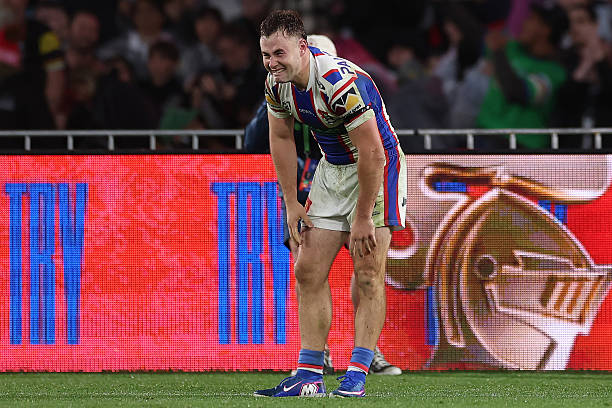
Photo: Getty Images
Some players rise to the occasion in the finals. Others produce performances that become part of rugby league folklore.
Since the turn of the century, the NRL has produced countless unforgettable individual displays on the biggest stage from grand-final masterclasses and Clive Churchill Medal performances to extraordinary efforts that dragged teams over the line when everything appeared to be against them.
After Sandon Smith's extraordinary performance against Penrith in the 2026 preliminary final, another name can be added to the conversation.
Here are some of the greatest individual finals performances of the NRL era, working backwards from 2026.
2026 — Sandon Smith, Knights vs Panthers
Sandon Smith produced one of the most extraordinary individual performances of the modern finals era as Newcastle stunned Penrith to reach their first grand final in 25 years.
Smith was involved in virtually everything, producing 178 running metres and 256 kick metres while scoring two extraordinary tries.
The first came after Penrith switched off, with Smith racing approximately 50 metres to score. Then came the moment that sealed the fairytale.
With Newcastle playing with just 12 men for 44 minutes following Phoenix Crossland's send-off, Smith intercepted a Panthers pass and sprinted 80 metres to put the result beyond doubt.
The significance of the performance went beyond the statistics. Newcastle had finished with the wooden spoon just 12 months earlier. Now they were heading to the grand final. Smith was at the centre of it.
2023 — Nathan Cleary, Panthers vs Broncos
Few grand-final comebacks have produced a performance quite like Nathan Cleary's. Penrith trailed Brisbane 24-8 before Cleary took control of the match.
The Panthers halfback produced a 40-20, created opportunities for his teammates and eventually scored the match-winning try in the 77th minute.
He finished the night with a performance worthy of the Clive Churchill Medal and became just the third player to win the award twice. It was the ultimate example of a superstar taking control when his team needed him most.
2022 — Nathan Cleary, Panthers vs Eels
Cleary was again at the centre of a Penrith grand-final victory a year later. Against Parramatta, he controlled the game from halfback as the Panthers secured back-to-back premierships.
His kicking game repeatedly forced the Eels backwards, while his combination with Jarome Luai and the Penrith forward pack proved too difficult for Parramatta to contain.
It was another reminder that Cleary had developed into one of the defining finals players of his generation.
2021 — Cody Walker, Rabbitohs vs Panthers
South Sydney ultimately fell short, but Cody Walker produced one of the most memorable individual moments of the 2021 finals series.
Walker received the ball around 30 metres from the line and somehow beat several Panthers defenders before diving over.
The try was a spectacular demonstration of Walker's footwork, acceleration and creativity. Although the Rabbitohs couldn't complete the comeback, Walker remained one of the most dangerous players on the field throughout the contest.
2018 — Luke Keary, Roosters vs Storm
With Cooper Cronk battling a serious shoulder injury against his former club, Luke Keary took control of the Roosters' attack.
The five-eighth scored a try, kicked a field goal and repeatedly threatened Melbourne's defence as the Roosters established an 18-0 halftime lead.
Keary's performance earned him the Clive Churchill Medal. It was particularly significant because of the circumstances surrounding Cronk and the pressure of facing the Storm, the club where Cronk had spent the majority of his career.
2017 — Billy Slater, Storm vs Cowboys
Billy Slater produced one of the great fullback performances of the modern era. The Storm dominated North Queensland, and Slater was at the heart of their attack.
He scored a try, created another and constantly threatened the Cowboys with his support play and running game.
His performance earned him the Clive Churchill Medal as Melbourne secured another premiership.
2017 — Cameron Smith, Storm vs Cowboys
Slater wasn't the only Melbourne star to dominate. Cameron Smith produced a remarkable performance from hooker, running for 133 metres and controlling the game from dummy-half.
His service, kicking and defensive organisation continually put Melbourne in the right position.
It was a masterclass in how a hooker can dictate a grand final without necessarily dominating the highlights.
2015 — Johnathan Thurston, Cowboys vs Broncos
If there is one finals performance that perfectly captures the pressure of rugby league, this is it.
Thurston's Cowboys were seconds away from losing the grand final when Kyle Feldt crossed in the corner.
Thurston then had the chance to win the premiership with the conversion.
He missed. The match went to golden point. But Thurston didn't hide.
He returned to the field in extra time and calmly kicked the field goal that delivered North Queensland their first premiership. He was awarded the Clive Churchill Medal.
2015 — Johnathan Thurston, Cowboys vs Storm
A week before the grand final, Thurston had already produced a spectacular performance.
Against Melbourne at AAMI Park, he created three tries in the first half, helping the Cowboys establish control over the Storm.
North Queensland eventually won 32-12 and booked their place in the first grand final in club history.
It was the performance that set the stage for Thurston's unforgettable grand-final heroics seven days later.
2015 — James Tamou, Cowboys vs Broncos
While Thurston received the Clive Churchill Medal, James Tamou produced a huge performance in the middle.
Tamou ran for 138 metres, made 30 tackles, broke two tackles, produced two offloads and even scored a try.
His work through the middle helped North Queensland survive Brisbane's enormous forward pack and ultimately claim the premiership.
2014 — Sam Burgess, Rabbitohs vs Bulldogs
Burgess played the entire grand final despite suffering a fractured cheekbone.
He was everywhere. His defensive work, carries and physical presence helped South Sydney dominate Canterbury as the Rabbitohs ended a 43-year premiership drought.
Burgess was rewarded with the Clive Churchill Medal. It remains one of the most iconic examples of a player performing through serious injury on the biggest stage.
2005 — Benji Marshall, Tigers vs Broncos
Benji Marshall was only 20 years old, but he produced one of the most spectacular finals performances of his generation.
The young five-eighth made a remarkable try-saving tackle before later intercepting a pass and racing approximately 90 metres to score.
The Tigers destroyed Brisbane 34-6 and advanced to their first grand final. Marshall's performance helped announce him as one of rugby league's next superstars.
2005 — Brett Hodgson, Tigers vs Cowboys
Hodgson produced an extraordinary attacking performance as the Tigers dismantled North Queensland.
The fullback scored three tries and kicked nine goals, finishing with an incredible 30 points.
It was one of the most prolific individual scoring performances in finals history.
2001 — Andrew Johns, Knights vs Eels
Andrew Johns delivered the performance Newcastle fans had been waiting for. The Knights defeated Parramatta in a classic grand final, with Johns controlling the game and directing Newcastle's attack.
He was awarded the Clive Churchill Medal as Newcastle secured the second premiership in club history.
Twenty-five years later, the Knights would return to the grand final — making the contrast between 2001 and 2026 particularly significant.
2000 — Darren Lockyer, Broncos vs Roosters
The 2000 grand final produced a low-scoring contest, but Darren Lockyer was instrumental in Brisbane's victory.
The Broncos fullback repeatedly threatened the Roosters with his attacking instincts and helped Brisbane control the contest.
It was another performance that demonstrated why Lockyer would become one of the defining players of the NRL era.
Where does Sandon Smith rank?
That is ultimately the fascinating question.
There have been spectacular grand-final performances, Clive Churchill Medal-winning masterclasses and individual efforts that have become part of rugby league folklore.
But Smith's performance against Penrith had a combination rarely seen.
Two tries. 178 running metres. 256 kick metres. An 80-metre intercept and Newcastle spent **44 minutes with 12 players on the field.
Most importantly, the performance came against a Penrith side that had reached six of the previous seven grand finals.
Smith didn't simply perform well. He produced the defining individual performance of a preliminary final that sent Newcastle to their first grand final since 2001.
Whether it ultimately belongs alongside the likes of Johns, Thurston, Burgess, Slater and Cleary is something that will be debated for years.
But after one of the most remarkable nights in Newcastle's history, Sandon Smith has earned his place in the conversation.
Comments (0)
Sign in to comment, like or dislike.
Loading…