
Should the NRL Bring Back Two Referees?
Paul Crawley thinks bringing back a two-ref system will prevent errors like we say in the Warriors game
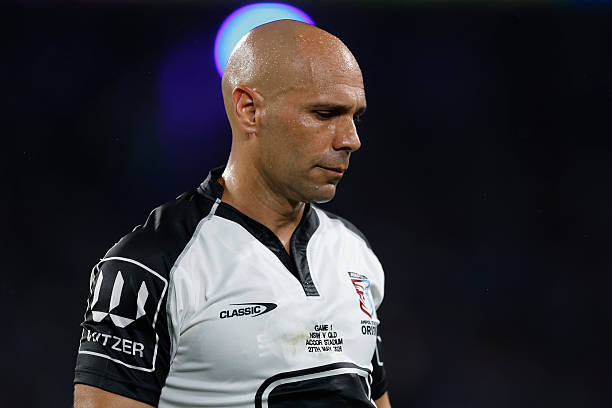
Photo: Getty Images
Paul Crawley wants the NRL to bring back a system it scrapped six years ago. But the debate over two referees versus one is almost as old as the system itself.
The NRL's refereeing crisis has reached the point where the league is once again being urged to reconsider one of the biggest changes to its officiating structure in the modern era.
Fox Sports journalist Paul Crawley has called for the NRL to bring back the two-referee system, arguing that the modern game has simply become too fast and too complicated for one official to control everything happening around the ruck, defensive line and play-the-ball.
His argument comes after another season of controversy surrounding refereeing decisions and Bunker interventions.
Crawley believes simply replacing individual referees won't solve the underlying problem.
“The NRL needs to seriously consider returning to two referees next season.”
His reasoning is straightforward.
“The fact is the game has never been faster because of the six-again restart rule, and all the referees are clearly struggling to keep up.”
Crawley argues that a second referee could specifically police the defensive line and 10-metre area, allowing the main referee to concentrate on the ruck and everything else happening around the play.
“By at least having a second ref on the field to police the 10 metres [it] would take some of the load off the lead ref, allowing him to concentrate on the ruck and everything else going on around the play.”
But this isn't a completely new idea.
The NRL's two-referee experiment
The NRL introduced the two-referee system in 2009, replacing the traditional model that had used one central referee.
It was a significant change. One referee was positioned around the play-the-ball and ruck, while the other operated further upfield around the defensive line. The two officials could communicate, with the referees alternating responsibilities during matches.
The primary motivation was to better police the ruck and the increasingly sophisticated wrestling techniques being used by defensive teams.
At the time, NRL chief executive David Gallop described it as a fundamental change designed to reflect the increasing pace and demands of the game.
The system subsequently became a normal part of NRL football for more than a decade, with evidence supporting its effectiveness.
In 2018, NRL referees boss Bernard Sutton pointed to data showing that play-the-balls were slower under a single-referee system.
During the 2017 World Cup, where matches were officiated by one referee, 38 per cent of play-the-balls were classified as taking more than four seconds.
In the NRL that season, with an assistant referee specifically helping police the ruck, the figure was 26 per cent.
Sutton argued that the second referee was particularly valuable in keeping defenders away from the play-the-ball area.
“Across an NRL competition, the two-referee system is very beneficial for us" he said.
Sutton went further, saying he was confident two referees were the right system for the NRL.
Tony Archer, then the referees' general manager, also argued that officials made more accurate decisions with two referees, particularly when it came to applying the 10-metre rule and policing the ruck.
So why did the NRL get rid of it?
This is where the debate gets interesting.
The NRL didn't scrap the second referee because of one dramatic officiating failure. It happened during the COVID shutdown.
When the competition was preparing to restart in 2020, the NRL was under enormous financial pressure and looking for ways to reduce costs so the league proposed returning to one referee.
ARLC chairman Peter V'landys openly acknowledged the financial motivation, saying the change would save the NRL money.
He also pointed to fan feedback, with an NRL survey showing strong support for returning to a single referee.
The change was therefore partly about the economics of restarting professional sport during a pandemic; It wasn't necessarily a declaration that the two-referee system had failed.
The NRL initially intended to review the experiment after the 2020 season. But the one-referee system stayed and has now been the norm for six seasons.
The case for two referees
There are several obvious arguments in favour of Crawley's proposal.
- The game is faster
This is probably the strongest argument.
The NRL of 2026 isn't the same game that existed when the two-referee system was introduced.
The six-again rule has fundamentally changed the speed and rhythm of matches.
There are fewer stoppages for ruck infringements, teams attack with more momentum and defensive lines have to reset almost instantly. That creates an enormous amount for one person to monitor.
Crawley argues that the second referee could take responsibility for one of the most difficult areas; keeping defenders onside, while the lead referee concentrates on the tackle and ruck.
- It could reduce the workload on the lead referee
One referee currently has to monitor the ruck, play-the-ball, markers, defensive line, offside, knock-ons, forward passes, illegal contact and everything happening around the tackle.
They also have to communicate with touch judges and the Bunker. A second on-field referee doesn't eliminate mistakes. But it potentially divides the workload to make it more manageable.
- The ruck was the original reason for introducing it
The entire purpose of the two-referee model was to improve control around the ruck. That issue hasn't disappeared.
If anything, the modern wrestling and defensive systems have made the ruck even more important.
The NRL's own refereeing department previously argued that the assistant referee's work in getting defenders out of the play-the-ball area was crucial.
- It could reduce reliance on the Bunker
This is another major part of Crawley's argument.
The Bunker was supposed to help eliminate major mistakes, but it has increasingly become part of the controversy itself.
Crawley believes giving on-field officials more support could reduce the need for endless video reviews.
“Bringing back two refs would also be an opportunity to reduce the reliance on the bunker, limit the time wasted watching replay after replay that drives fans bonkers, and give more power back to the on-field officials.”
That is particularly relevant when matches are already being extended by lengthy reviews.
The case against two referees
The one-referee system isn't without supporters. When the NRL made the change in 2020, there was significant support from fans for returning to one official.
V'landys said an NRL survey had found an “overwhelming majority” wanted one referee.
There was also an argument that having one referee produces greater consistency because there is one person interpreting the game rather than two officials potentially seeing the same incident differently.
Eels forward Nathan Brown said at the time that there were pros and cons to both systems, while former Cronulla captain Paul Gallen also acknowledged the advantages of having one referee interpreting the game.
Then there is the question of whether adding another referee actually solves the problem.
Former NRL head of football operations Wayne Pearce was sceptical in 2020, arguing that mistakes were happening with two referees anyway.
His argument was that the second official hadn't necessarily eliminated slow play-the-balls or wrestling.
Queensland coach Kevin Walters went even further, saying the one-referee model had worked for the game for a century before the change.
“Did we get better decisions? We got some better decisions at different stages but it didn't dramatically change the way the game was played.”
That's the biggest question for the NRL. Would two referees actually produce better decisions, or would it simply create two officials capable of making mistakes?
The biggest difference in 2026
The argument for bringing back two referees isn't necessarily the same argument that existed in 2009.
Back then, the major concern was policing the ruck. Today, the argument is also about the sheer volume and speed of the game. The NRL has continued to evolve since the two-referee system disappeared.
The six-again rule has increased the speed of play. Defensive structures have become more sophisticated. The Bunker has become more prominent. And refereeing decisions are scrutinised from virtually every possible camera angle.
One official is now expected to control all of that in real time. Crawley believes the solution isn't simply finding better referees; it's giving them more help.
“It is almost unfair to expect one referee to keep pace with everything that is happening around him.”
That may be the most important part of the debate.
The money argument has changed
Perhaps the most obvious reason to reconsider the decision is that the circumstances of 2020 no longer exist.
When the NRL returned from COVID, saving money was critical. Today, the financial situation is very different.
Crawley points directly to the league's new broadcast deal and argues that the financial argument for one referee is no longer as compelling.
“Yet with the new TV deal, surely money is no longer an issue.”
That's not to say adding another full-time official would be cheap. But if the NRL genuinely believes the second referee improves decision-making, the question becomes whether the cost is justified.
The evidence isn't completely one-sided
There is also an important caveat.
In 2024, NRL head of football Graham Annesley explained why the two-referee system had not returned.
The league's position was that there had been no significant difference in decision-making since switching to one referee during COVID. That's a significant counterargument.
The NRL has effectively had several years to evaluate the single-referee model. Its own football department hasn't concluded that returning to two referees is automatically necessary.
So the debate isn't simply “one referee bad, two referees good.” There is evidence supporting both sides.
Should the NRL seriously consider it?
What makes Crawley's argument worth discussing is that the question isn't really about whether referees are making mistakes. They always will.
It's about whether the NRL has designed an officiating system that gives its officials the best possible chance of getting decisions right.
The two-referee model was introduced because the game had become too complicated for one referee to adequately monitor the ruck and defensive line.
The league then spent more than a decade using it. It was removed during an extraordinary financial crisis, with cost-cutting and fan feedback both cited as reasons.
Six years later, the game is faster again and the Bunker is more prominent, with refereeing controversies remaining one of the biggest talking points in the competition.
Crawley's proposal isn't necessarily a magic solution. But it raises a legitimate question:
If the NRL was willing to spend more than a decade with two referees because the game had become too difficult for one official to control, has the game now evolved to the point where one referee is once again being asked to do too much?
Perhaps the answer isn't simply to find better referees. Perhaps it's to give them another pair of eyes. What do you think?
Comments (0)
Sign in to comment, like or dislike.
Loading…