
Junior Amone Cleared for Tonga Despite NRL Deregistration: Does Rugby League Need Consistent Disciplinary Rules?
Amone was deregistered from the NRL following an assault using a hammer...
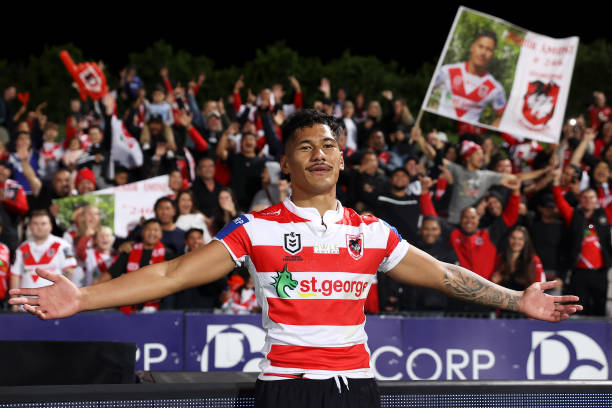
Photo: Getty Images
Junior Amone's return to the international stage has raised an uncomfortable question for rugby league: should a player who has been deregistered by the NRL be eligible to represent his country at the Rugby League World Cup?
The former St George Illawarra Dragons playmaker has received official clearance to represent Tonga at the 2026 tournament, despite his career being interrupted by a criminal conviction and his subsequent deregistration from the NRL.
Amone's selection is a significant boost for Tonga, who are looking to challenge Australia and New Zealand for the World Cup. However, his inclusion also raises questions about how rugby league handles player eligibility, disciplinary decisions and the relationship between domestic competitions and international representative football.
Why was Junior Amone deregistered?
Amone, 24, previously played 51 NRL games for St George Illawarra before his career was interrupted by an off-field incident.
He was deregistered following a conviction for an assault involving a hammer and was ordered to serve an intensive correction order.
After completing the relevant requirements, Amone began rebuilding his rugby league career with Wynnum Manly in the Queensland Cup, where his performances attracted attention during the 2026 season.
His form was strong enough to put him back in contention for international selection, with Tonga coach Kristian Woolf identifying the playmaker as a valuable option for the halves.
Amone had previously represented Tonga at the 2022 Rugby League World Cup, meaning his potential return was not a new international allegiance but an opportunity to re-establish himself after a difficult period.
His selection was initially subject to eligibility and integrity approval. On October 9, Tonga confirmed that he had received the necessary clearance from the International Rugby League and the NRL.
That decision allowed Amone to remain in Tonga's final squad, with Gold Coast forward Moeaki Fotuaika omitted as the squad was finalised.
How can Amone play internationally after being deregistered?
The important distinction is that Amone's deregistration from the NRL did not automatically amount to a universal ban from every rugby league competition.
Domestic and international competitions operate under different rules and approval processes. A player who is not registered to play in the NRL is not necessarily prohibited from representing a national team.
In Amone's case, his participation was not simply assumed. Tonga's coaching staff sought approval from the relevant authorities, and that clearance was granted.
The decision therefore does not mean the NRL has reversed its previous action or that Amone has automatically earned a return to the NRL. It means he has been cleared to participate in this particular international tournament.
The NRL's domestic registration decisions, the International Rugby League's eligibility requirements and a player's availability for representative football are related issues, but they are not necessarily identical.
Amone's situation illustrates how those systems can produce different outcomes for the same player.
Is the system fair?
There are arguments on both sides.
Supporters of allowing Amone to play can point to his return to football, his performances in the Queensland Cup and the fact that the relevant authorities have approved his participation.
International rugby league also depends on having strong national teams and allowing eligible players to represent their heritage. Tonga have invested heavily in building a competitive squad, and Amone offers additional depth in a position where experienced playmakers are particularly valuable.
There is also a distinction between permitting someone to play after the relevant process has been completed and suggesting that their previous conduct should be ignored.
However, critics may question whether a player who has been deregistered from the NRL should be able to participate in a major international tournament while remaining outside the NRL system.
For those critics, the concern is consistency. If a governing body considers a player's circumstances serious enough to prevent their participation in its competition, should that decision carry consequences across the wider sport?
The answer is not necessarily that every domestic sanction should automatically apply internationally. Different competitions have different responsibilities, and the circumstances of individual cases matter.
But the rules should be clear enough that players, clubs, national teams and supporters understand how eligibility decisions are made.
Should rugby league introduce a universal ban?
One possible solution would be a clearer framework governing when domestic disciplinary decisions affect international eligibility.
Under such a system, certain serious cases could trigger a mandatory review by the International Rugby League before a player is permitted to represent a national team.
The review could consider the nature of the offence, the outcome of any legal proceedings, the player's subsequent conduct and any existing disciplinary decisions.
A second option would be to establish minimum eligibility standards for international competitions while retaining the ability to assess cases individually.
That approach would avoid automatically treating every NRL registration decision as an international ban, while giving the sport a consistent process for particularly serious cases.
There are drawbacks to a blanket policy. A domestic deregistration may arise in different circumstances, and automatically extending every decision across all competitions could create disproportionate outcomes.
Any system would also need clear rules about procedural fairness, appeals and the distinction between sporting sanctions and criminal penalties.
The goal should not be to create an automatic ban simply because a case attracts public attention. It should be to ensure that similar cases are assessed under transparent and consistent standards.
A bigger question for international rugby league
Amone's clearance is not proof that the NRL and International Rugby League have contradictory rules. The relevant authorities have approved his participation, and his situation involves more than a simple suspension being carried from one competition to another.
Nevertheless, it provides an opportunity for rugby league to examine whether its domestic and international disciplinary systems are sufficiently clear and consistent.
International eligibility debates are becoming increasingly prominent, with players switching national allegiances and representative pathways changing alongside reforms to State of Origin eligibility.
The sport needs rules that allow international rugby league to grow without creating confusion over player eligibility or disciplinary standards.
Amone's return to Tonga may ultimately be remembered for what he contributes on the field. But his selection also raises a question the sport should be prepared to answer: when a player's eligibility changes between competitions, how should rugby league ensure that its rules remain fair, transparent and consistent?
Comments (0)
Sign in to comment, like or dislike.
Loading…