
Hudson Young to Tour PNG Chiefs HQ With $900k Offer On the Table
Hudson Young could be the next high profile player to join the PNG Chiefs
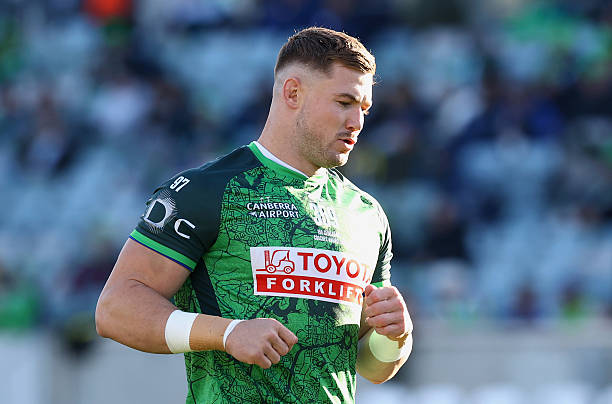
Photo: Getty Images
Hudson Young's future has become one of the biggest talking points in the NRL transfer market, with the Canberra Raiders forward reportedly touring the Papua New Guinea Chiefs' facilities as the expansion club looks to secure another major signing ahead of its 2028 debut.
According to reports from Danny Weidler, the Chiefs have put a reported $900,000-a-season offer on the table for the NSW and Australian representative, with the opportunity to experience the club's facilities and plans in Port Moresby forming an important part of the recruitment process.
However, the biggest attraction might not simply be the salary itself. The PNG Chiefs have access to a unique Australian tax exemption for qualifying employment income, meaning a contract worth $900,000 could be worth considerably more in a player's pocket than a similar Australian NRL deal.
With Canberra having withdrawn its enormous contract offer, the opportunity for Young to make the move is becoming increasingly significant.
Why $900,000 in PNG could be worth more than $1.1 million in Australia
The difference comes down to taxation, under the special tax arrangements introduced for the PNG Chiefs.
Importantly, the exemption covers more than just a player's basic salary. It can also include qualifying match payments, allowances, bonuses, benefits and other employment remuneration.
This is a significant advantage when compared with a conventional Australian NRL contract, where players are generally subject to Australia's progressive income tax rates.
For a player earning close to $1 million annually, the difference can be substantial.
So what could Young actually take home?
To understand the attraction, consider a simplified comparison using the reported figures.
A player earning $900,000 annually through qualifying PNG Chiefs employment could potentially retain the full $900,000 before personal expenses and other deductions, assuming the income meets the exemption requirements.
By comparison, an Australian-based player earning $1.1 million would ordinarily face a significant income tax bill.
Using Australian resident tax rates for the 2026-27 financial year, and assuming no other income, deductions or offsets, a $1.1 million salary would produce approximately $392,000 in income tax and Medicare levy. That would leave approximately $708,000 after those taxes.
On those simplified figures, the $900,000 PNG salary could leave a player around $192,000 better off annually than a $1.1 million Australian salary.
Over a three-year contract, that difference could approach $576,000. These are illustrative calculations, not a confirmed Hudson Young tax assessment.
They assume the PNG exemption applies to the entire qualifying salary and do not account for superannuation, other income, deductions, contractual benefits or personal circumstances.
The NRL salary cap complication
There is another major obstacle the Chiefs need to navigate.
The NRL has been particularly cautious about the tax advantage available to the new franchise, with concerns that the club could use the difference in take-home pay to attract players for salaries below their genuine market value.
Young's situation has already highlighted the issue. The Raiders previously tabled a four-year contract worth $4.4 million, equivalent to $1.1 million per season.
The Chiefs' original reported $900,000-a-season proposal was not accepted for salary-cap purposes, with the NRL's salary cap auditor initially valuing Young at $1.1 million before revising that figure to $1 million.
The NRL has since indicated that players and clubs can make submissions to challenge market-value assessments in exceptional circumstances.
ARLC chairman Peter V'landys has made it clear that the salary cap must remain fair across the competition, even with the unique tax arrangements available to the PNG franchise.
This means the Chiefs may be able to pay Young $900,000, but the amount counted against their salary cap could be higher if the auditor determines his market value is greater.
The distinction between what a player receives and what the club must account for under the salary cap is central to this entire debate.
Is this an offer Canberra simply cannot match?
This is where the discussion becomes particularly interesting. Canberra could offer Young more money on paper, but the PNG tax exemption changes the equation.
If the reported $900,000 salary qualifies for the exemption, it could provide a higher take-home return than a significantly larger Australian contract.
That creates a challenge for rival NRL clubs, which must compete with a financial advantage that cannot simply be replicated through a standard salary offer.
There are still other factors Young will need to consider, including family, lifestyle, relocation, the club's facilities, the competition environment and his long-term career ambitions.
His reported visit to Port Moresby is therefore important. It gives him the opportunity to assess what life at the new franchise would actually look like.
Comments (0)
Sign in to comment, like or dislike.
Loading…