
Dane Gagai's International Switch Reignites Eligibility Debate
Is rugby leagues, and the NRL's eligibility laws fair and correct?
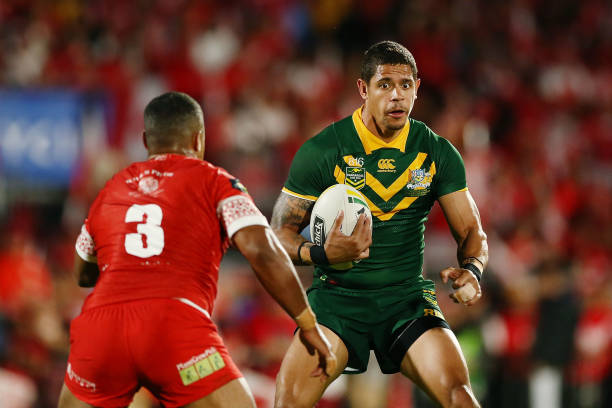
Photo: Getty Images
From State of Origin to the international stage, rugby league's eligibility system is changing rapidly.
But as Dane Gagai prepares to represent New Zealand after winning a World Cup with Australia, the sport faces a bigger question: where should the line be drawn between heritage, loyalty and competitive fairness?
Dane Gagai has spent much of his career representing Queensland in State of Origin, played seven Tests for Australia and helped the Kangaroos win the 2017 Rugby League World Cup.
Now, the Newcastle Knights veteran is preparing for a very different challenge: representing New Zealand at the 2026 World Cup, potentially against the country he once helped lead to international glory.
The 35-year-old has been granted special permission to change his international eligibility from Australia to New Zealand, where he qualifies through his mother, Tania. He has also represented his Ngāti Pikiāo heritage through the Māori All Stars since 2019.
On its own, Gagai's decision is a compelling personal story. But the circumstances surrounding his approval reveal a much bigger issue facing rugby league.
International Rugby League initially rejected Gagai's application because its rules generally prohibit players from switching between Tier One nations. Australia, England and New Zealand have traditionally occupied that category.
However, the IRL Appeals Committee eventually approved the application, citing special circumstances and the changes that have recently allowed other players to switch allegiances.
Gagai had not represented Australia since 2018, was not selected in the preliminary 40-man Kangaroos squad for the 2026 World Cup and had been left in a difficult position by the changing rules.
IRL chairman Troy Grant explained that Gagai should not be disadvantaged compared with players who had been given opportunities to change their international allegiance following recent decisions.
Australian Rugby League Commission chairman Peter V'landys and Kangaroos coach Kevin Walters also supported his application. The result is a decision that could have consequences beyond one veteran centre.
If rugby league is prepared to make exceptions for players whose circumstances have changed, should it introduce a more consistent system for future cases?
With State of Origin eligibility having been significantly relaxed in 2026, is the sport moving towards a model in which players can represent their state and their heritage nation without having to choose between them?
How rugby league's eligibility rules developed
To understand the current debate, it is important to distinguish between two separate competitions: State of Origin and international rugby league.
For much of the modern game's history, representing Queensland or New South Wales was closely connected to the question of whether a player could represent Australia.
International eligibility rules were designed to prevent players from moving freely between the major national teams. Under the IRL's published 2020 rules, players could generally qualify for a nation through their birthplace, the birthplace of a parent or grandparent, or qualifying residence.
Players eligible for multiple countries could generally select one Tier One nation and one Tier Two or Tier Three nation. However, they could not ordinarily switch between Tier One nations once they had made their election.
That distinction mattered enormously for players with family connections to several countries.
A player born and raised in Australia could qualify for State of Origin while also having a genuine ancestral connection to New Zealand, Samoa, Tonga, England or another rugby league nation.
Yet choosing to represent one country internationally could affect the player's options elsewhere.
The system was intended to provide stability and protect the credibility of international competition. Without restrictions, critics argued, players could potentially change national teams according to which side offered the best chance of winning a tournament.
But the rules also created difficult decisions for players whose strongest cultural or family connections did not necessarily align with the country they had represented earlier in their careers.
The growth of Pacific rugby league has made those tensions increasingly difficult to ignore.
Australia's NRL contains players with heritage connections spanning the Pacific and beyond. Many have grown up in Australia, developed through Australian junior systems and become eligible for State of Origin, while retaining a strong desire to represent their family's country of origin.
The expansion of the international game has also made the stakes considerably higher. Matches involving Samoa, Tonga, New Zealand and Australia now attract significant interest, and the prospect of a competitive World Cup depends partly on the ability of those nations to select their best eligible players.
The old system was designed around a more restricted international landscape. The modern game is increasingly multicultural, commercially connected and competitive.
That has forced administrators to reconsider whether rules developed for one era remain appropriate for another.
State of Origin's historic role in the debate
State of Origin is central to this discussion because it has long been one of rugby league's defining competitions.
Since the modern Origin format began in 1980, eligibility has traditionally been based on a player's connection to New South Wales or Queensland.
The core criteria have included being born in one of the two states, residing there before the age of 13, or qualifying through a parent who played Origin.
Those rules helped establish the concept that Origin represents a player's formative connection to a state.
However, international eligibility created an additional restriction. Under the previous arrangement, players were generally required to be eligible to represent Australia or a Tier Two nation to qualify for Origin.
That meant players who had committed to New Zealand or England could be excluded from Origin even if they met the traditional state-based criteria.
For example, a player born and raised in Sydney who chose to represent New Zealand could find himself ineligible for New South Wales, despite having the same local upbringing as a teammate who represented Australia.
The situation became increasingly difficult to justify as the international game developed.
Players were effectively being asked to choose between representing their heritage and participating in one of rugby league's biggest annual competitions.
That was the issue the Australian Rugby League Commission addressed in February 2026.
The 2026 rule change that changed everything
In February, the ARLC announced that players who met the existing State of Origin criteria would be eligible regardless of which country they represented internationally.
The core state eligibility criteria remained unchanged. What disappeared was the requirement to remain eligible for Australia, or a Tier Two nation, in order to play Origin. The change immediately opened the door for a number of prominent players.
New Zealand international Briton Nikora became eligible for Queensland, while Casey McLean became available for New South Wales. Tonga forward Addin Fonua-Blake, who had previously represented New Zealand internationally, also became eligible for the Blues.
Australian-born England international Victor Radley and Queensland representative AJ Brimson were among the other players whose Origin options were affected by the new policy.
The principle was straightforward: State of Origin should be about a player's connection to New South Wales or Queensland, not their international allegiance.
Former Queensland captain Johnathan Thurston supported the change, arguing that it could strengthen both Origin and the international game.
The decision also removed a major obstacle for younger players. Emerging talents no longer needed to fear that choosing their heritage nation would automatically close the door to State of Origin.
That is particularly important for countries such as Samoa and Tonga, which have built increasingly competitive squads featuring established NRL stars.
But the ARLC's decision created another question. If a player could now represent New Zealand or England internationally while continuing to play State of Origin, should someone who had previously represented Australia be allowed to switch to another Tier One nation?
That question became particularly relevant for Kalyn Ponga and AJ Brimson, who received permission to change their international allegiances after previously representing Australia in the World Cup Nines in 2019.
Gagai's case then exposed the inconsistency that remained.
Why Dane Gagai's case is different
Gagai's situation is more complicated than that of a player who has not represented a senior national side.
He was part of Australia's 2017 World Cup-winning squad and has played seven Tests for the Kangaroos. He has also made 23 appearances for Queensland in State of Origin.
His international record makes him a clear example of why eligibility rules exist: he has already represented one of the sport's major national teams at the highest level.
Yet the circumstances surrounding his application were also unusual. Gagai had not played for Australia since 2018. He was not selected in the preliminary Kangaroos squad for the 2026 World Cup, and he had a genuine heritage connection to New Zealand.
Meanwhile, other players who had represented Australia in the 2019 World Cup Nines had been allowed to change their international allegiances following more recent decisions.
Gagai's application was initially rejected under the existing Tier One restrictions, before the appeals process concluded that special circumstances justified approval.
That decision is understandable from an individual perspective. It would seem unfair to deny a player an opportunity because of a rule that had since been relaxed for others in comparable circumstances.
However, it also raises a question about the consistency of the system.
If one player can receive special permission because he has not represented his original country for eight years, what should happen to another player who has been out of the international picture for five years? Or three?
Should eligibility depend on the number of years since a player's last Test? Should it depend on whether they were selected for a World Cup squad? Or should every player be subject to the same rule regardless of their circumstances?
The IRL's decision has not established that all players can now freely switch between Australia, New Zealand and England. Gagai's approval was based on special circumstances, and the existing restrictions have not simply disappeared.
But the case has highlighted the need for a clearer framework.
Could State of Origin become a stepping stone for other nations?
One of the biggest concerns surrounding the rule changes is whether State of Origin could become a competition that benefits countries outside Australia more than it benefits the Kangaroos.
Under the new system, a player can represent Queensland or New South Wales and then play for another nation at the World Cup.
That creates a situation in which Origin could help develop and showcase players who will later compete against Australia internationally.
Take the example of a Queensland representative with New Zealand heritage. Under the new rules, that player could compete against New South Wales in Origin before lining up for the Kiwis against the Kangaroos.
The same principle applies to players representing Samoa, Tonga or England.
From one perspective, that is an excellent outcome. Origin remains the strongest possible showcase for eligible players, while international teams benefit from access to more experienced and battle-hardened NRL stars.
From another perspective, it changes the traditional relationship between Origin and the Australian national side.
For decades, Origin was viewed as a major pathway to the Kangaroos. The strongest performers could progress from club football to Origin and then to international representation for Australia. That pathway still exists, but it is no longer the only option.
The challenge for administrators is ensuring that Origin remains a competition with its own clear identity, while allowing international rugby league to develop without unnecessary restrictions.
The early signs suggest the change could benefit the international game. It also creates an opportunity for smaller nations to compete with Australia and New Zealand on a more even footing.
Whether that opportunity translates into sustained growth will depend on more than eligibility rules alone. Nations still need strong domestic programmes, coaching, funding and regular international fixtures.
Nevertheless, allowing more of the NRL's best players to represent their heritage nations is a significant step.
The arguments for and against allowing players to switch nations
The case for allowing switches
Players' heritage and identity do not necessarily change because they once represented a different country.
A player might have chosen Australia as a young professional because it offered the clearest pathway to international football. Years later, that player might have a stronger desire to represent the country of their parents or grandparents, particularly if they no longer feature in Australia's plans.
Allowing a switch can extend a player's international career and help another nation become more competitive.
It can also encourage young players to commit to their heritage nations without sacrificing opportunities elsewhere.
The international game benefits when more countries have access to elite players. Competitive tournaments are more compelling than contests in which a small number of nations possess most of the strongest available talent.
The case against allowing switches
International representation is also supposed to mean something. If players can freely move between the major nations, critics could argue that national allegiance becomes a tactical decision rather than a long-term commitment.
A player might represent one country early in their career, then move to a rival when their prospects change. In the worst-case scenario, players could attempt to join whichever nation offers the best chance of winning a World Cup.
That could undermine confidence in the competition and disadvantage nations that develop players with fewer opportunities to recruit established international stars.
There is also a fairness question. If one player receives permission to switch because of their circumstances, other players may reasonably expect the same treatment.
The issue is not whether players should be allowed to embrace their heritage. It is how to balance that right with the need for clear and consistently applied rules.
Four possible solutions for rugby league
The sport does not necessarily need to return to the old system, nor does it need to allow unrestricted movement between national teams. There are several ways the IRL could address the problem.
1. Introduce a one-time switch with strict conditions
The IRL could formally permit players to switch between Tier One nations once, provided they satisfy clearly defined conditions.
Those conditions could include a minimum period since their last senior international appearance, proof of heritage eligibility and a requirement that the player has not represented their original country during a specified period.
For example, a player might need to have been absent from senior international selection for four years before applying to change allegiance.
The precise period would need to be debated, but the principle would be to create a transparent pathway rather than relying on individual appeals.
The advantage: Players would know where they stand, and administrators could apply the same rules consistently.
The drawback: A fixed waiting period could still disadvantage players whose careers or international opportunities change unexpectedly. It could also create incentives for players to wait out the clock.
2. Keep Tier One restrictions, but introduce a formal amnesty
Another option would be to retain the existing prohibition on switching between Australia, England and New Zealand, while creating a one-off amnesty for players affected by recent rule changes.
Under this model, players who had represented a Tier One nation before the changes could apply within a defined window.
Once that window closed, the original restrictions would return. This approach would acknowledge that the rules have changed while preventing unrestricted switching in the future.
The advantage: It would address the transitional unfairness highlighted by Gagai's case without fundamentally abandoning the old system.
The drawback: It could create a rush of applications and leave players who miss the deadline feeling unfairly treated. It would also require careful consideration of players with different career histories.
3. Separate State of Origin and international eligibility permanently
The ARLC has already moved in this direction by removing the requirement for Origin players to remain eligible for Australia.
The IRL could build on that principle by treating state representation and international allegiance as completely separate questions.
Origin eligibility would be based on a player's connection to New South Wales or Queensland. International eligibility would be determined by a separate set of rules covering birthplace, ancestry, residence and changes of allegiance.
This would mean that a player's Origin status would never be affected by their international choice.
The advantage: It would give players certainty and protect the integrity of Origin as a state-based competition.
The drawback: It would not, by itself, resolve the question of whether players should be allowed to switch between Australia, New Zealand and England.
4. Establish an independent eligibility panel with published criteria
Perhaps the most practical solution would be to retain restrictions but create a formal independent appeals process.
Rather than relying on vague references to special circumstances, the IRL could publish the factors that determine whether an application should succeed.
Those factors could include the player's international history, the length of time since their last appearance, whether they were selected for a major tournament, the strength of their heritage connection and whether the change would undermine the competition.
The panel would publish its reasoning for each decision, subject to appropriate privacy protections.
The advantage: Decisions would become more transparent, and players would have a clearer understanding of the rules before applying.
The drawback: An appeals system can never remove all disagreement, particularly when players have different histories and circumstances.
Of these options, a formal one-time switch with clearly defined conditions, supported by an independent appeals panel, would offer the strongest balance between fairness and stability.
It would recognise that players' circumstances change while preventing international allegiance from becoming an unrestricted revolving door.
A decision that could define the next era of international rugby league
Dane Gagai's switch to New Zealand is an intriguing World Cup storyline, particularly with the Kiwis preparing to face Australia in their opening match.
But its importance extends beyond whether the veteran centre makes the team or how he performs against his former international teammates.
The decision has highlighted the complicated relationship between State of Origin, international allegiance and the growth of rugby league's emerging nations.
The 2026 Origin reforms have already removed one of the biggest barriers for players who want to represent their heritage while continuing to play for their state.
The next challenge is ensuring international eligibility rules are equally clear.
Rugby league does not have to choose between tradition and growth. It can preserve the significance of representing a country while acknowledging that players' identities and opportunities are more complicated than they once were.
But to achieve that balance, the rules must be consistent, transparent and designed for the future rather than repeatedly adjusted in response to individual cases.
Gagai has been granted his opportunity. The bigger question is whether rugby league will now create a system that makes the next player's decision easier to understand and easier to judge fairly.
Comments (0)
Sign in to comment, like or dislike.
Loading…