
Australia vs New Zealand: Rugby League World Cup Final Glory Awaits
The Kangaroos and Kiwis are set to renew one of international rugby league's biggest rivalries, with the 2026 Rugby League World Cup title on the line at Brisbane's Suncorp Stadium
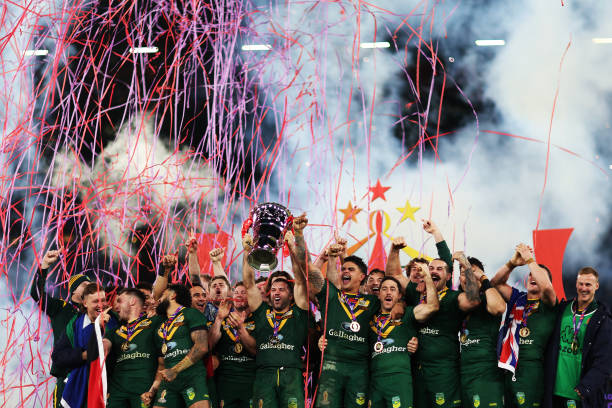
Photo: Getty Images
There is no bigger occasion in international rugby league than Australia against New Zealand, and the two traditional powerhouses are preparing to meet once again in a World Cup final.
The Kangaroos will have home advantage at Suncorp Stadium, but standing in their way are a dangerous New Zealand side featuring some of the game's most exciting attacking players.
With both teams boasting enormous individual quality, the final is shaping as a fascinating contest between Australia's depth, experience and attacking weapons and New Zealand's physicality, skill and ability to create opportunities from almost anywhere on the field.
The match will take place on Sunday, November 15, with kick-off scheduled for 7:35pm AEDT.
Match details
Fixture: Australia vs New Zealand
Date: Sunday, November 15, 2026
Kick-off: 7:35pm AEDT
Venue: Suncorp Stadium, Brisbane
Referee: Grant Atkins
The confirmed team lists
Both nations have named star-studded sides, with several of the NRL's biggest names preparing to represent their countries on the sport's biggest international stage.
Australia – Kangaroos
1. Reece Walsh
2. Jack Bostock
3. Kotoni Staggs
4. Bradman Best
5. Tom Trbojevic
6. Cameron Munster
7. Tom Dearden
8. Patrick Carrigan
9. Harry Grant
10. Tino Fa'asuamaleaui
11. Jacob Preston
12. Liam Martin
13. Isaah Yeo (c)
Interchange: Ethan Strange, Keaon Koloamatangi, Cameron Murray, Reuben Cotter, Sam Walker, James Tedesco.
Reserve: Blayke Brailey.
Australia have suffered a late change, with Latrell Mitchell ruled out through illness. James Tedesco has been brought into the interchange, providing another experienced attacking option.
New Zealand – Kiwis
1. Kalyn Ponga
2. Jamayne Isaako
3. Dane Gagai
4. Casey McLean
5. Ronaldo Mulitalo
6. Kodi Nikorima
7. Jahrome Hughes
8. James Fisher-Harris (c)
9. Jeremy Marshall-King
10. Moses Leota
11. Isaiah Papali'i
12. Briton Nikora
13. Joseph Tapine
Interchange: Te Maire Martin, Naufahu Whyte, Erin Clark, Xavier Willison, Phoenix Crossland, Charnze Nicoll-Klokstad.
Reserve: Scott Sorensen.
New Zealand receive a significant boost with Ronaldo Mulitalo returning from suspension, while Kodi Nikorima and Naufahu Whyte have both been cleared to play despite injury concerns during the week.
Australia: Speed, structure and attacking firepower
Australia enter the final with arguably the most dangerous attacking backline in international rugby league.
The combination of Reece Walsh, Cameron Munster, Tom Dearden and Harry Grant gives the Kangaroos several different ways to attack, whether through individual brilliance, quick service from dummy-half or well-executed attacking shapes.
Walsh has been one of Australia's biggest attacking weapons throughout the tournament, using his speed, footwork and ability to create opportunities from broken play.
Tom Trbojevic has also been particularly dangerous, scoring eight tries in just four World Cup appearances. His ability to find space on the outside and finish attacking movements makes him a major threat.
In the middle, Patrick Carrigan, Tino Fa'asuamaleaui and Isaah Yeo provide a strong foundation. Australia will look to dominate territory, build pressure through consecutive sets and use their attacking players to capitalise on defensive mistakes.
One of Australia's biggest strengths is their depth. With Cameron Murray, Reuben Cotter, Keaon Koloamatangi and James Tedesco available from the interchange, Kevin Walters has plenty of options to maintain intensity throughout the contest.
New Zealand: Physicality, creativity and individual brilliance
New Zealand have a different style of attack, built around a powerful forward pack and some exceptionally talented playmakers.
James Fisher-Harris, Moses Leota and Joseph Tapine give the Kiwis enormous strength through the middle, while Isaiah Papali'i and Briton Nikora provide plenty of aggression and attacking ability on the edges.
Their forward pack will be crucial in challenging Australia's defensive line and creating opportunities for their outside backs. The biggest attraction, however, is their attacking spine.
Kalyn Ponga is one of the most dangerous players in rugby league when given space, while Jahrome Hughes brings speed, creativity and excellent decision-making at halfback.
Kodi Nikorima adds another dimension at five-eighth, giving New Zealand the ability to shift the ball quickly and attack from different areas of the field.
The return of Ronaldo Mulitalo is another major boost. He brings experience, finishing ability and a strong presence on the wing.
New Zealand also have one of the tournament's most exciting young players in Casey McLean, who has scored 16 tries in just eight Test appearances.
If the Kiwis can establish dominance through the middle and give their attacking players room to operate, they have more than enough quality to trouble Australia.
Five key battles that could decide the final
Reece Walsh vs Kalyn Ponga
Perhaps the most exciting individual battle of the entire final. Both fullbacks are capable of producing something special, whether through individual runs, support play or creating opportunities for their teammates.
Walsh has been solid throughout the tournament, while Ponga remains one of the most naturally gifted attacking players in the competition.
Whoever has the greater influence could provide their team with a significant advantage.
The battle through the middle
Australia's Carrigan, Fa'asuamaleaui and Yeo will face a serious challenge from Fisher-Harris, Leota and Tapine.
This is where the game could ultimately be decided. If Australia can dominate the middle and create quick play-the-balls, it will give Grant, Munster and Dearden the opportunity to attack a retreating defensive line.
However, if New Zealand can match Australia's physicality and generate momentum of their own, the Kangaroos could find themselves under pressure.
Harry Grant vs Jeremy Marshall-King
The two hookers will have a major influence on how their respective teams attack.
Grant is an excellent runner from dummy-half and has the ability to change the tempo of a game almost instantly.
Marshall-King offers New Zealand excellent service and creativity, with the ability to keep Australia's defence guessing.
The battle between the two could become particularly important during the middle stages of the match.
Cameron Munster and Tom Dearden vs Jahrome Hughes and Kodi Nikorima
Both halves combinations have the ability to control the game, but they bring different strengths.
Munster's unpredictability and ability to create something out of nothing make him particularly dangerous, while Dearden provides composure and organisation.
Hughes and Nikorima will need to match that creativity while ensuring New Zealand control field position and take advantage of attacking opportunities.
The interchange battle
With both sides naming six interchange players, the coaches have plenty of options to change the momentum.
Australia's bench includes Cameron Murray, Reuben Cotter and Keaon Koloamatangi, while New Zealand have Naufahu Whyte, Erin Clark and Xavier Willison.
Maintaining intensity through the middle for the full 80 minutes could prove decisive, particularly if the match remains close late in the contest.
The history: One of rugby league's biggest rivalries
Australia and New Zealand have a long history of international rugby league, with the Kangaroos traditionally holding the upper hand.
However, New Zealand have produced some memorable performances against their trans-Tasman rivals, including one of the biggest upsets in World Cup history.
The 2000 World Cup final saw Australia defeat New Zealand 40-12, continuing the Kangaroos' dominance of the international game.
Eight years later, the two nations met again in the 2008 World Cup final at Brisbane's Suncorp Stadium.
On that occasion, New Zealand produced a remarkable performance, defeating Australia 34-20 to claim their first-ever men's Rugby League World Cup title.
Led by the likes of Benji Marshall, the Kiwis stunned the Australians in front of a packed Brisbane crowd, creating one of the most memorable moments in the tournament's history.
The sides met again in the 2013 World Cup final at Old Trafford, with Australia responding emphatically, winning 34-2.
New Zealand will be hoping to create another memorable chapter in the rivalry when they return to Suncorp Stadium this Sunday.
The rivalry has remained competitive in recent years, although Australia have enjoyed the better results.
Their most recent meeting came on October 15, 2026, when Australia defeated New Zealand 24-22 in the opening round of the World Cup.
The Kangaroos also defeated the Kiwis 16-14 in November 2022.
In fact, Australia enter this final having won their last 22 Rugby League World Cup matches, an extraordinary record that demonstrates their consistency at the tournament.
New Zealand have not defeated Australia on Australian soil since 2015, adding another significant challenge to their task.
However, the Kiwis have already demonstrated that they can compete with Australia, coming within two points of the Kangaroos earlier in this tournament.
Prediction: Can the Kiwis produce another Suncorp miracle?
On paper, Australia have the depth, experience and recent form to enter the final as favourites.
Their 22-match World Cup winning streak, home advantage and enormous attacking talent make them a difficult opponent for anyone.
However, writing off New Zealand would be a mistake. They have a powerful forward pack, two dangerous fullbacks in their wider attacking structure and a number of players capable of changing a game in an instant.
The Kiwis also have the memory of 2008, when they shocked Australia at the very same stadium to claim their first World Cup.
Could history repeat itself? Australia will be desperate to continue their remarkable World Cup streak and claim another trophy, while New Zealand will be determined to bring the title back across the Tasman.
One thing is certain: with two of international rugby league's biggest rivals fighting for the ultimate prize, fans are in for a blockbuster final.
Comments (0)
Sign in to comment, like or dislike.
Loading…