
2030 Rugby League World Cup Set For Historic American Expansion as Major International Changes Emerge
The Rugby League World Cup could be heading for a completely different landscape in 2030
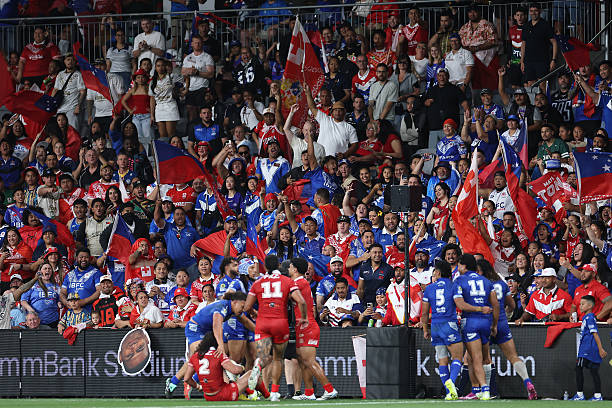
Photo: Getty Images
The Rugby League World Cup could be heading for a completely different landscape in 2030, with the United States and Pacific region emerging as the leading destination for the next tournament.
International Rugby League is preparing to reveal its plans for the 2030 tournament, with Utah and Hawaii reportedly identified as leading locations for matches in a competition that could take rugby league into an entirely new market.
The proposed move comes after a World Cup that has showcased the extraordinary growth of Pacific rugby league, with Tonga and Samoa attracting enormous support and producing some of the tournament's most memorable moments.
But the potential American expansion is not the only major development. International Rugby League has also approved a significant eligibility change, allowing players to represent nations through their great-grandparents, while the 2030 tournament is set to once again combine the men's, women's and wheelchair competitions.
It could represent one of the biggest changes to the international game in years.
United States emerges as leading destination for 2030
The biggest talking point is the potential move towards the United States, with Utah and Hawaii reportedly emerging as the leading locations for the 2030 Rugby League World Cup.
Reports from Channel 7's David Riccio suggest the International Rugby League board has identified the two locations as preferred options for pool matches, with other American cities also potentially involved.
Los Angeles and San Francisco have been mentioned as possible destinations, although the final venue arrangements have not been confirmed.
The appeal of Utah and Hawaii is particularly interesting. Both locations have significant Pasifika communities, including large Tongan and Samoan populations.
The scenes surrounding the Tonga-Samoa clash during the current World Cup demonstrated the passion those communities have for international rugby league.
Taking matches to those communities could provide an opportunity to turn existing interest into genuine support for the sport in North America.
The proposal also builds on the NRL's recent expansion into the United States through its annual season-opening event in Las Vegas.
Rather than simply staging an exhibition match, however, a World Cup would give the sport an opportunity to establish a much larger international presence.
The tournament could run for approximately five weeks, with matches potentially spread across several locations.
One proposal being discussed is a Magic Round-style format, with multiple pool matches staged at the same venue over a concentrated period.
Such an arrangement could create a festival atmosphere, make the tournament more attractive to broadcasters and help supporters attend several international fixtures in one trip.
However, the host arrangements and venue list should be treated as reported plans until International Rugby League formally confirms them.
Why the Pacific nations could be the biggest winners
The potential American expansion is not simply about finding new stadiums.
It is about tapping into communities that already have a strong connection to rugby league.
Tonga and Samoa have been two of the biggest attractions of the 2026 tournament, with their supporters creating incredible atmospheres and demonstrating the commercial potential of international rugby league.
The two nations have helped show that international football can attract enormous interest beyond the traditional Australia-New Zealand rivalry.
A tournament featuring matches in Utah and Hawaii could give those supporters a genuine home-style experience, while also introducing the sport to American audiences.
There is an obvious opportunity for Tonga and Samoa to become major attractions if the tournament does head to the United States.
It would also provide an opportunity for the NRL and International Rugby League to build on the momentum created by the current World Cup.
Major eligibility change approved: great-grandparents now count
Away from the hosting discussion, International Rugby League has approved a significant change to its eligibility rules.
Players will now be able to qualify to represent a country through a great-grandparent, expanding the previous rules that recognised parents and grandparents.
The change is expected to come into effect for international fixtures next year.
It is particularly significant for smaller rugby league nations that have struggled to access the full depth of players with heritage connections.
Cook Islands coach Karmichael Hunt has been one of the strongest advocates for the change, arguing that nations such as the Cook Islands need access to more experienced players if they are going to compete with the international heavyweights.
Hunt previously pointed to Canberra Raiders fullback Kaeo Weekes as an example of a player whose Cook Islands heritage could make him relevant to the national team under expanded eligibility rules.
Speaking about the need to increase the available player pool, Hunt said:
“If you want to identify and represent your Cook Island heritage and you have got that in your blood you should have the right to do that.”
International Rugby League chairman Troy Grant also backed the change, highlighting the cultural importance of representing a player's heritage.
“This is all about the legitimacy and the passion and pride that players bring to their nations,” Grant said.
“The reality is we live in a multicultural world and you've got to respect that.”
Grant also explained that expanding eligibility would help maintain the depth and availability of players for nations that are contributing to the growth of international rugby league.
The decision could have a significant impact on the Cook Islands, Lebanon, Tonga and Samoa, among others.
It creates opportunities for players who may have previously been unable to represent a nation despite having a genuine family connection to that country.
There will inevitably be debate about how far eligibility should extend, particularly when it comes to protecting the identity and credibility of international representation.
But for smaller nations, having access to a larger talent pool could be crucial to remaining competitive.
Men's, women's and wheelchair World Cups to remain together
Another important decision has already been made regarding the structure of the 2030 tournament.
The men's, women's and wheelchair Rugby League World Cups will once again be staged together.
International Rugby League had previously considered separating the competitions, with standalone women's and wheelchair tournaments planned for 2028 and 2029.
However, the governing body reversed that approach in December 2025, deciding that all three competitions should remain part of the same event.
The decision followed a review of the hosting process and feedback from players, administrators and member nations.
Grant explained that the combined format offered a unique opportunity to bring the entire rugby league community together.
The 2030 tournament will therefore continue the model used at the 2022 and 2026 World Cups, with all three competitions taking place concurrently.
It is an important decision for the women's and wheelchair games, ensuring they remain part of rugby league's biggest international event rather than being separated from the men's competition.
Could the 2030 tournament feature 12 nations?
Another proposal being discussed is a 12-team men's tournament.
The current 2026 competition has featured a streamlined format, with fewer teams than previous editions.
A 12-team tournament could provide a balance between maintaining a competitive competition and allowing more nations to participate.
There has also been discussion around potentially staging pool-round fixtures in a Magic Round-style format, bringing several matches together at one venue.
However, the precise number of teams, draw and competition structure still need formal confirmation.
There has also been speculation about whether Tonga and Samoa could eventually receive official tier-one status within international rugby league.
That would be a significant development, particularly because tier-one classification could affect which players those nations are able to select.
For now, that remains a separate discussion rather than a confirmed part of the 2030 tournament plans.
A major opportunity for international rugby league
The 2026 World Cup has demonstrated that international rugby league has an audience capable of delivering major crowds, passionate support and compelling football.
Australia and New Zealand remain the traditional powerhouses, but Tonga and Samoa have shown that the international game is becoming increasingly competitive and culturally significant.
The possibility of taking the next World Cup to the United States and Pacific region is a clear attempt to build on that momentum.
Utah and Hawaii could provide access to communities with an existing passion for the sport, while the expanded eligibility rules could help smaller nations become more competitive.
There are still important questions surrounding the final host arrangements, tournament format and the commercial viability of taking such a major event to North America.
But the direction of travel is becoming clearer. International rugby league wants to expand, it wants to give emerging nations a stronger platform, and it wants the World Cup to become a genuinely global event.
If the reported American hosting plans are confirmed, the 2030 Rugby League World Cup could be one of the most significant tournaments in the sport's history.
Comments (0)
Sign in to comment, like or dislike.
Loading…