
Why Tottenham Sacking Ange Postecoglou Was Their Undoing
20th in the Premier League, the decision seems even worse now than it did at the time...
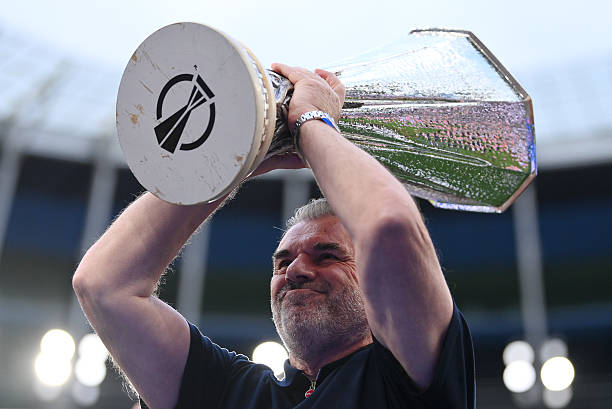
Photo: Getty Images
Tottenham Hotspur sacked Ange Postecoglou just 16 days after he delivered the club its first major trophy in 17 years. More than a year later, the decision looks increasingly difficult to justify.
Ange Postecoglou was never perfect at Tottenham.
His teams could be reckless defensively. His commitment to attacking football sometimes bordered on stubbornness. And finishing 17th in the Premier League, losing 22 of 38 matches, was an objectively dreadful league campaign.
But Tottenham did not sack him because he had failed to build anything. They sacked him after he had built something and then decided not to find out what it could become.
Today, Spurs are bottom of the Premier League after five games, with two points and two goals, following another summer in which the club spent more than £300 million.
It feels appropriate to revisit the decision to move on from Ange, and why it was the wrong choice for the club.
Ange actually changed Tottenham
When Postecoglou arrived in 2023, Tottenham were coming off an eighth-place finish under Antonio Conte and a season in which their football had become increasingly conservative, frustrating much of the Spurs fanbase.
Ange immediately changed the identity, which was the reason he was hired in the first place. His Spurs played with a high defensive line, aggressive pressing, inverted full-backs, positional rotations and an insistence on building from the back.
It was risky. It was also a completely different style to someone like Conte.
Spurs began his first Premier League season with eight wins and two draws from their opening 10 matches, producing some of the most entertaining football the club had played in years. They eventually finished fifth.
The numbers demonstrated that this wasn't simply a case of Tottenham looking more exciting.
Compared with the previous season, Spurs dramatically increased their attacking output: goals per match rose from 1.84 to 2.75, shots from 13.63 to 18.00 and touches in the opposition box from 23.63 to 43.25.
Under Ange, Tottenham were becoming recognisably "Ange's Tottenham", instilling a new footballing identity/
The tactics were flawed but they were also fixable
The biggest criticism of Postecoglou was always his defensive structure. The high line could be exposed. The midfield could become stretched. Injuries made the system even harder to sustain.
Those criticisms were legitimate. In 2024/25, Spurs conceded 63 Premier League goals, while their opponents generated an expected-goals figure of 64.4, highlighting just how vulnerable they had become defensively.
But there is a difference between saying the system had problems and saying the system could not be improved. Ange had spent only two seasons at the club. His first season produced fifth place. His second produced a European trophy.
The logical next step was arguably to improve the squad and refine the weaknesses but not throw the entire project away.
Even Tottenham's own statement after sacking him was revealing. The club said Postecoglou had given them "a great platform to build upon."
If he had genuinely created a great platform, why was he not allowed to build on it? This seems like a hypocritical remark.
Results are the biggest argument against him but context matters
This is where the pro-sacking argument is strongest. Tottenham finished 17th. They lost 22 league matches.
Across his final 66 Premier League matches, Spurs collected just 78 points.
Those numbers cannot simply be ignored because of the Europa League. But there was also another side to the story.
Postecoglou's overall Tottenham record was 47 wins from 101 matches in all competitions, giving him a 46.5% win rate. His Premier League points-per-game figure across the two seasons was 1.37.
And the second season was heavily affected by injuries and the decision to prioritise the Europa League. Most importantly, the team actually delivered when it mattered most.
He won the trophy Tottenham had been desperate for
On May 21, 2025, Tottenham beat Manchester United 1-0 in Bilbao to win the Europa League.
It ended a 17-year wait for a major trophy. It was Tottenham's first European trophy since 1984.
But just sixteen days later, Ange was gone. That timing is difficult to comprehend.
Imagine being a Tottenham fan told before the season and being told Tottenham will win a European trophy.
Would the manager who delivers it really be the first thing you change? The hierarchy at Spurs decided the answer was yes.
Perhaps that would have been understandable if the club had immediately found a manager capable of taking the team to another level. Instead, the opposite happened.
The fans had finally bought into Tottenham again
One of Ange's most underrated achievements was what he did to the relationship between the team and supporters, which is a very underrated attribute in managers.
Tottenham had spent years cycling through managers and football philosophies.
Mauricio Pochettino, Jose Mourinho, Nuno Espirito Santo, Antonio Conte. Each appointment represented a different direction.
Ange offered something supporters could immediately understand. Attack, risk. intensity and belief.
The atmosphere around Tottenham changed because supporters could see what the team was trying to become. That doesn't mean every fan wanted him to stay.
But the idea that he had simply failed to connect with the supporters ignores how quickly he changed the mood around the club.
He gave Tottenham an identity again.
And then there's the money
This is where the argument becomes particularly interesting off the back of their huge spending in the summer window recently.
He inherited a team undergoing a major rebuild, lost Harry Kane immediately and dealt with significant injuries during his time at the club.
Tottenham's net spending under Ange was not simply a case of the club buying its way to success.
In the summer of 2024, for example, Spurs recorded a net spend of £77.4 million which was considerably below Brighton's £153.5 million and behind several other Premier League clubs.
The more important point is what Tottenham did after Ange.
By 2026, Spurs had handed Roberto De Zerbi a summer transfer budget exceeding £300 million amounting to the biggest spending spree in the club's history.
Yet after five league matches, they sit bottom with two points and just two goals. That doesn't prove Ange would have succeeded. It does, however, make the decision to abandon his project harder to defend.
Ange even told us what he wanted
Perhaps the most revealing part of the entire Ange debate came after his departure.
In an interview on Stick to Football, Postecoglou spoke openly about Tottenham's recruitment during his time at the club and the players he believed could have helped take Spurs from fifth into the Champions League places.
He revealed that he had been looking at Pedro Neto, Bryan Mbeumo, Antoine Semenyo and Marc Guehi.
These weren't random punts.They were established or emerging Premier League players who could immediately contribute to a side trying to climb the table.
Postecoglou explained that after finishing fifth in his first season, Tottenham needed to sign Premier League-proven players if they genuinely wanted to move from fifth towards fourth and third.
Instead, Spurs signed Dominic Solanke for a club-record £65 million, alongside teenagers Wilson Odobert, Archie Gray and Lucas Bergvall. Ange wasn't dismissing those young players.
In fact, he described them as outstanding prospects who he believed could become brilliant players for Tottenham.
But his point was that they weren't necessarily the signings that would immediately take Tottenham from fifth to the Champions League places.
That distinction is crucial. Tottenham were building for the future while simultaneously expecting immediate results.
His comments also provide important context for the argument that Ange was given unlimited financial backing.
Yes, Tottenham spent significant money. But spending money and giving a manager the players he believes the team needs are two VERY different things.
The recruitment strategy appeared to be split between immediate improvement and long-term potential. That became even more obvious during the following January.
With Tottenham's injury crisis worsening, Postecoglou repeatedly called for reinforcements.
In January 2025, with 12 first-team players sidelined, he warned that Spurs were "playing with fire" if they didn't strengthen. Reuters reported at the time that he was in regular discussions with technical director Johan Lange about trying to get help for the squad.
A few days earlier, he had already said the club was still short in several areas and needed to reinforce the squad.
Ange was also directly involved in convincing players to join the club.
In 2023, he explained that conversations with new recruits such as James Maddison and Guglielmo Vicario were important because he wanted players who understood the demands of his football and had the personality to play it.
In January 2025, his intervention helped Tottenham convince Mathys Tel to join on loan after the teenager had initially rejected the club's approach.
Postecoglou spoke to Tel directly about his football, the opportunities he would receive at Tottenham and how the team's style could suit him.
That tells us something about the project Ange was trying to build, and that is clearly attracted several players to the club.
He wasn't simply trying to assemble the most talented collection of players possible.
He was trying to build a specific type of squad — players with the technical ability, personality and mentality to play his system.
Which makes the decision to remove him before that squad had fully developed even more significant.
Tottenham didn't just sack a manager. They potentially abandoned a recruitment and footballing philosophy before it had reached its intended next stage.
Tottenham didn't need perfection. They needed patience.
This is ultimately the biggest issue. Ange Postecoglou wasn't perfect. He had tactical weaknesses, his defensive approach was vulnerable, and his second Premier League season was disastrous domestically.
Tottenham were completely entitled to question whether he could take them forward.
But there is a difference between questioning a manager and deciding that the entire project needs to be scrapped.
Tottenham had a manager who had:
- Changed the club's footballing identity
- Finished fifth in his first season
- Started that season with eight wins and two draws
- Reconnected supporters with the team
- Returned Spurs to Europe
- Won the Europa League
- Ended a 17-year trophy drought
And they sacked him 16 days after the biggest achievement of his Tottenham career. The club's own statement said he had left behind "a great platform to build upon."
Maybe Ange would eventually have failed. Maybe his tactics would never have become defensively sustainable. Maybe Tottenham needed somebody else.
We'll never know, because Spurs didn't give him the chance to find out.
And more than a year later, after multiple managers, enormous spending and another dramatic rebuild, Tottenham are still trying to find the identity Ange gave them almost immediately.
Comments (0)
Sign in to comment, like or dislike.
Loading…