
Watford Sack Alessio Dionisi: One of the Worst Run Clubs in England
Alessio Dionisi has become the latest casualty at Vicarage Road after just 18 games in charge
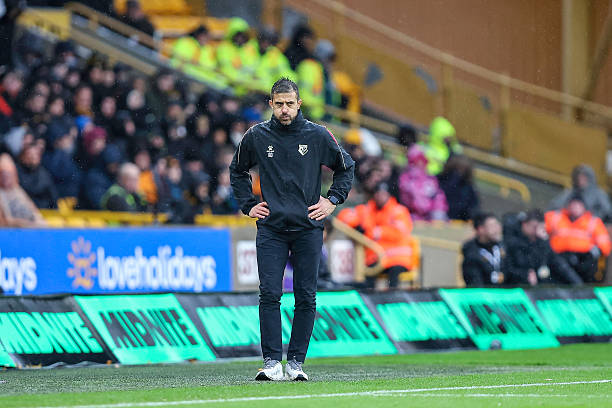
Photo: Getty Images
Alessio Dionisi has become the latest casualty at Vicarage Road, but Watford’s problems cannot simply be blamed on another manager.
After years of chopping and changing in the dugout, the club’s leadership must answer a bigger question: where is the long-term plan?
Watford have sacked another manager. At this point, it is becoming less of a surprise and more of an expectation.
Alessio Dionisi’s time at Vicarage Road has come to an end after just 18 matches, with Saturday’s humiliating 4-0 defeat to Sheffield United proving to be the final straw.
The Italian leaves with Watford sitting 21st in the Championship, having collected just four league victories during his spell in charge.
The club confirmed his departure on Sunday, pointing to a run of just three wins in 13 matches. Sporting director Luke Dowling thanked Dionisi for his professionalism and confirmed that the search for a replacement had already begun.
And there lies the problem. Watford are once again searching for a new manager, once again promising to find the right person, and once again facing the prospect of starting from scratch halfway through a season.
For a club that has spent years changing managers at an extraordinary rate, the question is no longer simply who should take over. It is why Watford keep finding themselves in this position.
Another manager gone, another season disrupted
Dionisi arrived in the summer after Ed Still’s brief spell at the club ended after only three months. His appointment was supposed to provide a fresh direction, but the optimism of an opening-day victory over Southampton quickly disappeared.
Watford struggled for consistency, winning only three of their next 13 matches before the club decided enough was enough.
The 4-0 defeat at Sheffield United was particularly damaging, but it would be convenient for the club to suggest that one afternoon was responsible for the decision. The wider problem has been building for years.
Dionisi becomes the latest name in a long list of managers who have been unable to establish themselves at Vicarage Road. And while every manager must ultimately be judged on results, it is difficult to ignore the environment in which they are expected to work.
Watford have repeatedly appointed coaches, changed direction and then discarded those same coaches before any meaningful long-term project could develop.
Since the Pozzo family took control of Watford in 2012, the club have become notorious for their managerial turnover.
Gianfranco Zola was the first appointment of the Pozzo era, taking charge for 75 matches before departing in December 2013. He was followed by Giuseppe Sannino, Oscar Garcia, Billy McKinlay and Slavisa Jokanovic.
That early period was already chaotic. Garcia stepped down after a short spell, while McKinlay was appointed permanently and dismissed after only two matches. Jokanovic eventually brought some stability and helped guide Watford to promotion to the Premier League in 2015.
But stability was never going to last. Quique Sánchez Flores took charge for the club’s first Premier League season before Walter Mazzarri replaced him.
Marco Silva followed, only to be dismissed in January 2018. Javi Gracia then arrived and enjoyed one of the more successful periods of the ownership, guiding Watford to an 11th-place Premier League finish and the 2019 FA Cup final.
Even that was not enough to guarantee him time. Gracia was sacked just four league matches into the following campaign. Sánchez Flores returned, lasted only a few months and was replaced by Nigel Pearson, who was unable to prevent relegation.
The revolving door continued with Vladimir Ivić, Xisco Muñoz, Claudio Ranieri, Roy Hodgson, Rob Edwards, Slaven Bilić, Chris Wilder, Valérien Ismaël and Tom Cleverley.
There were successes along the way. Jokanovic and Xisco helped deliver promotions, while Gracia produced a memorable Premier League campaign. But those moments have increasingly been surrounded by instability.
Rob Edwards lasted only a few months. Ranieri managed just 14 matches. Wilder's spell was similarly brief. The club have repeatedly moved on before a manager has had the opportunity to build something sustainable.
This pattern has continued into the current campaign. After Cleverley departed in 2025, Watford moved through Paulo Pezzolano, a second spell for Gracia, Ed Still and now Dionisi.
The club have already gone through multiple changes in the dugout during a period when they desperately need consistency.
The problem is bigger than the man in the dugout
There is no suggestion that every Watford manager has been unfairly dismissed. Some appointments have failed, some results have been unacceptable and some decisions were understandable in the circumstances.
But when the same problem keeps happening under the same ownership, eventually the people making the decisions have to come under scrutiny.
Watford's managerial turnover raises serious questions about the club's footballing structure.
What is the long-term identity? What style of football are they trying to establish? What profile of manager are they looking for? And how can a coach realistically build a project when the threat of dismissal appears to hang over every poor run of results?
The club cannot continually blame the latest manager while avoiding the bigger discussion about the system that keeps appointing them.
The Pozzo family deserve credit for some of the recruitment and talent identification that helped Watford establish themselves in the Premier League. Their ownership has delivered promotions, top-flight football and some memorable seasons. But those achievements do not erase the repeated instability.
BBC Sport's examination of Gino Pozzo's managerial record in May 2025 highlighted that Watford had dismissed at least one head coach in every calendar year since he took ownership in 2012. It also pointed to a shift in the club's fortunes after the decision to dismiss Gracia so early in the 2019-20 season.
There is a difference between being ruthless and being directionless. Watford's repeated managerial changes have increasingly made it difficult to see where one ends and the other begins.
What exactly is the next manager walking into?
Whoever takes the job will inherit a club sitting just above the Championship relegation zone, with pressure already building and little room for error.
They will also inherit the same structural questions that have followed the previous appointments.
The next manager will need results immediately, but they will also need to rebuild confidence, establish a consistent playing style and convince supporters that this appointment is different from the last one.
That is a difficult task when the club's recent history offers so little evidence of patience.
Watford cannot expect a new manager to arrive and instantly fix problems that have developed over several seasons. Nor can they expect supporters to believe in another fresh start simply because a new name has been announced.
The club need more than another appointment. They need a footballing plan that survives a bad month, a disappointing transfer window or a difficult run of fixtures.
Without that, the next manager could simply become the next name added to an increasingly ridiculous list.
Dionisi's dismissal might be justified on results alone. Four league wins and a 21st-place position are hardly convincing, and the performance at Sheffield United was nowhere near good enough.
But that does not make Watford's wider situation any less concerning. A football club cannot continually change its manager and expect a different outcome without examining the decisions being made above him.
The people responsible for appointing these managers, shaping the squad and setting the club's direction have to accept their share of the responsibility.
Watford have had talented players, Premier League seasons and opportunities to build something meaningful. Instead, the constant changes have left them looking like a club permanently searching for its next solution.
Another manager has gone. Another search has begun. Another new era is about to be announced.
Unless something changes behind the scenes, there is little reason to believe the next appointment will end any differently.
Comments (0)
Sign in to comment, like or dislike.
Loading…