
Several Premier League Players Refuse to Take the Knee: Is Football’s Anti-Racism Gesture Losing Its Meaning?
An important debate is back in the limelight
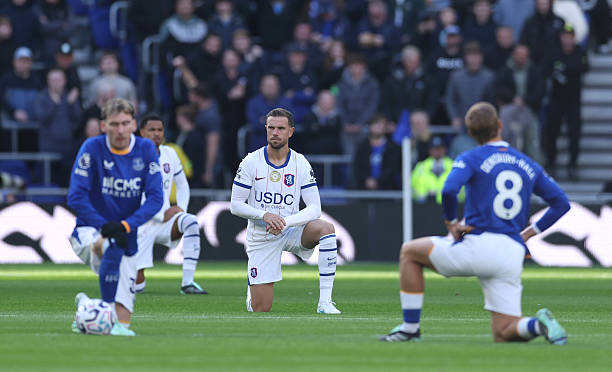
Photo: Getty Images
Ainsley Maitland-Niles, Marc Guéhi, Issa Diop, Rayan and Tyler Adams were among the players reported to have remained standing during the Premier League’s latest No Room For Racism match rounds.
Their decisions have reignited a debate that has followed football for years: can a symbolic gesture create meaningful change, or has taking the knee become a ritual that no longer carries the same weight?
The Premier League’s anti-racism campaign returned to the spotlight this weekend, but not every player chose to participate in its most recognisable pre-match gesture.
Everton’s Ainsley Maitland-Niles remained standing before his side faced Chelsea on Saturday, 17 October. Manchester City defender Marc Guéhi and Ipswich Town defender Issa Diop also declined to take the knee before their match. On Sunday, Bournemouth players Rayan and Tyler Adams were reported to have remained standing before the game against Sunderland.
Their decisions came as the Premier League promoted two dedicated No Room For Racism match rounds, running from 17 to 25 October 2026.
No public explanation had been confirmed for the individual decisions at the time of reporting. It would therefore be wrong to assume that each player was making the same statement, held identical views or opposed the campaign itself.
Nevertheless, the scenes have reopened a significant discussion about racism, protest, politics and the responsibilities placed on footballers in the modern game.
Taking the knee was once a near-universal feature of Premier League football. Now, as participation becomes more selective and some players question its effectiveness, football faces a difficult question: what should an anti-racism gesture actually achieve?
How taking the knee became a symbol in football
To understand the current debate, it is necessary to look back to the origins of the gesture.
Taking the knee became an internationally recognised symbol of protest through American football player Colin Kaepernick, who began kneeling during the United States national anthem in 2016 to protest against racial injustice and police brutality.
The gesture subsequently became associated with wider protests against racial inequality, particularly after the killing of George Floyd in police custody in Minneapolis in May 2020.
Footballers across Europe adopted the protest, and the Premier League introduced taking the knee when the competition resumed following its COVID-19 suspension in June 2020.
Players also wore shirts carrying Black Lives Matter messaging, placing racial equality at the centre of football’s public conversation.
The gesture was significant because it brought an issue often discussed away from the pitch into one of the world's most-watched sporting competitions.
Footballers were no longer simply being asked to discuss discrimination in interviews. They were using the opening moments of matches to communicate a message to millions of viewers.
But the protest was controversial from the beginning. Some supporters applauded the gesture, while others booed. Players also disagreed about whether kneeling was the most effective way to demonstrate opposition to racism.
The debate was never simply about whether racism existed in football. It was also about the appropriate response, the role of professional athletes in public life and whether sporting events should be used to communicate political or social messages.
Wilfried Zaha: “We should stand tall”
One of the earliest and most prominent Premier League players to reject taking the knee was former Crystal Palace forward Wilfried Zaha.
In February 2021, Zaha announced that he would stop participating in the pre-match gesture. He subsequently stood while others knelt before Crystal Palace’s match against West Bromwich Albion in March.
Zaha explained that he felt the gesture had become routine and questioned whether it was making a meaningful difference.
He argued that players continued to receive racist abuse regardless of whether they knelt before matches.
His position was particularly notable because he was a Black player speaking about a gesture intended to demonstrate solidarity against racism.
Zaha did not argue that racism was unimportant. Instead, he questioned whether repeatedly performing the same action was sufficient to address it.
His decision exposed a central tension in the debate: does the continued visibility of a protest demonstrate its importance, or can repetition gradually strip it of meaning?
For supporters of the gesture, consistency matters. Repeating the message ensures that anti-racism remains visible and reminds supporters, players and football authorities that discrimination is unacceptable.
For critics, however, a gesture that becomes automatic risks losing its ability to challenge anyone or change behaviour.
Zaha’s position did not settle the debate, but it established a precedent for players who wanted to oppose racism while rejecting the expectation that they must demonstrate that opposition in one particular way.
Ivan Toney and the criticism of “gesture politics”
Former Brentford striker Ivan Toney also questioned the value of taking the knee.
In 2021, Toney criticised the practice, arguing that players risked being used as a public symbol while those with greater power avoided making the changes needed to address discrimination.
He suggested that taking the knee allowed decision-makers to feel that they had done something meaningful without necessarily delivering sufficient progress.
Toney’s criticism reflects a broader argument about what is often described as gesture politics, meaning the use of highly visible symbolic actions that may communicate a position without necessarily producing corresponding practical change.
In football, that criticism raises several questions.
Does a pre-match protest lead to stronger action against racist abuse? Does it improve the treatment of players from ethnic minority backgrounds? Does it change how clubs recruit and promote staff? Does it make stadiums and online spaces safer?
If a gesture raises awareness but does not independently answer those questions, should it be considered a success, a failure or one part of a much larger process?
There is no simple answer. Awareness can be valuable, and symbolic acts can help establish public expectations. But awareness alone cannot guarantee that abuse will stop or that institutions will change.
Toney’s criticism was directed at the gap between a visible gesture and the practical measures he believed were needed. It should not automatically be interpreted as opposition to anti-racism itself.
His comments also raise an important question about responsibility: if players are repeatedly asked to demonstrate solidarity, what obligations should fall on leagues, clubs, governing bodies, social media companies and law enforcement agencies?
When the Premier League stopped taking the knee every week
Taking the knee was initially performed regularly across the Premier League, but that changed ahead of the 2022–23 season.
In August 2022, Premier League captains agreed that the gesture would no longer take place before every match. Instead, it would be reserved for selected occasions, including designated No Room For Racism fixtures.
The decision followed discussions with players about how best to maintain the message and its impact.
The change recognised that there were competing views about the gesture’s effectiveness, even among people committed to tackling discrimination.
Supporters of limiting the practice could argue that reserving it for particular occasions makes those moments more visible and meaningful. Others could worry that reducing its frequency risks making anti-racism less prominent.
The Premier League has continued to promote No Room For Racism through other measures, including educational resources, efforts to investigate online abuse and programmes intended to improve diversity and opportunities across football.
In April 2026, the league published a five-year update on its No Room For Racism Action Plan, highlighting work across areas including anti-racism enforcement, coaching pathways, executive pathways and community support.
The league has also reported that its dedicated team has conducted more than 4,000 investigations into online abuse.
Those initiatives are important to the wider debate because they demonstrate that the campaign is not limited to the pre-match gesture. The relevant question is how effectively symbolic messaging and practical action work together.
Politics in sport: should footballers be expected to take a position?
The controversy around taking the knee reflects a much broader question about the relationship between sport and politics.
For decades, athletes have used their public platforms to raise issues that extend beyond competition. Some have protested racial discrimination, others have spoken about human rights, gender equality, religious freedom or working conditions.
Sport is often described as a way to bring people together, but it also reflects the societies in which it operates. Players, supporters and clubs do not leave their personal experiences or beliefs at the stadium gates.
The challenge is deciding how those beliefs should be expressed within sporting institutions.
One argument is that footballers have a responsibility to use their visibility to challenge discrimination. The Premier League reaches enormous audiences, and players can influence conversations in ways that many public figures cannot.
Supporters of taking the knee see it as a simple, peaceful and highly visible statement that racism is unacceptable. They may argue that allowing the gesture to disappear risks reducing the visibility of an issue that has not been resolved.
Another argument is that players should have the freedom to decide how they express their views. A pre-match ritual may be meaningful to one individual and unconvincing to another. Requiring everyone to perform the same gesture could turn a voluntary expression of solidarity into an exercise in conformity.
There is also a distinction between political expression and party-political campaigning. An anti-racism gesture is a statement about discrimination and equality, but its place in sport can still generate disagreement about the role of public institutions, individual freedom and the boundaries of sporting events.
These arguments are not mutually exclusive. Someone can believe racism must be challenged while also believing that players should not be compelled to demonstrate their opposition in one particular way.
The more difficult question is whether the debate over the gesture sometimes distracts from the underlying issue.
When discussion focuses on who knelt and who stood, it can become easier to overlook the experiences of players subjected to abuse, the systems designed to respond to it and the evidence needed to assess whether those systems are working.
That does not make the gesture irrelevant. It means its significance should be assessed alongside the practical work taking place beyond the opening whistle.
Has taking the knee actually achieved anything?
The most important question is also the hardest to answer: what has taking the knee achieved?
The gesture has undoubtedly kept anti-racism visible in major sporting competitions. It has given players a collective way to express solidarity and helped ensure that discrimination remains part of football's public conversation.
It has also encouraged debate about racism, the experiences of Black players and the responsibilities of clubs and governing bodies.
But visibility is not the same as eliminating discrimination.The Premier League continues to report cases of racist abuse, while the experiences of players such as Jess Carter demonstrate that online harassment remains a concern.
Those incidents do not prove that taking the knee has achieved nothing. Equally, the continued visibility of the gesture does not prove that it has reduced racism. Assessing its impact requires looking beyond the pre-match image.
Relevant measures include whether racist abuse is investigated, whether offenders face appropriate consequences, whether players receive support, whether clubs respond effectively to incidents and whether opportunities within football become more equitable.
The Premier League's own action plan addresses several of these areas. Its reported investigations into online abuse demonstrate that work is being undertaken beyond the pitch, although the number of investigations alone does not establish the overall effectiveness of every measure.
A fair assessment must distinguish between what the gesture can achieve and what it cannot achieve on its own.
A pre-match protest cannot independently police social media, change every supporter’s behaviour or guarantee equal opportunities throughout the football industry. It can, however, communicate a public standard and reinforce the expectation that discrimination should not be tolerated.
The question is whether that message is supported by enough action to make it credible.
Conclusion: a gesture is only the beginning
The refusal of several Premier League players to take the knee during the October 2026 No Room For Racism match rounds has reopened a debate that began when football first adopted the gesture in 2020.
Ainsley Maitland-Niles, Marc Guéhi, Issa Diop, Rayan and Tyler Adams have all been reported as standing while teammates knelt. Their individual reasons have not been confirmed, and it would be premature to assume they share the same position.
Their decisions nevertheless reflect a question that football has struggled with for years: how can a sport turn public opposition to racism into lasting progress?
Wilfried Zaha questioned whether kneeling had become routine. Ivan Toney challenged the possibility that players were being used as symbols without enough action from those in power. Marcos Alonso chose to point towards an anti-racism message rather than kneel. The Lionesses changed their approach at Euro 2025 after Jess Carter received racist abuse.
Each episode has brought a different perspective to the same wider discussion.
Taking the knee can communicate solidarity, but it cannot be the sole measure of football's commitment to equality. Nor should a player’s decision not to kneel automatically be treated as proof of opposition to anti-racism.
Ultimately, the measure of football's progress will not be found only in the moments before kick-off. It will be found in how the game responds when discrimination occurs, how it supports those affected, how it holds offenders accountable and how it creates opportunities for people from different backgrounds.
The gesture may remain part of that effort. But its meaning depends, in large part, on what happens after the players stand up and the match begins.
Comments (0)
Sign in to comment, like or dislike.
Loading…