
Gianni Infantino Out Arsene Wenger in? Why Wenger Would Be An Excellent FIFA President
Could football be heading towards one of its biggest leadership changes in years?
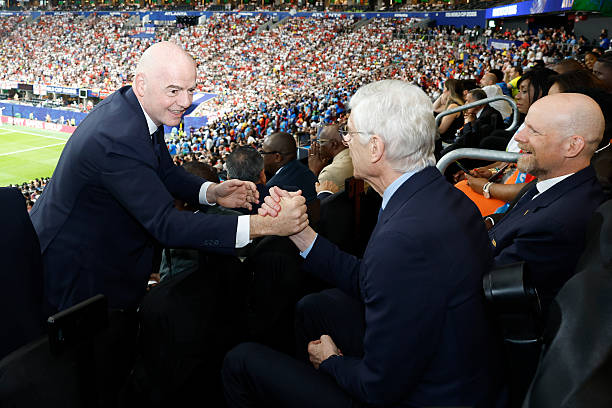
Photo: Getty Images
Could football be heading towards one of its biggest leadership changes in years? Arsène Wenger is reportedly considering a move that would take him from the technical side of the game to the very top of world football, with the former Arsenal manager potentially preparing a challenge for the FIFA presidency.
The 77-year-old Frenchman is being discussed as a possible alternative to current president Gianni Infantino ahead of the 2027 election. And judging by the reaction across football social media, the possibility has generated considerable enthusiasm among supporters who would welcome a new direction for the sport.
Nothing has been confirmed, however, and Wenger is yet to officially declare his candidacy. But with a decision expected imminently, the possibility is becoming increasingly difficult to ignore.
WHEN COULD WENGER BECOME FIFA PRESIDENT?
The next FIFA presidential election is scheduled for the 18th of March 2027, at the 77th FIFA Congress in Rabat, Morocco.
That means there is still time for a potential challenger to emerge, although the immediate deadline is much closer.
Candidates must formally submit their intention to stand by 18 November 2026, with the backing of at least five of FIFA's 211 member associations.
Wenger is reportedly expected to make a decision by the end of this week. UEFA has been searching for a credible alternative to Infantino, and the former Arsenal manager is among the names being considered.
He is not the only potential challenger. Japan Football Association honorary president Kozo Tashima has also indicated an intention to stand, while other names have been discussed.
Wenger's potential candidacy would nevertheless bring a different level of attention to the contest. His reputation extends across continents, and his experience in both club football and FIFA's own administration gives him a profile few potential candidates can match.
INFANTINO'S LEGACY: GROWTH, EXPANSION AND CONTROVERSY
Gianni Infantino has been FIFA president since February 2016, succeeding Sepp Blatter during a period when the organisation was attempting to rebuild its reputation following years of corruption scandals.
His presidency has brought significant commercial growth and major changes to the international game. The 2026 men's World Cup has expanded from 32 teams to 48, while the 2025 FIFA Club World Cup introduced a new 32-team format.
FIFA has also increased financial investment in member associations through its development programmes, with the organisation reporting record projected revenues for the 2027–2030 cycle.
There is a genuine argument that Infantino has helped FIFA become a much larger commercial organisation while directing more funding towards football development around the world. However, his legacy is far from universally celebrated.
One of the biggest controversies of his presidency emerged in July 2026, when FIFA explored creating a commercial subsidiary known as FIFA Forward Enterprise.
The proposal would have allowed private investors to purchase a stake in the commercial interests of FIFA competitions, including the World Cup. Infantino argued that the plan could unlock additional revenue for football development, but it faced strong opposition from UEFA and other confederations.
The proposal was subsequently abandoned, with questions remaining about the transparency and governance surrounding the process.
There have also been wider concerns about Infantino's relationship with powerful political figures, FIFA's approach to hosting major tournaments and the concentration of influence within the organisation.
His position has not collapsed, though. Infantino has received significant backing from several confederations, including Africa, and remains a serious contender for another term.
There is also a debate over the rules governing his eligibility. Infantino was first elected in 2016 to complete Blatter's interrupted term, before winning full mandates in 2019 and 2023. FIFA's Council ruled that his initial partial term would not count towards the presidential term limit, a decision challenged by governance campaigners.
That dispute has added another layer to the debate about whether FIFA needs a change at the top.
WHY WENGER COULD BE THE RIGHT MAN
Wenger would bring something different to the FIFA presidency: a lifetime of football experience, a reputation for innovation and a genuine understanding of how the game develops.
His managerial career speaks for itself. He transformed Arsenal after arriving in 1996, winning three Premier League titles and seven FA Cups. His 2003–04 side went an entire league season unbeaten, earning the legendary 'Invincibles' status.
But his potential suitability for FIFA goes beyond trophies. Since November 2019, Wenger has served as FIFA's Chief of Global Football Development, a role that has given him direct experience working on the development of the game across different regions.
One of his major projects has been the FIFA Talent Development Scheme, designed to give young players around the world better access to coaching, facilities and pathways into professional football.
At FIFA's 2026 Congress, Wenger reported that 193 member associations had signed up to the scheme, with 600 tailored talent projects and 55 active FIFA Talent Academies.
That is particularly important because football's future should not be determined solely by the countries that already possess the strongest leagues, facilities and financial resources.
Wenger has spent much of his career advocating for technical development, youth coaching and improving the opportunities available to young players.
His experience in Japan, France and England also gives him an international perspective that stretches well beyond European football.
For supporters frustrated by the increasingly commercial and political nature of FIFA, Wenger could represent a more football-focused leadership style.
He understands the technical side of the sport, has experience working within the organisation and has spent decades building relationships across the global game.
There is a compelling argument that FIFA's president should have a deep understanding of football itself, rather than simply being an administrator or political operator. Wenger would certainly bring that footballing background.
WOULD WENGER ACTUALLY BE A CHANGE FROM INFANTINO?
There is one important question surrounding the excitement: Wenger is not an outsider and is part of the FIFA establishment already.
He has worked at FIFA since 2019 and was originally appointed by Infantino himself. He knows how the organisation operates, but that also means he would inherit many of the same structures and challenges that have defined the current presidency.
His supporters could argue that this is precisely why he is attractive. He would not need to learn the organisation from scratch and could bring his own vision to an institution he already understands.
However, being an outstanding football manager and technical director does not automatically make someone an effective president of a global governing body.
The job requires political negotiation, financial oversight, governance reform and the ability to unite 211 national associations with vastly different interests.
Wenger would need to demonstrate that he could do more than improve the footballing side of FIFA. He would need to convince member associations that he could lead the entire organisation.
With Infantino already holding significant support across the global game, winning the election would be a considerable challenge.
FOOTBALL FANS WANT A DIFFERENT DIRECTION
The reaction to Wenger's potential candidacy has been fascinating.
Across social media, supporters have been welcoming the possibility of a respected football figure challenging Infantino, with many seeing Wenger as someone who could put the sport itself back at the centre of FIFA's priorities.
That reaction should not be mistaken for a worldwide consensus, particularly when the actual election will be decided by member associations. But it does demonstrate the appeal of the idea.
Football has changed enormously during Infantino's decade in charge. The World Cup is expanding, club competitions are being redesigned, commercial revenues continue to grow and the sport is becoming increasingly intertwined with global business and politics.
Wenger could offer a different emphasis: investment in young players, coaching, football infrastructure and making the game more accessible across the world.
Whether he actually enters the race remains to be seen. But with the candidate deadline approaching on 18 November, the former Arsenal manager has a huge decision to make.
If Wenger does put his name forward, the 2027 FIFA presidential election could become far more than another formality for Infantino. It could become a genuine debate about what football wants its future to look like.
Comments (0)
Sign in to comment, like or dislike.
Loading…