
Cesc Fàbregas Exposes Old Trafford’s Problems as Michael Carrick Comes Under Fire
Two clubs and two managers with vastly contrasting trajectories
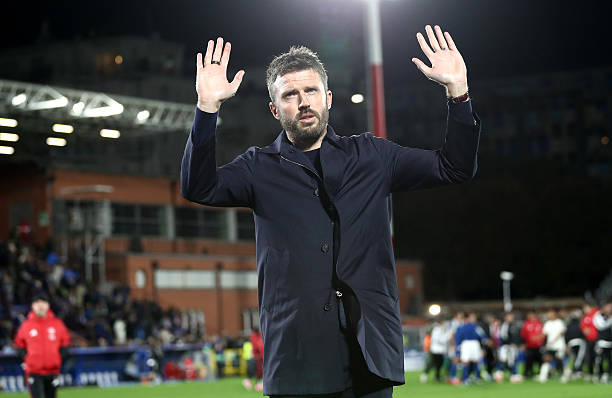
Photo: Getty Images
Manchester United’s Champions League humiliation at Como was about more than one disastrous night. While Cesc Fàbregas continues to build a team with a clear identity, Michael Carrick is facing familiar questions about tactics, leadership and a club that has struggled to rediscover its standards since Sir Alex Ferguson’s retirement.
Manchester United’s decline reached another alarming point on Wednesday night as Como produced a stunning 4–1 Champions League victory over the English giants.
Nico Paz scored twice and played a decisive role in Como’s attacking performance, while Anastasios Douvikas and Jacobo Ramón also found the net. Joshua Zirkzee scored a late consolation for United, but it did little to disguise the scale of the defeat.
For Fàbregas, the result represented another milestone in Como’s remarkable rise. For Carrick, it intensified the pressure on a manager already struggling to convince that he can turn United’s season around.
The most striking contrast was not simply the scoreline. Como looked organised, confident and committed to a clear tactical plan. United looked disjointed, struggled to cope with their opponents’ pressure and finished the evening with their captain publicly questioning the coaching staff’s approach.
Como 4–1 Manchester United: How the Match Unfolded
Como needed less than three minutes to take the lead, with Paz finding space and finishing from the edge of the penalty area.
The early goal settled the Italian side and allowed Fàbregas’s players to dictate the tempo. United struggled to establish control and were repeatedly put under pressure when attempting to build from the back.
Douvikas doubled Como’s advantage in the 49th minute, finishing after a pass from Paz. The Argentine then scored his second of the night in the 57th minute, leaving United three goals behind before the hour mark.
Ramón added a fourth in the 76th minute with a close-range header, completing a dominant performance from the hosts.
Zirkzee scored in stoppage time, but the goal was little more than consolation.
United were without several players, including Lisandro Martínez, Kobbie Mainoo and Luke Shaw, while Leny Yoro was suspended. Matthijs de Ligt returned after a lengthy absence, but the defensive and midfield problems remained obvious.
Injuries and suspensions provide context, but they cannot entirely explain the lack of pressure, poor defensive organisation and inability to respond after Como took control.
Como’s Rise: From the Fourth Tier to Beating Manchester United
To understand the significance of this result, it is important to understand where Como have come from.
The club’s modern rise began after its 2019 takeover by the Indonesian Djarum Group. At the time, Como were playing in Italy’s third tier, having experienced financial difficulties and periods of instability in the preceding years.
The new ownership brought substantial financial backing and a longer-term ambition. Como progressed through the Italian divisions, returning to Serie B in 2021 before earning promotion to Serie A in 2024. That promotion ended a 21-year absence from Italy’s top division.
Como then finished 10th in their first season back in Serie A, establishing themselves before making a further leap forward. They finished fourth in the 2025–26 campaign, qualifying for the Champions League and completing a rise that would have seemed extraordinary only a few years earlier.
The club’s success is not a story of coaching alone. Como have invested heavily in players and infrastructure, with significant spending helping accelerate their progress. Their ownership has provided resources that many clubs at a similar starting point simply do not possess.
But money still needs to be converted into a functioning team. That is where Fàbregas has become central to the project.
Why Has Cesc Fàbregas Been So Successful as a Coach?
Fàbregas arrived at Como as a player ahead of the 2022–23 season. After retiring, he moved into coaching, initially working with the club’s younger teams before progressing into the senior setup.
He became a central figure in the first-team coaching structure and was formally confirmed as head coach in 2024.
His advantage is not simply his playing reputation. Fàbregas spent his career at some of Europe’s biggest clubs, including Arsenal, Barcelona and Chelsea, and played under coaches with very different approaches to possession, pressing and positional play.
That experience appears to have shaped the football he wants Como to play.
A recognisable tactical identity
Como do not approach matches as though their only objective is to survive. They want the ball, look to control space and attempt to dictate how opponents defend.
Opta Analyst reported that Como averaged 61.6 per cent possession in Serie A during the 2025–26 season, the highest figure in the division.
The same analysis recorded an average of just 9.1 opposition passes per defensive action, a measure commonly used to assess pressing intensity. That suggested Como were not merely keeping possession for the sake of it; they were also aggressive when trying to win the ball back.
The combination matters. A possession-based team can become passive if it lacks intensity without the ball. An aggressive pressing team can become vulnerable if it does not retain control after recovering possession. Fàbregas has attempted to combine the two.
Nico Paz gives the system a decisive edge
Paz has emerged as one of the most important players in Como’s rise.
His ability to receive the ball between the opposition’s midfield and defence, turn under pressure and carry possession into dangerous areas gives Como a route through compact defensive structures.
Paz recorded 18 goal involvements in Serie A during 2025–26, more than any other midfielder in the division.
Against United, his influence was clear. He scored twice, assisted Douvikas and repeatedly exploited spaces that United struggled to protect.
Paz is not the only reason for Como’s success, but he represents what the club’s project is trying to achieve: talented players developing within a coherent system.
Investment with a footballing plan
Como’s ownership has been prepared to spend heavily, and that must be acknowledged when assessing their achievements.
Their rise has not been achieved on coaching alone. Recruitment, financial resources and the club’s ability to attract talented players have all contributed.
The difference is that those resources have helped build a side with a clear playing identity rather than simply assembling an expensive collection of individuals.
That is the challenge for United. Spending money is not the same as building a team.
Como’s project has progressed from promotion to consolidation, then from consolidation to European qualification. The club has a clear direction, even if its long-term ambitions remain a work in progress.
Carrick Under Pressure: Manchester United’s Problems Run Deeper Than One Defeat
Carrick arrived with significant goodwill after his successful interim spell at United in 2021 and his subsequent coaching experience. His return to the club’s senior managerial position carried the expectation that he could help restore stability.
There has been evidence that he can produce results. Carrick won 12 of his first 17 matches in charge during the previous season and guided United back into the Champions League. That form helped earn him a two-year contract.
However, the current campaign has unravelled. Following the defeat at Como, United had managed only two wins in 11 matches across all competitions and sat 13th in the Premier League. The team had also been eliminated from the Carabao Cup.
The contrast between the previous season’s strong run and the current slump raises questions about whether Carrick can find solutions when opponents disrupt his preferred approach.
The defeat in Italy was especially damaging because United did not simply lose a close contest. They were outplayed for extended periods and conceded four goals against a club still establishing itself among Europe’s elite.
The tactical disagreement with Bruno Fernandes
One of the most revealing moments came after the final whistle, when captain Bruno Fernandes publicly questioned United’s decision not to press Como more aggressively.
Fernandes said:
“It's a decision from the staff to not press man-to-man and sometimes leave space behind and try to get the ball.”
He argued that allowing Como too much time in possession gave the Italian side confidence. Fernandes also suggested United needed to be braver under pressure and take the risk of pressing higher.
When asked whether Carrick had got his tactics wrong, Fernandes replied that it was for the manager and staff to assess.
Carrick responded with a pointed message of his own:
“Whatever system you play, whatever tactics you play, if you don't run, and you don't run forward, and you don't run back, you ain't going to win.”
The exchange exposed a disagreement over how United should defend, but it also highlighted a broader problem. When the captain and manager appear to be offering different explanations for the same defeat, questions about shared understanding and accountability inevitably follow.
There is a distinction between a player offering legitimate tactical criticism and a dressing room losing confidence in its leadership. One interview does not prove the latter. Nevertheless, the public nature of the disagreement added to the scrutiny surrounding Carrick.
Manchester United Since Sir Alex Ferguson: The Numbers Behind the Decline
Ferguson retired in 2013 after winning 13 Premier League titles. United have not won another league title since.
The club has continued to spend heavily, appointed managers with different footballing philosophies and won major trophies, including the Europa League and domestic cups. But the consistency that defined Ferguson’s reign has proved difficult to reproduce.
Historical Premier League statistics published by the league in October 2024 provide a useful comparison of the permanent and interim managers who followed him.
Premier League points per match
Sir Alex Ferguson - 2.16
José Mourinho - 1.89
Ole Gunnar Solskjær - 1.81
Louis van Gaal - 1.79
Erik ten Hag - 1.72
David Moyes - 1.68
Ralf Rangnick - 1.54
The gap between Ferguson and his successors is substantial. Ferguson averaged 2.16 points per league match, while the next-highest figure in the comparison was Mourinho’s 1.89.
Ten Hag’s record was particularly concerning defensively. United conceded 1.32 goals per Premier League match under him, compared with 0.87 under Ferguson, according to the same league analysis.
These figures do not explain every managerial failure. Managers inherited different squads, faced different opponents and worked under different ownership and recruitment structures. But they show how far United have fallen short of the standard set during Ferguson’s era.
The recurring cycle
Since 2013, United have repeatedly followed a familiar pattern:
- A new manager arrives with a plan to restore the club.
- Recruitment is shaped around that manager’s preferred system.
- Results improve for a period, creating optimism.
- Tactical weaknesses, inconsistent performances or dressing-room tensions emerge.
- The manager comes under pressure, and another rebuild begins.
This cycle has made it difficult to establish continuity in both playing style and recruitment.
A club can change managers and still retain a coherent footballing strategy. United’s challenge has been ensuring that the club’s leadership, recruitment department and coaching staff are working towards the same long-term objectives.
Without that alignment, a managerial change risks treating the symptoms rather than the underlying problem.
Has Manchester United Developed a Culture Problem?
The word “culture” is often used loosely in football, and it would be unfair to claim that every United player or manager has contributed to a single, proven dressing-room problem.
However, several public disputes over recent years have reinforced the perception that the club has struggled to maintain a consistent relationship between players, coaches and the wider institution.
In November 2022, Ronaldo gave a controversial interview in which he said he felt betrayed by the club and claimed he did not respect then-manager Erik ten Hag.
The interview contributed to the breakdown of his relationship with United, and he left the club by mutual agreement.
In September 2024, Ronaldo again argued that United needed to rebuild from the bottom up, saying there had been “no evolution” since Ferguson’s retirement.
His comments reflected the frustration of a former star, but they also illustrated how disagreements at United have repeatedly become public rather than remaining internal matters.
Rashford also found himself at the centre of a public controversy in early 2024 after an unauthorised trip to Belfast, following which he missed training and a cup match.
He acknowledged making mistakes but pushed back against questions about his commitment to the club, arguing that criticism had crossed a personal line.
The episode was not proof of a wider dressing-room culture, but it became another example of a United player’s off-field conduct and relationship with the club dominating the headlines.
Fernandes has often been one of United’s most vocal players, both in demanding higher standards and in expressing frustration during difficult performances.
In April 2024, he said criticism was part of life at Manchester United and that players needed to be prepared to handle both praise and scrutiny.
His comments after the Como defeat were different in tone because they directly challenged a tactical decision by the coaching staff.
A captain should be able to identify problems and demand improvements. The concern arises when those conversations appear to be taking place in public rather than through a unified message from the team.
United need leadership that can hold players accountable while maintaining confidence in the manager’s authority. Whether Fernandes’s latest comments reflect a deeper breakdown or simply frustration after a poor performance remains an open question.
The Ronaldo-Ten Hag fallout, the Rashford controversy and the latest Fernandes-Carrick disagreement are different situations and should not be treated as identical.
Together, however, they illustrate the relentless scrutiny surrounding United and the difficulty of maintaining a stable public relationship between players, managers and supporters.
Former managers have also offered competing accounts of their time at Old Trafford, including criticism of the club’s decision-making and internal relationships.
It is difficult to establish from public comments alone what happens inside a dressing room. But United’s repeated public disputes have created an impression of instability that the club must overcome through consistent leadership, clearer communication and better results.
Why the Contrast With Como Is So Stark
Como are not a perfect model, nor are they operating with the same history, commercial expectations or global scrutiny as Manchester United.
Their financial backing has been substantial, and their rise is not simply the product of a brilliant young coach working with limited resources. Nevertheless, the difference in direction is striking.
Fàbregas has helped establish a recognisable style, and the club has recruited players suited to that approach. Como's possession numbers, pressing intensity and progression through the Italian divisions provide evidence of a project that has developed over several seasons.
United, meanwhile, have repeatedly attempted to rebuild around new managers. Their resources and worldwide profile have not prevented them from struggling to establish a consistent playing identity.
The 4–1 defeat was therefore more than an embarrassing result. It offered a snapshot of two clubs at very different stages of their development.
Como are moving towards the highest level of European football with momentum and a clear plan. United are trying to recover from another setback while questions grow over the manager, the squad and the institution supporting them.
Carrick’s immediate priority is to restore basic organisation, intensity and confidence. The Como match exposed problems both with United’s defensive structure and their willingness or ability to apply pressure collectively.
The manager must also decide how to respond to Fernandes’s comments. A tactical disagreement can be addressed constructively, but United need a clear message about how the team will play and what is expected from every player.
Injuries and suspensions have reduced Carrick’s options, and the club’s summer recruitment has also attracted criticism. Those factors matter when judging the manager’s performance, but the scale of the defeat makes an immediate response essential.
United face Bournemouth next in the Premier League. That fixture now carries added significance, with the pressure on Carrick increasing after the loss in Italy.
Whether the club changes manager or continues with him, the longer-term challenge remains the same: United must create a structure that outlasts individual appointments.
Comments (0)
Sign in to comment, like or dislike.
Loading…