
An International Fan’s Perspective: Why Overseas Football Supporters Deserve to Be Valued
The viral video of a frustrated Bournemouth supporter has instigated debate online about international fans
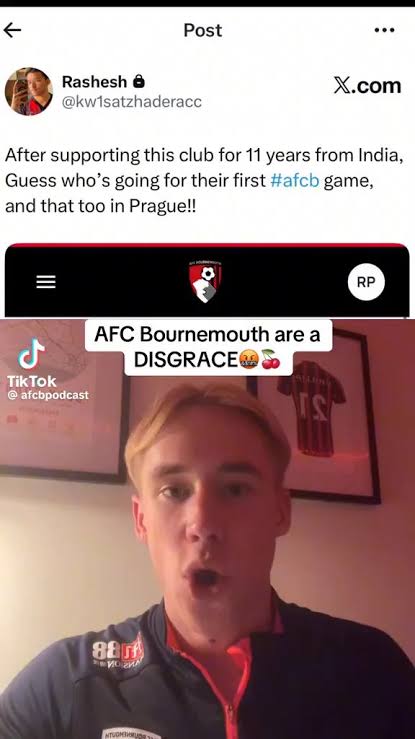
Photo: afcbpodcast Tiktok
The viral video of a frustrated Bournemouth supporter questioning an Indian fan’s ticket to a major match has reignited an important debate.
Local supporters deserve to be protected, but being an international fan should never make someone’s love for a football club less valid.
There is something special about being a football fan.
It does not matter whether you stand on the terraces every weekend, watch from a pub around the corner from your club’s stadium, or stay awake until the early hours of the morning on the other side of the world. Football has a way of making people feel connected to something bigger than themselves.
But a viral video involving a Bournemouth supporter and an Indian fan has raised a difficult question: who deserves to be in the stadium when tickets are limited?
The frustration of a long-time supporter who cannot secure a ticket is understandable. For someone who has followed their club for decades, attended countless matches and built their life around football, missing out on a huge occasion can be heartbreaking.
Yet the international fan who manages to get a ticket should not automatically become the villain of that story.
Because there is another side to football fandom that sometimes gets forgotten: the experience of supporting a club from thousands of kilometres away.
Supporting a club from the other side of the world
Being an international football fan is different.
You might never have grown up within walking distance of your club’s stadium. You might not have a family history of supporting the team. You might never have experienced the atmosphere of a packed home end, stood outside the ground before kick-off or walked home after a last-minute winner.
Instead, your connection is built through television screens, late nights, online communities, highlights, social media and the emotional rollercoaster that comes with following a team you may not see in person for years.
For many overseas supporters, watching their club live is not a regular Saturday afternoon activity. It is a dream that can take years to fulfil. A once in a lifetime opportunity.
Flights, accommodation, time off work and the cost of travelling across the world all have to be considered. A trip to England might require months of saving and careful planning, all for the chance to experience something local supporters might take for granted: walking into the stadium and seeing their team play in person, possibly for the only time in your life.
That does not make an international supporter more deserving than someone who attends every week. But it does mean their connection should not be dismissed as less genuine, or less meaningful.
Football fandom is not measured exclusively by how often somebody can physically attend a match.
You do not have to live near the stadium to care
There is a tendency in some football discussions to separate supporters into categories.
The local fan is considered the authentic supporter. The overseas fan is labelled a tourist, a glory hunter or someone who only cares about the experience of attending a famous stadium.
Sometimes those criticisms are fair. There are people who follow clubs primarily because of their global profile, and there are match-going supporters whose commitment stretches back generations.
But geography alone tells us very little about the strength of somebody’s support.
An international fan can follow every fixture, understand the club’s history, celebrate its victories, suffer through relegation battles and remain loyal during its worst seasons.
They can spend years defending their club among friends who support rival teams, invest their money in official merchandise and organise their lives around watching matches at inconvenient hours.
They might not have the luxury of attending every weekend, but that does not mean they care any less.
A supporter watching from Australia, India, the United States or anywhere else can have an equally meaningful emotional connection to a football club.
The distance is different. The passion can be just as real.
International fans help make football what it is today
There is also a practical reason clubs should value their international supporters.
The Premier League is a global product. Its international audience helps sustain demand for broadcasting rights, subscriptions, merchandise, sponsorships and club content. Overseas supporters follow transfer news, discuss matches, share highlights and introduce new generations to English football.
Many spend money on official shirts, club memberships, streaming services and trips to England. When they finally visit, they contribute to the wider tourism economy through hotels, restaurants, transport and other businesses.
They are part of the ecosystem that makes modern football so commercially powerful.
Of course, international supporters do not contribute equally, and nobody should suggest that spending money buys a greater claim to a seat. The point is not that clubs should prioritise tourists over loyal local supporters.
It is that the relationship between a club and its international audience should be recognised as something valuable, rather than treated as an inconvenience.
These supporters help keep football visible and relevant around the world. They deserve to feel welcomed by the clubs they follow.
Are you telling me that the 100,000 Liverpool fans at the MCG in Melbourne singing one of the most well-known "you'll never walk alone" renditions aren't real fans?
But what about the lifelong supporter who misses out?
This is where the conversation becomes more complicated.
Imagine following Bournemouth for years, attending matches whenever you can, paying for memberships and waiting for the opportunity to see your team in a major game. You go through the ticketing process and miss out, only to discover that someone who has travelled from overseas has secured a seat.
It would be natural to feel frustrated.
Local supporters are the foundations of football clubs. They create the atmosphere, sustain match-day traditions and provide a sense of continuity through good seasons and bad. They should not be pushed aside simply because clubs can attract wealthier visitors or sell premium experiences.
Ticketing systems should recognise that commitment. Season-ticket holders, members and supporters with a genuine history of attending matches should have a fair opportunity to access tickets, particularly for high-demand fixtures.
The BBC has previously reported on the risks international supporters face when trying to secure Premier League tickets, including the case of a South Korean fan who travelled thousands of miles for a match but was turned away after buying through an unauthorised resale website.
That is another reminder that the system can be difficult for fans who have invested significant time and money into experiencing football live.
But there is an important distinction between questioning how tickets are allocated and questioning whether a person deserves to support a club because of where they come from.
If an international fan has obtained a ticket legitimately, followed the club’s rules and paid the appropriate price, why should they be blamed for another supporter missing out?
The anger should be directed towards an allocation system that leaves people disappointed, not automatically towards the person fortunate enough to get through it.
The real problem is scarcity, not international fandom
Football clubs face a genuine challenge. Their stadiums have limited capacity, and the biggest matches can attract far more demand than there are seats available.
At the same time, clubs want to grow their international audiences and welcome supporters who have travelled long distances to experience a match. Those goals do not have to be incompatible.
Clubs can protect access for local and long-standing supporters while creating transparent pathways for international fans to attend.
They can explain how ticket allocations work, crack down on unauthorised reselling and ensure that overseas visitors are not forced towards risky ticketing websites.
They can also recognise that international visitors may be planning once-in-a-lifetime trips, without allowing that fact to override the legitimate claims of established supporters.
There will always be difficult decisions when demand exceeds supply. Not everybody will get a ticket, and no system will satisfy every supporter.
But the solution cannot be to suggest that only those born near a stadium have the right to feel connected to the team playing inside it.
Football's global reach is one of its greatest strengths. It should not become a reason to turn supporters against one another.
I think there should be a local fan allocation, then an international fan allocation that is fair so all fans, regardless of where you are from can get the chance to see their team play.
International fans are not asking to replace local supporters
This is perhaps the biggest misunderstanding in the debate.
Most international supporters are not asking clubs to abandon their local communities. They are not arguing that someone who has attended every home match for 20 years should lose their seat so a tourist can take a photograph.
They simply want their support to be respected.
They want to be able to travel to England, wear their club's colours, visit the stadium and experience the atmosphere they have spent years watching from afar.
They want to feel that their connection to the club is real, even if they cannot attend every week.
They want to be welcomed when they finally get the opportunity to make that dream a reality. That should not be a controversial position.
The Bournemouth video may have struck a nerve because it captures two understandable emotions: the disappointment of a supporter who missed out and the scrutiny directed towards someone who managed to get a ticket.
Both experiences can be acknowledged without treating international fans as outsiders who have somehow stolen football from its rightful owners.
Football belongs to its communities — and its global family
There is no question that football must protect the people and communities that built its clubs. Local supporters should remain central to ticketing decisions, and clubs must be careful not to let commercial opportunities undermine the match-going experience.
But football has never been just about the people who can reach a stadium every weekend.
It is about the child watching their first match on television. The family who have supported the same club for generations. The student staying up until 3am to watch a midweek fixture. The fan who saves for years to travel overseas and finally sees their team walk onto the pitch.
All of them form part of football's wider story.
An international supporter should not be automatically considered less genuine because of their passport, their accent or the distance between their home and the stadium.
A lifelong local supporter should not have their commitment dismissed simply because someone else managed to secure a ticket.
Both deserve respect. The challenge is for football to create a ticketing system that recognises the importance of its existing communities while allowing its global family to share in the experience.
Because the ultimate goal should not be to decide which supporters are worthy of loving a football club.
It should be to make sure the game remains accessible to the people who care about it.
An international fan might live thousands of kilometres away, but distance does not dictate devotion.
I can say this first hand. A local supporter cannot imagine what it's like staying up to 4am every weekend watching football. A local supporter cannot imagine working and saving for years just to get the slight chance you could see your team play.
Not every fan has a geographical connection to their club, but many do. As an Australian, we have millions of people of English heritage, including myself. So although we live far from the stadium, there' still generational support within many families around the globe.
I understand this fans frustration, but having a go at international fans in this manner unveils a significant amount of ignorance, and lack of real empathy for what international fans are.
What have you made of this fans comments?
Comments (0)
Sign in to comment, like or dislike.
Loading…