
Why Manchester City Fans Brought Inflatable Bananas to Anfield
A strange tradition re-emerged at Anfield
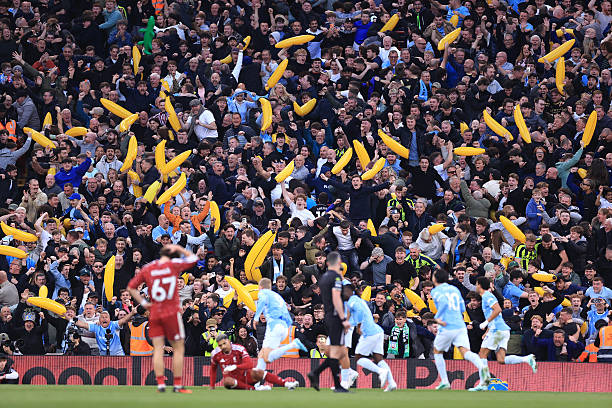
Photo: Getty Images
Manchester City supporters made headlines by waving hundreds of inflatable bananas at Liverpool, but the unusual display has a history stretching back almost 40 years, and its return carried a message of defiance.
Manchester City fans have never been afraid to stand out from the crowd, and their trip to Anfield on Sunday provided another reminder of that reputation.
As Liverpool supporters prepared to give Enzo Mareca's side a hostile reception, City’s travelling fans responded with a sea of bright yellow inflatable bananas, bringing one of English football’s strangest traditions back into the spotlight.
The display was more than a bizarre matchday spectacle. It was a throwback to a difficult period in the club’s history, when supporters used humour and colourful inflatables to bring life to the terraces.
It also arrived at a particularly tense moment, with City facing fierce criticism following an independent commission’s findings over the club’s financial-rule breaches. City have appealed the verdict and deny wrongdoing.
According to reports, Manchester City supporters’ group 1894 distributed more than 1,000 inflatable bananas ahead of the Liverpool clash, ensuring the tradition would be impossible to miss.
It all started with a five-foot banana
The story dates back to the late 1980s, when City were a very different club from the financial powerhouse they would eventually become.
After relegation from the top division in 1987, City were competing in the second tier of English football. The atmosphere surrounding the game was often gloomy, with English clubs also banned from European competition following the Heysel Stadium disaster.
But one supporter helped introduce a little colour to the terraces. Manchester City fan Frank Newton took an inflatable banana to a match against Plymouth Argyle during the 1987–88 season. The idea reportedly came after a friend challenged him to take an inflatable banana to a game.
What began as a simple joke quickly caught on. Other supporters began bringing their own inflatables, and the banana became a familiar sight at Maine Road, City’s former home, and at away matches across the country.
The craze was helped along by the club’s fanzines and the willingness of supporters to embrace something unusual. Before long, the terraces were filled with yellow bananas, alongside inflatable dinosaurs, Frankenstein’s monsters, fried eggs and other bizarre creations.
The trend became one of the defining images of English football in the late 1980s.
The connection to Imre Varadi
There is another part of the story that has become inseparable from the banana tradition: former City striker Imre Varadi.
Varadi played for City during the 1980s, scoring 31 goals in 81 appearances across all competitions, and his surname became the inspiration for the chant “Imre Banana”.
The exact sequence of events is debated. Some accounts suggest the chant inspired the original banana, while others say it developed after Newton had already brought one to a match.
What is clear is that the wordplay became part of City’s terrace culture, helping the banana evolve from a one-off joke into a symbol of the club’s supporters.
The tradition was never simply about the fruit itself. It represented a fanbase that was prepared to laugh, make its own entertainment and embrace the unconventional, even when the team was struggling.
Why did the bananas return at Anfield?
The timing of the latest display gave the old tradition a new significance.
City travelled to Liverpool for their first Premier League match since the independent commission’s verdict on the club’s financial-rule breaches. Liverpool supporters made their feelings clear, with hostile chants, banners and accusations of cheating greeting the visitors.
The rivalry has a sporting dimension, too. Liverpool and City have been central to some of the Premier League’s closest title races in recent years, with Liverpool twice finishing a point behind City in the 2018–19 and 2021–22 seasons.
Against that backdrop, the travelling City supporters brought back the bananas as a visible reminder of the club’s identity beyond its modern success.
The display also offered a way to answer the hostility with humour and defiance rather than allowing the occasion to be defined entirely by the controversy.
City’s fans have a history that predates the club’s Abu Dhabi ownership and its recent dominance of English football. The inflatable bananas connect today’s supporters with generations who followed the club through relegation battles, financial difficulties and years outside the top flight.
The message was particularly relevant at Anfield, where the home crowd had prepared an emphatic welcome for Maresca's side.
A tradition that refuses to disappear
Like many football fashions, the inflatable craze eventually faded during the early 1990s. But it never completely disappeared from City folklore.
The bananas have returned on special occasions, allowing newer supporters to participate in a tradition that older fans remember from the Maine Road days.
Their latest appearance demonstrated how football culture can preserve the identity of a club through generations, even as the sport becomes increasingly commercialised.
For younger viewers, the sight of thousands of supporters waving inflatable fruit might have seemed completely random. For City fans, it was a reminder of a more unpredictable era of football, when a single supporter’s joke could turn into a nationwide craze.
While the modern Manchester City is a world away from the club that first embraced the banana in the 1980s, the tradition offers a link between the two.
The bananas cannot answer the questions surrounding the club’s financial case, nor can they change the outcome of the appeal. But they can remind supporters that Manchester City existed long before its recent success and that its fans have always found their own ways to make themselves heard.
From a five-foot inflatable at a second-tier match to a sea of yellow at Anfield, the story of Manchester City’s bananas is ultimately one of humour, identity and the enduring power of football supporters to create traditions of their own.
Comments (0)
Sign in to comment, like or dislike.
Loading…