
The Most Controversial Tifo in Football History; Crvena Zvezda's Latest Controversy
Crvena Zvezda are in headlines with a very controversial display
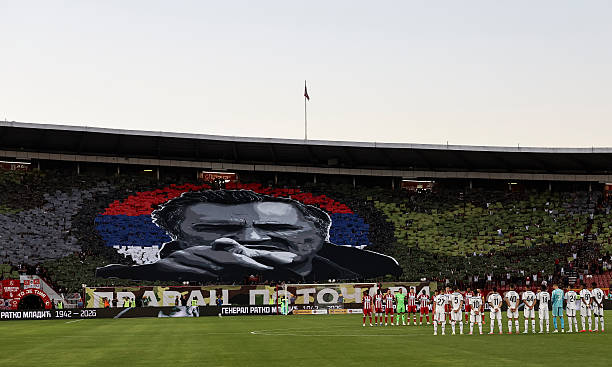
Photo: Getty Images
Football tifos are supposed to represent the passion, identity and creativity of supporters. But throughout history, some have crossed a very different line.
That debate has returned to the forefront after Crvena Zvezda supporters unveiled a huge image of Ratko Mladic during the club's derby against Partizan.
The former Bosnian Serb military commander was convicted by the International Criminal Tribunal for the former Yugoslavia of genocide, war crimes and crimes against humanity. He was sentenced to life imprisonment and died in custody in The Hague this year.
The display came only days after UEFA fined Crvena zvezda €90,000 and imposed an away-ticket ban after supporters had already honoured Mladic during a Europa League match against Viktoria Plzen. UEFA cited inappropriate chanting and racist or discriminatory behaviour.
Football supporters have always used the stands to express themselves.
Tifos can celebrate a club's history, honour legendary players, mock rivals or create spectacular visual displays that make a stadium feel unlike anywhere else in sport.
But sometimes those displays carry a much darker message. The display appeared during the Eternal Derby against Partizan on September 6, just one day before Mladic was buried in Belgrade.
It featured a giant image of Mladić alongside the words "Pravac Potocari" — "Direction: Potocari" — a reference to the location of the Srebrenica massacre.
For many, this was not simply a provocative football display. It was the glorification of a man convicted of some of the most serious crimes committed in Europe since the Second World War.
Who was Ratko Mladic?
Mladic was the commander of the Bosnian Serb Army during the Bosnian War between 1992 and 1995.
In 2017, the International Criminal Tribunal for the former Yugoslavia sentenced him to life imprisonment after finding him guilty of genocide, crimes against humanity and war crimes.
Among the crimes for which he was convicted was his role in the 1995 Srebrenica genocide, in which more than 8,000 Bosniak Muslim men and boys were killed.
He was also convicted over crimes committed during the siege of Sarajevo and other campaigns against non-Serb populations, killing many civillians.
Mladic died in The Hague on August 27, 2026, aged 84, while serving his life sentence.
Yet his legacy remains deeply contested. To many victims and survivors, he represents some of the worst atrocities of the Bosnian War.
To some Serbian nationalists, however, he remains a military hero. That divide has become impossible to ignore following his death.
The football connection
The Crvena Zvezda display was not an isolated incident.
Only days earlier, supporters had honoured Mladic during Crvena Zvezda's Europa League match against Viktoria Plzen in Czechia.
Fans reportedly chanted his name, performed military-style salutes and displayed a banner praising him. There is also more history here.
Crvena Zvezda supporters previously honoured Mladic in 2017, shortly after his life sentence was handed down. UEFA responded at the time with a fine and a stadium punishment.
The latest incident therefore raises a question that goes beyond one tifo:
What happens when a club's supporters repeatedly use the stadium to glorify someone convicted of genocide and where does freedom of expression end?
This is where the debate becomes complicated. Football supporters should be able to express themselves.
Political messages are not automatically hateful. Nor should every controversial opinion be banned from a football stadium simply because it makes someone uncomfortable.
Football has historically been a place where supporters have protested governments, supported social movements and expressed political beliefs.
But should there be a distinction between*expressing a political opinion and celebrating someone convicted of genocide?
That is the difficult question raised by the Crvena Zvezda display. The issue isn't simply that the image was controversial. The person being celebrated was convicted by an international criminal tribunal of genocide and other crimes, including crimes connected to the killing of thousands of civilians.
Football's complicated relationship with history
Perhaps the most uncomfortable aspect of the incident is that football stadiums do not exist separately from the societies around them.
The Balkans' football culture is particularly intertwined with the region's turbulent political history. Crvena Zvezda and Partizan are not simply two football clubs.
Their rivalry is one of the fiercest in European football, and their supporters have developed strong political and nationalist identities over decades.
That doesn't mean every Crvena Zvezda supporter supports Mladic, nor does it mean every Serbian football fan shares the ideology behind the tifo.
But it does demonstrate how football can become a vehicle for historical memory. A stadium can become a place where competing versions of history are presented to thousands of people at once.
And that makes tifos much more powerful than they might initially appear.
The responsibility of the club
Another question is whether responsibility should stop with the supporters.
Crvena Zvezda's official social-media accounts shared imagery of the tifo, adding another layer to the controversy. That raises an important distinction.
A group of supporters displaying something in a stadium is one thing but a football club endorsing that message is something else entirely, speaking the culture surrounding the club as a whole and what/who they represent.
UEFA has already demonstrated that it considers clubs responsible for certain behaviour by their supporters, with Crvena Zvezda receiving significant punishment following the earlier Mladic tribute.
But financial penalties and away-ticket bans only address part of the problem. The bigger question is whether football authorities can actually prevent stadiums from becoming platforms for the glorification of war criminals, racism, antisemitism, fascism or other forms of extremism.
Why do these displays keep happening?
There is also a psychological element to football's most controversial tifos. Provocation is part of ultra culture.
The objective is often to create something that will shock the opposition, dominate the conversation and demonstrate the power of the home support.
The more outrageous the message, the more attention it receives, creating a dangerous incentive with the controversy itself becoming the spectacle.
In that sense, the Crvena Zvezda tifo achieved exactly what many provocative supporter displays are designed to achieve: it became impossible to ignore.
Should football stadiums have limits?
That may ultimately be the biggest question. There is a legitimate argument that football should allow supporters considerable freedom to express political and cultural views.
But there must also be a line. Racism, antisemitism, discrimination and the glorification of atrocities are not simply unpopular opinions. They can cause real harm, particularly when displayed to tens of thousands of people and broadcast to millions more.
The challenge for football authorities is determining where that line sits and applying it consistently.
Because the Crvena Zvezda incident is not really about whether a tifo is allowed to be controversial. Football has always been controversial despite what many people seem to think about the relationship between football and politics.
The more important question is: Can a football stadium be a place for passionate expression without becoming a platform for glorifying hatred, violence and atrocities?
The answer may determine how the next generation of football supporter culture develops.
And as the Crvena Zvezda tifo showed in Belgrade, that debate is far from over.
Comments (0)
Sign in to comment, like or dislike.
Loading…