
Spain Champions of the World Again! Full 2026 World Cup Wrap!
Spain are world champions! What a World Cup!
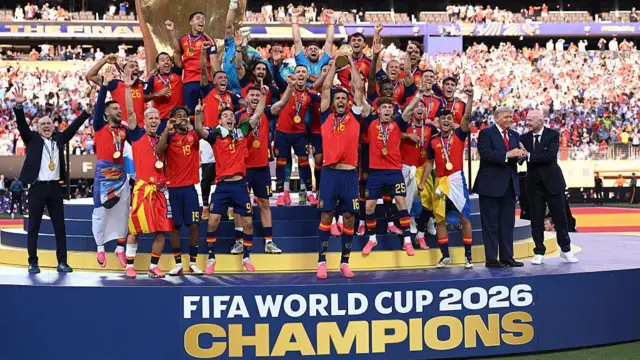
Photo: David Ramos/Getty Images
Over a month of football between 48 nations, with over 100 games played is now officially over, with Spain crowned champions!
The biggest FIFA World Cup in history has officially come to an end, with Spain defeating Argentina 1-0 in the final to lift their second World Cup trophy and become champions of the world once again.
From unforgettable upsets and breakout stars to record crowds and historic firsts, the 2026 tournament delivered one of the most memorable World Cups football has ever seen.
Here's a complete wrap of the tournament.
Spain Edge Argentina in Epic Final
The tournament concluded with a fitting final between defending champions Argentina and a brilliant Spanish side that had steadily emerged as the competition's most complete team.
Spain claimed a dramatic 1-0 in extra time, ending Argentina's hopes of defending their title and denying Lionel Messi the perfect farewell to his World Cup career.
Spain's midfield once again controlled long periods of the contest, while their defensive organisation frustrated an Argentine attack that had thrilled supporters throughout the knockout stages, with Argentina having 0 shots in the game up until extra time.
When the final whistle sounded, Spain celebrated becoming world champions for the second time in their history, adding the 2026 title to their triumph in South Africa 16 years earlier. The victory was in similar fashion, this time Ferran Torres was the hero for Spain as he etches his name in football folklore.
For Argentina, it was a heartbreaking end to an incredible tournament. Despite the disappointment, reaching consecutive World Cup finals further cemented their place among the world's elite.
A Historic Tournament
The 2026 FIFA World Cup will be remembered as a tournament of firsts.
For the first time ever, 48 teams competed at the World Cup. The competition was also jointly hosted by the United States, Canada and Mexico, making it the first men's World Cup to be staged across three nations.
The expanded format produced more matches, more goals and more opportunities for emerging football nations to make history.
Countries such as Cape Verde, Paraguay, Egypt and Norway captured global attention with impressive performances, while traditional powerhouses were pushed to their limits throughout the tournament. For the first time in history, the 4 highest ranked sides made the final 4 of the World Cup.
The Tournament's Biggest Surprises
As always, the World Cup produced plenty of unexpected moments. Several favourites crashed out earlier than expected, while underdogs enjoyed historic runs deep into the knockout stages.
Cape Verde became one of the stories of the tournament after reaching the Round of 16 in their World Cup debut. 40-year old keeper Vozinha made himself from an unknown to a household name after amazing performances against the eventual finalists Spain and Argentina.
Norway announced themselves as genuine contenders by reaching the quarter-finals behind a golden generation led by Erling Haaland and Martin Odegaard.
Egypt also produced their greatest World Cup campaign before suffering a heartbreaking and controversial Round of 16 defeat to Argentina.
The expanded format allowed more nations than ever before to experience football's biggest stage, and many took full advantage of the opportunity.
The Goals, The Drama and The Controversy
The football itself rarely disappointed. Supporters witnessed stunning long-range goals, dramatic extra-time winners, penalty shootouts and countless unforgettable moments across the month-long tournament.
But the competition was not without controversy.
Argentina's knockout victories over Egypt and Switzerland generated fierce debate over several refereeing decisions, while off-field scrutiny surrounding the Argentine Football Association also became one of the biggest talking points of the tournament.
The introduction of the first-ever World Cup Final halftime show also divided opinion, with some embracing FIFA's attempt to create a Super Bowl-style spectacle and others arguing the focus should remain solely on football.
Despite the controversy, the football remained the centrepiece.
The Stars of the Tournament
The 2026 World Cup saw established superstars deliver once again while a new generation announced itself on the global stage.
The top scorers were a reflection of the World's best at their best, with Kylian Mbappe, Lionel Messi, Erling Haaland, Ousmane Demeble and Harry Kane all bagging 6 or more goals in the tournament.
Here is a comprehensive list of all the achievements and records produced at the 2026 World Cup:
First-ever 48-team FIFA World Cup
First World Cup hosted by three nations (United States, Canada and Mexico)
Most teams ever at a World Cup (48)
Most matches ever at a World Cup (104)
Largest World Cup in history by participating nations
Most host cities in a single World Cup (16)
First World Cup with a Round of 32
Spain
Second FIFA World Cup title (2010, 2026)
First nation to win both the UEFA Nations League and World Cup in consecutive cycles
Became the first European nation to win the expanded 48-team World Cup
Argentina
First defending champions to reach consecutive World Cup finals since Brazil (1994–1998)
Lionel Messi became one of the oldest outfield players to appear in a World Cup final
Argentina reached back-to-back World Cup finals for the first time since 1986 and 1990
Lionel Messi
Most World Cup appearances in history
Oldest Argentina player to appear in a World Cup final
Extended his record for most World Cup matches by an outfield player
Most goals and assists in World Cup history
Lamine Yamal
Youngest player to win the FIFA World Cup
Youngest player to score in a World Cup knockout match
Youngest player to appear in a World Cup final
Kylian Mbappe
First player to win the Golden Boot twice.
France's all-time leading goalscorer (second all time)
His 10 goals were the most at a World Cup since Gerd Muller's 10 in 1970, with only Just Fontaine (13) and Sandor Kocsis (11) scoring more in a single tournament.
Michael Olise
Most assists in a single World Cup, breaking Pele's long-standing record.
Norway
Best finish in World Cup history
First World Cup quarter-final appearance
Cape Verde
First nation making its World Cup debut to reach the Round of 16 in the 48-team era
Went undefeated in the group stage
Curacao
Smallest ever nation to play at the World Cup
Bosnia and Herzegovina
Best World Cup finish in Bosnian history
Egypt
Best World Cup finish in Egyptian history
Mexico
Topped their group conceding 0 goals in the group stage
South Africa
Made the knockouts for the first time in their history
Paraguay
Made the Round of 16 for the first time in their history
DR Congo
Made the knockouts for the first time in their history
Spain
Best defence in World Cup history
First World Cup Final halftime show
First World Cup closing ceremony featuring major online creators, including IShowSpeed
Highest total attendance in World Cup history
Most tickets sold for a FIFA World Cup
Highest commercial revenue generated by a FIFA World Cup
Largest global television and streaming audience for a World Cup
Other Notable Milestones
Most nations to score at a single World Cup
Goodbyes to legends, with Lionel Messi, Cristiano Ronaldo, and Neymar among the players saying goodbye
These are the headline records and milestones that defined the 2026 tournament, combining historical firsts, individual achievements and the impact of the expanded 48-team format.
Individual Award Winners
Several players were recognised for their outstanding performances throughout the tournament.
Golden Ball (Best Player): Rodri (Spain)
Golden Boot (Top Goalscorer): Kylian Mbappe (France)
Golden Glove (Best Goalkeeper): Unai Simon (Spain)
Best Young Player: Pau Cubarsi (Spain)
FIFA Fair Play Award: Netherlands
The Legacy of 2026
The 2026 FIFA World Cup has changed international football forever. The expansion to 48 teams proved that more nations can compete without sacrificing the excitement that makes the World Cup so special.
Several emerging football countries demonstrated they belong on the biggest stage, while established powers were forced to adapt to a more competitive global landscape.
The tournament also showed football's continued ability to unite billions of people around the world, producing unforgettable moments that will be remembered for years to come.
Looking Ahead to 2030
Attention now turns to the next World Cup, which will celebrate the tournament's centenary in 2030.
With Spain now champions, every nation begins the long journey towards attempting to dethrone the world's newest kings of football.
If 2026 proved anything, it's that international football has never been more competitive.
From the first kick-off to the final whistle in New Jersey, the tournament delivered everything supporters could have hoped for, drama, heartbreak, controversy, unforgettable moments and, ultimately, a worthy champion.
Spain are world champions once again, and fully deserved.
The road to 2030 starts now!
Comments (0)
Sign in to comment, like or dislike.
Loading…