
Socceroos Fall Short to Brazil in 6-goal Thriller: What We Learnt From This Brazil Series
A wild game ends the short series with plenty to take from the two games
29 Sept 2026·6 min read·by Taj Soupidis
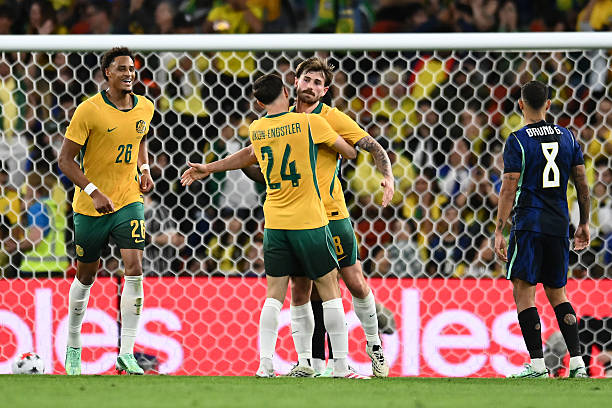
Photo: Getty Images
The Socceroos have fallen to a 4-2 defeat against Brazil at Suncorp Stadium in front of a crowd in excess of 52,000, but the scoreline does little to tell the full story of another hugely encouraging performance from Tony Popovic's side.
After holding the five-time world champions to a 1-1 draw in Townsville four days earlier, Australia once again showed it can compete with one of international football's biggest nations.
This time, however, Brazil had just enough quality to punish Australia's mistakes and eventually pull away.
The Socceroos were behind inside two minutes but thenfound themselvves ahead after Alessandro Circati and Connor Metcalfe turned an early 1-0 deficit into a 2-1 lead, before Brazil levelled through Raphinha's penalty just before half-time.
Bruno Guimarães then restored Brazil's lead after a brilliant piece of attacking play involving Endrick, before Brazil added a fourth from another penalty late on to secure the win.
Despite the defeat, there was plenty for Australia to take from the two-game series.
Australia's hopes of another fast start were dealt a blow inside three minutes.
Brazil moved the ball quickly through the Australian midfield before Vanderson finished the move to put the visitors ahead.
It could have been a difficult night for the Socceroos from there. Instead, they responded brilliantly.
Alessandro Circati produced the equaliser before Connor Metcalfe put Australia in front, turning the match completely on its head.
For a side still developing under Popovic, the response was particularly impressive. Australia did not sit back after conceding.
They continued to press, attacked with purpose and repeatedly looked capable of hurting Brazil.
It was another indication that the Socceroos are beginning to develop an attacking identity rather than simply relying on defensive organisation against stronger opponents.
Brazil eventually found their way back into the contest just before half-time.
VAR intervened after Harry Souttar's challenge in the penalty area was reviewed, with Brazil awarded a spot kick.
Raphinha stepped up and fired past Patrick Beach to make it 2-2. It was a frustrating moment for Australia after having done so much right during the opening half.
Raphinha, however, would not finish the match.
The Barcelona star was substituted at half-time after experiencing muscular discomfort in his right thigh.
The injury was reportedly precautionary, with Brazilian reports saying Raphinha felt the issue during the first half.
That will nevertheless be something Barcelona and Brazil will monitor closely, particularly given Raphinha's previous history of muscular problems.
Raphinha had played the full 90 minutes in the first meeting between the nations in Townsville, so playing two international matches in four days may have contributed to the decision to take no risks.
Things became considerably more heated in the second half. Harry Souttar and Endrick were involved in a series of physical contests, with the Australian defender producing several strong challenges on the Brazilian youngster.
Eventually, the tension boiled over. After another heavy challenge from Souttar, Endrick shoved the Australian defender in the back as Souttar walked away.
The incident sparked a confrontation between the two sides, with Aziz Behich quickly coming across to support his captain.
It was a fiery moment in an otherwise friendly match and added another layer to what had already been an intense contest.
While the confrontation grabbed the headlines, Endrick then showed exactly why Brazil have such high hopes for him.
The Real Madrid forward exploded down the left before producing a brilliant ball across the box for Bruno Guimarães.
The Arsenal midfielder finished the move to put Brazil 3-2 ahead. It was the type of moment that demonstrated the difference between the two teams.
Australia were competitive for long periods, but Brazil have players capable of producing something extraordinary in an instant.
The Socceroos refused to simply accept the result. Nestory Irankunda continued to threaten Brazil's defence, while Australia's midfield remained willing to play forward rather than simply defend deep.
The same bravery that had been evident in Townsville was again on display.
Eventually, though, Brazil's quality and depth proved decisive. The visitors added a fourth goal late on to put the result beyond doubt and secure a 4-2 victory.
Brazil leave Queensland with a win and a draw from the two matches. Australia leave with plenty of reasons to be optimistic.
Two games against Brazil have shown real progress
The results are ultimately disappointing for Australia, but the broader picture is encouraging.
The Socceroos have played two matches against Brazil and lost neither by more than two goals, while taking the lead in both encounters.
They held Brazil to a 1-1 draw in Townsville, coming within seconds of a famous victory before Rayan's stoppage-time header rescued the visitors.
Then, in Brisbane, Australia scored twice against a Brazilian side containing a number of elite players. There are also individual positives everywhere.
Alessandro Circati continues to look increasingly comfortable at international level.
His move to Benfica and his development with the Socceroos suggest Australia have another important defensive option emerging.
Hull City defender Lucas Herrington again showed why he's the most talked about youngster in the country.
His performances against Brazil have shown that his development at club level is translating onto the international stage.
Nestory Irankunda remains one of the biggest reasons for Australian optimism.
His stunning free-kick in Townsville was one of the moments of the series, while his pace and willingness to attack defenders again caused Brazil problems in Brisbane.
Pat Beach has also gained valuable experience against some of the best attackers in world football and has further solidified his grip on the number 1 jersey.
For a young Socceroos squad, two games against Brazil are exactly the sort of tests that can accelerate development.
Australia were never going to dominate Brazil across 180 minutes.
What Popovic will be looking at is whether his players can take the lessons from these games into the next stage of the cycle.
The Socceroos showed they can press Brazil, they showed they can create chances, they showed they can score even without the likes of Mohamed Toure.
Most importantly, they showed they are willing to play against elite opposition rather than simply trying to survive.
There are still obvious areas to improve. Australia conceded four goals in Brisbane and were punished for mistakes in dangerous areas.
Their ability to maintain concentration late in matches also remains something Popovic will want to address. But the two-match series has provided a valuable benchmark.
Australia have shown they are not miles away from competing with teams of Brazil's calibre.
What comes next for Brazil?
Brazil's next match will be another international friendly against India on October 3 in Kolkata.
It will be Brazil's first-ever meeting with India and the final match of their September/October international window.
Carlo Ancelotti's side will continue its rebuild following Brazil's 2026 World Cup campaign, with the Italian coach using these matches to assess younger players and build towards the next major tournaments.
The Australia series has given him plenty to consider, particularly with players such as Endrick, Estevao and Rayan all pushing for bigger roles.
What comes next for Australia?
The Socceroos now have a longer wait before their next matches.
Their next confirmed fixtures are in November, when they travel to the Middle East for two final preparation matches ahead of the 2027 AFC Asian Cup.
Australia will face Qatar in Doha on November 1, before travelling to Amman to play Jordan on November 17.
Those matches will be particularly important for Popovic. The Brazil series has tested Australia against one of the world's elite teams.
Qatar and Jordan will provide a different challenge and a much more direct preview of the type of opposition Australia will face at the Asian Cup.
Australia have been drawn into Group D at the 2027 Asian Cup alongside Singapore, Iraq and Tajikistan, with their opening match against Singapore scheduled for January 9.
Comments (0)
Sign in to comment, like or dislike.
Loading…