
Real Madrid, Atletico Madrid and the Refereeing War After the Madrid Derby
A refereeing controversy has sparked a war of words between both Madrid clubs
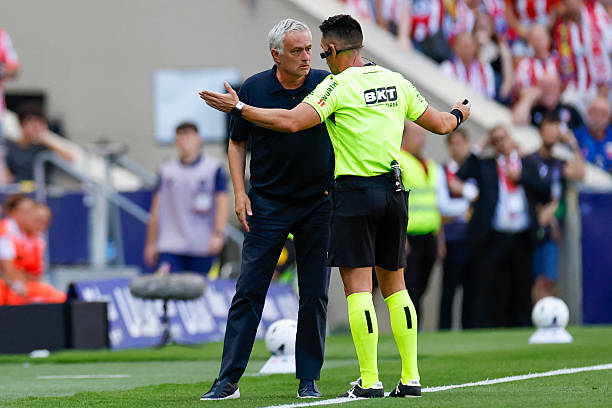
Photo: Getty Images
The Madrid derby was supposed to be about Atletico Madrid taking three points from their biggest rivals.
Instead, barely 24 hours after Atletico's 2-1 victory, the conversation has become dominated by referees, red cards, VAR and Jose Mourinho's return to one of his favourite battlegrounds.
Mourinho arrived at his post-match press conference carrying a sheet of paper containing images of two incidents involving Atletico players.
His message was characteristically blunt.
For the Real Madrid manager, Cristian Romero and Kang-in Lee should both have been sent off in the first half.
“We could skip the press conference because the story of the match is here,” Mourinho said, holding up the photographs.
“They were two clear red cards.”
Real Madrid's official match report went even further, describing the refereeing performance of Miguel Angel Ortiz Arias as “dreadful” and arguing that the decisions involving Romero and Lee influenced the result.
But while Real Madrid undoubtedly have grounds to question some decisions, the story becomes considerably more complicated when each incident is examined individually.
Romero and Bellingham
The first major controversy arrived in the 35th minute.
Jude Bellingham reached the ball ahead of Atletico defender Cristian Romero, with the Argentine subsequently making contact with Bellingham's knee with his studs.
The initial decision was actually against Bellingham, who was shown a yellow card. VAR intervened, however, because the wrong player had been identified.
After reviewing the footage, Ortiz Arias cancelled Bellingham's yellow and booked Romero instead.
That correction was important but it did not result in the red card Mourinho wanted.
Real Madrid argued that Romero's studs going into Bellingham's knee constituted serious foul play and should have resulted in a dismissal.
The situation is not quite as straightforward as Madrid's presentation suggested. The VAR intervention was specifically about mistaken identity. The published analysis of the incident indicates that the question of a red card for Romero was not what triggered the review.
That distinction and context matters.
Real Madrid can legitimately argue that the challenge deserved greater punishment, but it is different from saying VAR reviewed a potential red card and deliberately decided to ignore it.
Then came Kang-in Lee
Just nine minutes later, Real Madrid had a much stronger case. Kang-in Lee caught Federico Valverde on the ankle with his studs.
Ortiz Arias awarded a foul but showed no card. More importantly for Madrid, VAR did not intervene.
Valverde was left with significant trauma to his left ankle, and Real Madrid immediately protested the decision.
This is the incident that has subsequently given Madrid's complaints their greatest ammunition.
According to AS, sources within the Technical Committee of Referees believe Lee should have been sent off. Mundo Deportivo likewise identified the failure to intervene on the challenge as the most significant refereeing error of the derby.
In other words, one of Mourinho's two biggest complaints has subsequently received support from within the refereeing structure itself.
That makes it considerably harder to dismiss Madrid's anger as nothing more than Mourinho looking for an excuse after a defeat. But then came the incident Real Madrid cannot ignore.
Huijsen's red card
Five minutes into the second half, Dean Huijsen brought down Giuliano Simeone.
The referee initially awarded Atletico a penalty and showed Huijsen a yellow card. VAR intervened.
Ortiz Arias went to the monitor, reviewed the incident and upgraded the punishment to a red card.
Mourinho said after the game that he had not yet seen the incident clearly enough to judge it himself.
The reported CTA assessment, however, was much clearer: Huijsen's red card was the correct call.
The defender had grabbed Simeone while being in no realistic position to play the ball, leading to the penalty and dismissal.
Real Madrid therefore cannot credibly argue that every major refereeing decision went against them.
So were Real Madrid right?
This is where the derby becomes genuinely interesting. Madrid's argument isn't entirely without substance.
The Lee incident has subsequently been identified by reporting on the CTA's assessment as a mistake, while the Romero incident remains a legitimate point of debate.
But that doesn't automatically mean the referee “decided” the derby. Real Madrid were not denied two confirmed red cards.
One of those incidents; Romero on Bellingham, involved an actual VAR correction that gave Romero a yellow card. Whether that punishment should have been upgraded to red is a matter of interpretation. The Lee incident is much more difficult for the officials to defend.
And then there is Huijsen.
The Real Madrid defender was correctly dismissed, according to the reported refereeing assessment, and Atletico scored the resulting penalty.
That doesn't erase the Lee error. But it does complicate the argument that Real Madrid were simply the victims of an officiating performance designed to favour Atlético.
Even LaLiga president Javier Tebas acknowledged that Madrid had reasons to complain while arguing that the complaints had gone too far. Tebas said Huijsen's red was definitely correct and that the Romero incident was not a red-card offence in his view. On Lee, he acknowledged that a red could reasonably have been given, while also saying the speed of the incident made the decision understandable.
Atletico hit back
Unsurprisingly, Atletico Madrid were not interested in allowing Mourinho's complaints to become the final word.
Diego Simeone called for respect towards referees after the match, arguing that there is a line that should not be crossed when criticising officials. Then Atletico took their response to social media as they tend to do often.
The club posted a video showing a printer producing the same photographs Mourinho had displayed at his press conference.
Across the post was the message: “Stop acoso arbitral ya.”
In English: “Stop referee harassment now.”
It was an obvious response to Mourinho's decision to make the refereeing the centrepiece of his post-match press conference.
And Atletico had another reason to be irritated. From their perspective, Real Madrid had turned a fiery derby into another chapter in the club's long-running battle with Spanish officiating.
The irony of Real Madrid complaining about referees
This is perhaps the most interesting part of the entire story.
Because if there is one thing Jose Mourinho has never been shy about, it is complaining about referees.
And his return to Real Madrid has already brought back one of the most recognisable elements of his first spell at the club.
Back in 2010, Mourinho famously produced a document containing 13 alleged refereeing errors from Real Madrid's match against Sevilla.
The document listed individual incidents ranging from missed yellow cards and offside decisions to a penalty Real believed should have been awarded.
Sixteen years later, the imagery is remarkably familiar. A Mourinho press conference. A piece of paper. Photographs of controversial decisions. A claim that the referee fundamentally changed the game. And a suggestion that Real Madrid are being treated differently.
The difference is that this time Atletico Madrid are the club on the other side of the argument. Atletico have their own history of feeling aggrieved by refereeing decisions in Madrid derbies.
That is why their “stop referee harassment” message carries an extra layer of irony.
Real Madrid are arguably the most powerful club in Spanish football, and yet their public response to an officiating controversy is once again centred around the idea that the club is being unfairly treated.
But there is another side to the irony.
There is a danger in turning this into a simple “Real Madrid have no right to complain” story. They clearly do have the right to complain about the Lee challenge.
If the CTA assessment reported by AS is accurate, then Madrid were correct to believe that a major refereeing mistake occurred.
That should not be dismissed simply because Mourinho is the person making the complaint.
The more interesting question is show far the complaint goes. Mourinho didn't simply question one decision.
He questioned the referee's experience, questioned the appointment process and raised concerns about VAR official Daniel Trujillo Suarez's history in Real Madrid matches. He also suggested that the pressure surrounding the appointment was unusual.
That is where Atletico's response becomes understandable from their perspective.
The argument has moved from: “We believe this decision was wrong" to “Why was this referee appointed, why was VAR handled this way and why does this keep happening to us?”
Those are very different levels of accusation.
The derby wasn't decided by one incident
The easiest narrative would be to say Real Madrid were robbed. The evidence doesn't quite support something that simple.
Real Madrid have a legitimate grievance over Kang-in Lee's challenge.
The Romero incident is more debatable, particularly because VAR's intervention was initially about mistaken identity rather than a missed red card.
Huijsen's dismissal, meanwhile, was considered correct. Atletico still had to take advantage of the situation. They did exactly that.
Grimaldo converted the penalty, Jonathan David scored the second and Atletico held on after Rudiger's late header gave Real hope.
The refereeing controversy will dominate the headlines because it is the easiest part of the match to argue about. But the derby was not simply a story of Real Madrid versus Ortiz Arias.
It was Atletico Madrid winning a fiercely contested derby, Real Madrid being reduced to ten men, one major decision against Atletico subsequently being questioned by the refereeing authorities, and Mourinho doing what Mourinho has done throughout his career when he believes his team has been wronged.
The irony is that Real Madrid may have a legitimate complaint. They just don't necessarily have the complete case. And perhaps that is exactly why the argument has become so heated.
Because in the Madrid derby, the referee is rarely just the referee. He becomes part of the rivalry.
Comments (0)
Sign in to comment, like or dislike.
Loading…