
North Korea are One Win Away From a Fourth U-20 World Cup. How is This Even Possible?
This has to be the most insane anomaly in football
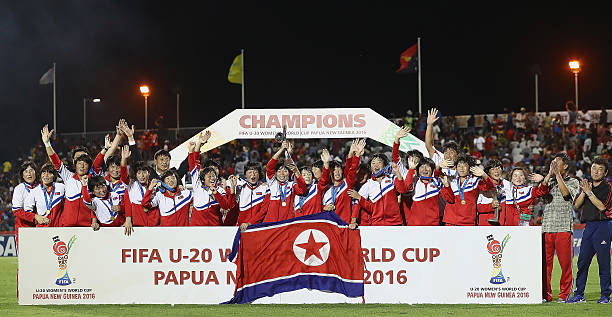
Photo: Getty Images
There are certain football stories that sound almost too strange to be true. North Korea reaching another Women's U-20 World Cup final is one of them.
The country is now just one victory away from winning the tournament for a record fourth time, after defeating Colombia 3-0 in Wednesday's semi-final in Lodz, Poland.
Spain stand between DPR Korea and history in Sunday's final. Win it, and North Korea will become the first nation to successfully defend the FIFA U-20 Women's World Cup while moving clear of the United States and Germany as the competition's most successful nation.
That is where the numbers start to become almost ridiculous. North Korea first won the U-20 World Cup in 2006, they won it again in 2016 then again in 2024.
Now, just two years later, they are in another final.
Four titles from four different generations of teenagers would be extraordinary for any football nation. For North Korea, it is part of something even bigger.
Their U-17 and U-20 women's teams have combined to win seven FIFA World Cups, dating back to 2006. If they beat Spain on Sunday, that becomes eight. FIFA notes that Germany, Spain and the United States have three combined youth women's World Cup titles each across the two age groups.
So how on earth are they doing it?
This isn't a golden generation
The first thing to understand is that North Korea's success cannot simply be explained by one exceptional group of players.
That is what makes it so remarkable. A golden generation can win a tournament. It cannot normally win the same tournament in 2006, 2016, 2024 and potentially 2026.
The explanation lies much earlier in the players' development. North Korea has spent decades building a highly centralised system for identifying and developing young footballers, particularly girls. The country's sporting schools are a crucial part of that system.
One of the most prominent is the Taesong District Juvenile Sports School in Pyongyang, which has operated a women's football programme since 1999. Players can be identified at a very young age, with football incorporated into their education and physical development.
Thousands of young footballers can be assessed through organised school competitions and testing, allowing the country's football authorities to identify players with the potential to progress through the national teams.
The Pyongyang International Football School has subsequently become another important part of the pathway.
It means North Korea isn't waiting until players are 17 or 18 before trying to create a national team. The process begins much earlier.
That is one of the biggest differences between North Korea and many traditional football powers.
The system is designed to win at youth level
North Korea's football development strategy appears to have recognised something that many countries struggle with:
It is considerably easier to become a world power in youth football than it is in senior football.
A country does not need a domestic league comparable with England, Spain or Germany to produce an exceptional group of 17-year-olds.
It needs talent identification, coaching, repetition, discipline and an enormous amount of time spent developing players. North Korea has concentrated heavily on those areas, especially discipline I am sure....
Sports policy academic Jung Woo Lee told DW that while many Western youth systems put considerable emphasis on enjoyment, North Korean players can enter highly structured and disciplined training environments from a young age.
That produces a very specific type of footballer. Technically trained, extremely conditioned, comfortable playing within a strict tactical structure, and perhaps most importantly, accustomed to playing together.
That last point matters enormously.
They don't just produce talented players. They produce a team.
The 2024 U-20 World Cup was probably the clearest demonstration of this. North Korea won all seven matches in regulation time scoring 25 goals.
They conceded just seven, with only two of those coming in the group stage.
They opened the tournament by beating Argentina 6-2, destroyed Costa Rica 9-0 and defeated the Netherlands 2-0.
Then came three consecutive 1-0 victories in the knockout rounds, including the final against Japan.
Their star was 17-year-old Choe Il-son, who scored six goals and won both the Golden Boot and Golden Ball.
But FIFA's technical analysis of that team is arguably more revealing than the results.
The Technical Study Group described North Korea as exceptionally consistent, highlighting the team's technical quality, collective movement and aggressive pressing.
They averaged 53.1% possession during the tournament and had the third-longest possession sequences.
Their forward passing success rate was 78.7 per cent, while they led the entire tournament in the completion rate of progressive passes.
This wasn't simply a team sitting deep, defending desperately and hoping to counterattack. There was a genuine footballing structure underneath it.
Their 4-4-2 defensive shape was highly organised. Their press was coordinated. Players understood when to jump onto opponents, when to close passing lanes and when teammates needed to move across and support them.
And because the players had been developed within the same system, there was an extraordinary level of familiarity and chemistry between them.
FIFA's analysis specifically noted that substitutions did not disrupt the team's rhythm or quality because the players coming into the team were operating at a similarly high technical and tactical level.
That is perhaps the biggest secret. North Korea isn't relying on one superstar. It is trying to make the entire squad good enough, and they have been sucessful in doing so over many years.
The women's game has been deliberately prioritised
There is another fascinating part of the story. North Korea's success in women's football is not accidental.
Despite being the most repressive nation on Earth, the country has invested heavily in women's sport for decades, and football has become one of its most successful international sporting vehicles.
North Korea won its first Women's Asian Cup in 2001, then defended the title in 2003 and won again in 2008.
It has also enjoyed enormous success at youth level. The U-20 side won the World Cup in 2006. The U-17 team won its first World Cup in 2008.
North Korea later became the first nation to win both the U-17 and U-20 Women's World Cups in the same calendar year, doing so in 2016.
The cycle has now started again. In 2024, North Korea won both the U-20 World Cup and U-17 World Cup. In 2025, the U-17s successfully defended their world title and now the U-20s are one match away from doing the same.
FIFA says the country has won seven FIFA youth women's World Cup titles in total and is chasing an eighth on Sunday.
That is not a fluke but is a pipeline.
There is a huge incentive to succeed
Football success can also have an importance in North Korea that goes far beyond sport. International sporting victories are heavily celebrated by the state as many people will know. A show of strength in front of the whole world goes down well by Kim Jong Un.
The 2024 U-20 team received a huge homecoming after winning the World Cup, while Kim Jong Un personally praised the players and coach Ri Song-ho. But there can also be more tangible incentives.
DW reported that players can potentially receive rewards including apartments or the opportunity to obtain residence certificates allowing them to live in Pyongyang. For somebody living outside the capital, that can represent a dramatic improvement in their circumstances.
Sporting success can therefore become more than a medal. It can potentially change a player's life, especially for a North Korean.
That creates a powerful incentive for young athletes to enter and remain within the system.
The strangest part: their success hasn't translated into the senior team in the same way
This is where the North Korean story becomes even more fascinating. If their youth teams are this good, why aren't the senior women dominating the world?
The answer is partly that the system appears to be optimised for youth success.
North Korea has historically struggled to provide its players with the same level of international exposure that footballers in Europe, North America or other major football nations receive.
The country's isolation makes it extremely difficult for players to regularly experience foreign leagues and elite club football. That creates a strange contradiction.
North Korea can produce a 17-year-old capable of dominating a World Cup against players from the world's biggest football nations.
But that player may have far fewer opportunities to play against elite senior professionals afterwards.
DW's analysis argues that this is one of the reasons the country's extraordinary youth success has not translated into equivalent sustained dominance at senior level.
There is also a tactical trade-off. The same isolation that allows North Korea to develop players inside a controlled, consistent system can limit exposure to new footballing ideas.
Women's football around the world is evolving rapidly. European club football is becoming more technical and tactically sophisticated.
Players are experiencing elite strength and conditioning, data analysis, different coaching philosophies and increasingly competitive professional leagues. North Korea cannot replicate all of that from inside its borders.
Right now none of that seems to matter
Because at U-20 level, North Korea remain terrifyingly effective.
Their current team has now reached the 2026 final after another dominant knockout run.
Against Colombia, they scored three times in 19 minutes across the end of the first half and start of the second.
Pak Ok-i opened the scoring in the 28th minute. Choe Rim-jong doubled the lead seven minutes later. So Ryu-gyong made it 3-0 just two minutes after half-time.
The result means North Korea are now one match away from becoming the first team to retain the U-20 Women's World Cup.
Their defensive record is becoming just as extraordinary as their trophy cabinet.
According to FIFA, the last opponent to score against North Korea at the U-20 World Cup was Austria's Valentina Madl during the 2024 tournament.
Since then, North Korea have gone nine consecutive matches without conceding at this competition — a tournament record.
Think about that. Across two separate World Cups, against different countries, with different players. North Korea haven't conceded for nine straight U-20 World Cup matches. That is not normal international youth football.
The fourth title would confirm something bigger
If North Korea beat Spain on Sunday, the conversation shouldn't simply be about another bizarre tournament upset.
It would be confirmation of one of the most successful youth development systems in international football.
Their women's U-20 team would have four World Cups. Their U-17s already have four.
They would have done it despite coming from a country with almost none of the conventional advantages associated with elite football.
When it comes specifically to winning women's youth football tournaments, the results are almost impossible to argue with.
Now Spain have the chance to stop the latest chapter. If they fail, North Korea won't just have another trophy, they will have a record fourth U-20 Women's World Cup and arguably the most remarkable youth football dynasty in the world.
Comments (0)
Sign in to comment, like or dislike.
Loading…