Manchester United Fans Lead Anti-owners Boycott
The war between Manchester United supporters and the club's ownership has entered a new phase
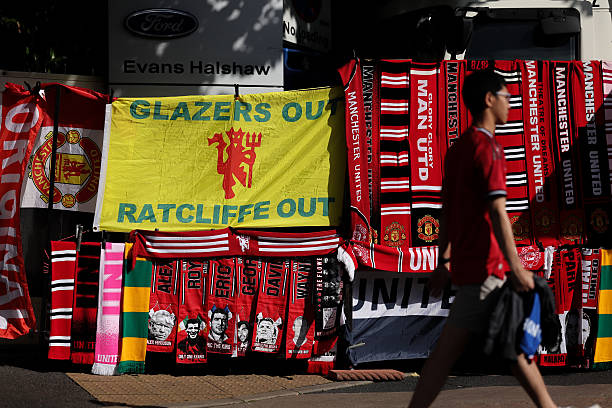
Photo: Getty Images
The war between Manchester United supporters and the club's ownership has entered a new phase.
For more than two decades, United fans have protested against the Glazer family. Now Sir Jim Ratcliffe and INEOS have been dragged into the same fight.
This time, supporters aren't just planning marches outside Old Trafford. They are targeting the money.
The hashtags #BoycottUnited and #GlazersAndIneosOut have been spreading across social media this week, with supporters calling for a boycott of Manchester United merchandise, club-related products, INEOS-linked businesses and some of the companies that sponsor the club.
The idea is simple: if protests haven't forced change, supporters want to make the commercial relationship with United's ownership uncomfortable.
So who are fans targeting?
There are several different categories, and it's important not to confuse them.
Manchester United's sponsors
Supporters are being encouraged to reconsider spending with companies that commercially partner with United.
Among the brands being targeted are:
Adidas
Snapdragon/Qualcomm
Coca-Cola
DHL
SumUp
Extreme Networks
Apollo Tyres
Canon Medical Systems
Malaysia Airlines
Paul Smith
Visit Malta
United's current official partner list also includes Betway, Casillero del Diablo, Champions Travel, Doo Group, Elevate, Mlily and others.
The supporters' argument isn't necessarily that these companies are responsible for United's ownership decisions.
It is that their money and association help support United's commercial operation and that sponsors therefore have a reputational interest in what happens at the club. This strategy isn't unprecedented.
United fans used essentially the same tactic during the huge anti-Glazer protests of 2021.
INEOS
The second target is much more direct.
Sir Jim Ratcliffe founded and owns INEOS alongside co-owners Andy Currie and John Reece, and INEOS became a major shareholder in Manchester United in 2024, taking control of the football operation while the Glazer family remained the majority voting shareholder. Manchester United's own filings currently show the Glazer family with 67.9% of voting rights and INEOS with 28.9%.
INEOS is an enormous industrial group rather than a single consumer brand. It operates 28 businesses across chemicals, energy and consumer sectors, with operations in 26 countries.
The boycott campaign has therefore encouraged supporters to target INEOS-associated consumer businesses, most visibly INEOS Automotive and the Grenadier 4x4.
There is an important distinction here, however. Some lists circulating online are already out of date.
INEOS Hygienics is no longer owned by INEOS. The company sold the business to SKG Capital Partners in 2025.
Likewise, fans should distinguish between businesses actually owned by INEOS and organisations in which INEOS has a sporting investment or partnership.
INEOS currently lists Manchester United, OGC Nice and Lausanne-Sport within its football portfolio, while it also has a one-third ownership interest in the Mercedes Formula 1 team.
The Glazers
Then there are the people at the centre of the original dispute.
The Glazer family completed its takeover of Manchester United in 2005 through a leveraged buyout. The fundamental objection from supporters was immediate.
The club had been effectively debt-free before the takeover. The Glazers' acquisition placed hundreds of millions of pounds of debt onto the club.
The Guardian's historical timeline records £525m of borrowing being loaded onto United as part of the takeover. It also documents years of subsequent protests, dividends, share sales and financing costs.
The anger became so strong that some supporters broke away completely.
FC United of Manchester was founded in 2005 by disgruntled United supporters who opposed the Glazer takeover.
It wasn't just a protest group. They created an entirely new football club.
Twenty years later, FC United remains one of the most visible legacies of the original anti-Glazer movement.
The green and gold revolution
By 2010, the protest had developed another symbol. Green and gold.
Supporters wore the colours of Newton Heath, the club that eventually became Manchester United, as a way of expressing the belief that the club belonged to its supporters and its history rather than its owners.
At the same time, United's debt had become a huge issue. The Guardian records United's debt reaching £716.5m in 2010, while the Glazers were also taking management and administration fees.
The argument wasn't simply:
“We don't like American owners.”*
It was about the financial structure of the takeover and the belief among many supporters that the club was being used as a financial asset.
Then came the European Super League
If there was one moment that turned the ownership dispute into a full-scale revolt, it was 2021.
Manchester United agreed to join the proposed European Super League. Supporters saw it as a direct attack on the traditional structure of English football.
The reaction was enormous. Fans broke into Old Trafford before the scheduled Liverpool match in May 2021. The game was postponed.
It remains one of the most dramatic ownership protests in Premier League history and afterwards, supporters turned their attention towards the club's commercial partners.
The #NotAPennyMore campaign called on United fans to boycott sponsors.
Supporters explicitly told commercial partners that their money was helping sustain the Glazer ownership and urged them to end their relationships with the club.
The campaign even had a measurable commercial impact.
The Hut Group abandoned a proposed £200m, 10-year training-kit sponsorship deal with United, with the Guardian reporting that concerns over the supporters' boycott campaign were a factor.
That history explains why supporters are turning to the same weapon again.
So why are fans angry with INEOS too?
This is where the current protest differs from the traditional anti-Glazer movement.
For years, Ratcliffe was viewed by at least some supporters as a potential solution. He was a lifelong United supporter. He was British. He had built one of the world's biggest industrial groups and crucially, he appeared to offer a route away from the Glazers.
The 1958 initially welcomed the possibility that Ratcliffe could help remove the Glazers. In January 2024, the group described his investment as giving them “more hope for a brighter future” and said it would monitor the new structure.
That optimism didn't last. Ratcliffe's INEOS became a minority shareholder while the Glazers remained in control of the majority voting rights.
That created a fundamental problem for supporters who wanted the Americans gone entirely.
The 1958 later argued that Ratcliffe had effectively chosen to work alongside the Glazers rather than remove them. The frustration has since expanded beyond ownership.
Supporters have been angered by job cuts, ticket-price increases and the club's crackdown on ticketing accounts.
The 1958 has argued that long-standing supporters have been treated unfairly in the process.
That has helped turn Ratcliffe from a potential saviour into another target for sections of the fanbase.
And now the football isn't helping the tension
The current campaign comes at a particularly combustible moment.
United have made a poor start to the 2026-27 Premier League season and were eliminated from the League Cup in the third round. That has provided the immediate spark.
But the current protests are clearly about more than five matches. L'Équipe reported that supporters launched the hashtags in response to both the sporting results and dissatisfaction with the ownership and management of the club.
That's important. If United were sitting top of the Premier League, many of the same structural complaints would still exist. The results have simply made them louder.
This isn't just about football anymore
That may be the most significant development. For 21 years, supporters have marched, they've sung, they've held banners, they've worn green and gold, they've invaded Old Trafford, they created FC United, they protested the European Super League, they targeted sponsors, and now they're trying to turn the club's enormous global commercial ecosystem against the ownership model.
The message is essentially:
If the owners won't listen to the supporters, perhaps the companies paying to associate themselves with Manchester United will.
Whether the current campaign has enough scale to materially affect United's finances remains to be seen. But the logic behind it is clear. Manchester United's commercial business is enormously important to the club.
The 2025 annual report recorded £333.3m in commercial revenue, including sponsorship, retail, merchandising and licensing. Sponsorship alone generated £188.4m in the 2024-25 financial year. That gives supporters an obvious pressure point.
The irony of the current situation
Perhaps the strangest part of the entire story is that United now effectively has two ownership battles happening at once.
The Glazers remain the majority voting shareholders. INEOS has sporting control, and a section of the fanbase wants both gone. That's a remarkable position for one of the biggest clubs in world football.
The 1958 summarised its position bluntly in January:
“Twenty-one years of a debt mountain, mismanagement and financial greed is 21 years too long.”
The group has since made clear that its opposition is no longer limited to the Glazers.
The current boycott therefore represents something bigger than another reaction to a bad result.
It is the latest chapter in a 21-year battle over who Manchester United ultimately belongs to.
The owners may legally control the club. The sponsors may legally have contracts with it. But supporters are making a different argument.
Manchester United is their club and they're trying to prove that their spending power still matters.
Comments (0)
Sign in to comment, like or dislike.
Loading…