
Manchester United Crisis Continues Hitting 38-Year Low
Nine games without a win for United with dressing room defector Lisandro Martínez seeing red
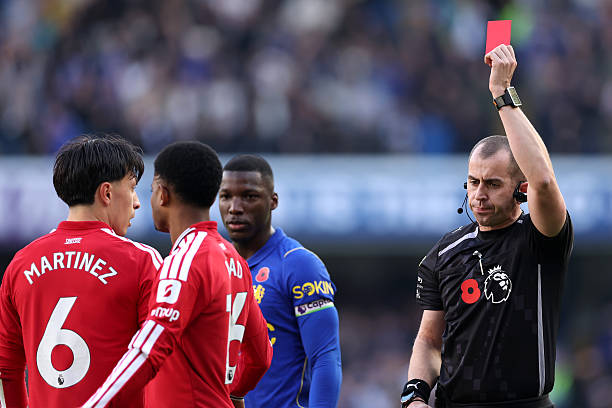
Photo: Getty Images
Manchester United are supposed to be one of football’s biggest institutions. Twenty English top-flight league titles, 13 Premier League crowns and three European Cups have helped build a reputation that few clubs can match.
But the current situation at Old Trafford is becoming increasingly difficult to defend.
A 2-0 defeat to Chelsea at Stamford Bridge has extended United’s winless run to nine matches in all competitions, their worst sequence in almost four decades.
Michael Carrick’s side have collected just seven points from their opening nine Premier League games, leaving them dangerously close to the relegation zone.
While there are plenty of problems throughout the club, Lisandro Martínez has managed to make himself part of the story for all the wrong reasons.
The Argentine defender recently chose to publicly criticise United’s hierarchy following the Champions League defeat to Atlético Madrid.
Now, after his performance against Chelsea and a costly red card, questions are being asked about whether he should have been focusing more on his own performances than pointing fingers elsewhere.
From European powerhouse to a club searching for answers
Manchester United’s history makes their current position even more difficult to comprehend.
Under Sir Alex Ferguson, United became the dominant force in English football, winning 13 Premier League titles and establishing themselves as regular contenders in Europe. The club's ability to compete for major trophies became an expectation rather than an ambition.
Their last Premier League title, however, came in the 2012-13 season in Ferguson’s final campaign in charge.
Since then, United have gone through multiple managers, expensive rebuilds and repeated changes in direction. The club have spent heavily attempting to return to the top, but the consistency and identity that once defined them have been difficult to rediscover.
The current numbers make grim reading. Nine consecutive matches without a victory in all competitions is a run not seen at the club since the late 1980s. They have managed only seven points from nine league matches and have failed to score in four of those games.
This is not simply a poor patch of form. It is another warning that the problems at Old Trafford run much deeper than one manager or one transfer window.
Martínez called out the hierarchy — but where is the accountability?
Following the 2-0 Champions League defeat to Atlético Madrid in October, Martínez delivered an outspoken assessment of the club's recruitment and decision-makers.
Speaking after the match, he said: “We expect more from the top, from upstairs, to bring in more players to compete.”
He went further when discussing technical director Jason Wilcox, saying: “I expect more from our technical director. I have to be honest.”
There is certainly an argument that United need better recruitment and a clearer long-term plan. The club have repeatedly struggled to build a balanced squad, and those responsible for football operations should absolutely face scrutiny.
However, Martínez's comments raised another question: should a player who is part of the team's ongoing struggles be publicly questioning the people above him?
Former United captain Wayne Rooney was among those who questioned the defender's decision to speak out. Rooney argued that although some of Martínez's concerns were understandable, those conversations should have remained behind closed doors.
That criticism becomes even more relevant when looking at what happened at Stamford Bridge.
If Martínez is prepared to publicly demand higher standards from the club's hierarchy, he must also be prepared to accept the same level of scrutiny when his own performances fall short.
The Chelsea red card that summed up United's problems
United actually showed signs of improvement during the first half against Chelsea.
Opta's expected-goals figures had United ahead 1.09 to 0.28 at the interval, and they had created the better opportunities.
Bruno Fernandes, Amad Diallo and the attacking players had chances to give their side an advantage, but United failed to take them. That failure proved costly.
Morgan Rogers opened the scoring five minutes after half-time, driving through the middle of United's defence before finishing past Senne Lammens. It was another example of how easily opponents have been able to expose United's defensive organisation.
Then came Martínez's moment of madness.
Already booked for a poor foul on Rogers, the defender raised his arm towards Wesley Fofana's face while defending a Chelsea corner. Following a VAR review, referee Peter Bankes awarded Chelsea a penalty and showed Martínez a second yellow card.
Cole Palmer converted from the spot to make it 2-0, leaving United with ten men and an even bigger mountain to climb.
The decision was difficult to defend. Martínez had already put himself in danger by collecting the first booking, yet he made another unnecessary challenge in his own penalty area.
It was his second Premier League red card of 2026, following his dismissal against Leeds United in April.
United's second-half expected goals figure was just 0.08, compared with Chelsea's 2.33. The difference between the two teams after the break was stark.
Martínez needs to look in the mirror
The timing of the red card makes it particularly frustrating for United supporters.
Only weeks earlier, Martínez had been willing to speak publicly about the standards expected from the club's leadership. Yet against Chelsea, he made a decision that directly contributed to his side conceding a second goal and losing any realistic chance of getting back into the match.
There is nothing wrong with demanding more from a football club. United's hierarchy should be questioned, and the recruitment strategy deserves serious scrutiny. But accountability cannot be a one-way street.
Martínez is an experienced international defender and a senior member of this squad. He should understand the responsibility that comes with that position, particularly when the team is already struggling.
His dismissal was avoidable, his involvement in the opening goal deserves examination, and his public criticism now looks even more uncomfortable given the way he contributed to another damaging defeat.
He is not responsible for every problem at Manchester United, and it would be unfair to suggest otherwise. But he cannot demand higher standards from everyone else while escaping criticism himself.
The pressure is now firmly on Michael Carrick.
United have gone nine matches without a win in all competitions, have taken just seven points from nine Premier League games and are struggling to produce consistent performances across 90 minutes.
The Chelsea defeat also marked another second-half collapse. United had looked competitive before the break, but Rogers' goal and Martínez's dismissal changed the contest completely.
Carrick's future will inevitably become a major talking point, especially with the club's results continuing to deteriorate.
However, replacing another manager will not automatically solve the deeper issues. United have already tried different approaches and different coaches, yet the same problems keep resurfacing.
The recruitment strategy, squad balance, leadership and standards throughout the club all need serious attention.
Manchester United's history demands more than what supporters are currently watching. The club cannot keep relying on its past reputation while delivering performances that belong nowhere near its former standards.
While Martínez was right to demand more from those above him, he now needs to start showing that same accountability on the pitch.
Comments (0)
Sign in to comment, like or dislike.
Loading…