
Felix Nmecha: Hypocrisy, Religion and the Politics in Sport
Football is once again caught in the middle of a much bigger cultural argument following a controversial celebration from Dortmund's Felix Nmecha
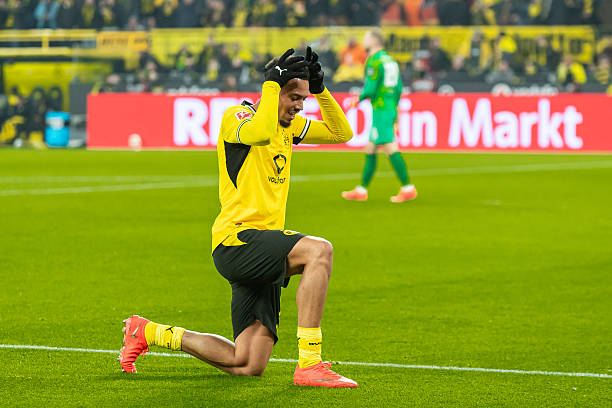
Photo: Getty Images
From Borussia Dortmund's latest controversy to the debate over Christianity, religion, LGBTQ+ rights and freedom of expression, football is once again caught in the middle of a much bigger cultural argument.
Football has never existed entirely separately from politics, religion or wider society despite what some people seem to think.
Players have used the biggest stages in sport to express their political beliefs, celebrate their faith, protest injustice and promote causes they consider important.
But what happens when those beliefs conflict with the values of the clubs they represent, the supporters who follow them and the communities watching them?
That question has resurfaced following the controversy surrounding Borussia Dortmund midfielder Felix Nmecha, whose religious goal celebrations have attracted criticism from sections of the club's fanbase.
What initially appeared to be a relatively simple expression of Christian faith has developed into a much wider discussion about religious freedom, conservative ideology, discrimination and whether football applies the same standards to different religions.
As the argument continues online, another question has emerged: are Christian footballers being judged more harshly for expressing their faith than other religious players? Many Christian's online have expressed this opinion citing Muslim players as an example.
To understand the controversy, it is important to look beyond the celebration itself.
THE FELIX NMECHA CONTROVERSY: WHAT ACTUALLY HAPPENED?
Nmecha, a German international and devout Christian, has been at the centre of religious and cultural debates since joining Borussia Dortmund from Wolfsburg in 2023.
His latest controversy followed Dortmund's 2-1 Bundesliga victory over Elversberg on November 7, in which Nmecha scored twice.
After scoring, the midfielder performed a distinctive celebration, pointing towards the sky before symbolically removing an imaginary crown from his head and placing it on the ground while kneeling.
The gesture represents the campaign 'The King's Return', which promotes the Christian message of Jesus Christ's return.
However, the celebration was not simply an individual expression of faith.
It was associated with an evangelical Christian network called 'Ballers in God', an organisation founded in 2015 that connects footballers through their Christian faith and uses the sport to spread religious messages.
Nmecha has been a prominent supporter of the network and its campaigns.
The controversy surrounding the organisation became more serious following investigations by German broadcasters ARD Monitor and Sportschau in July 2026.
Their investigation examined the network's links to religious outreach and its wider ideological messaging.
Among the findings were examples from an associated online counselling service, Groundwire, where investigators posing as users were given advice describing abortion as 'Satan's plan'.
A sample counselling conversation also described homosexuality as sinful and suggested that a young person questioning their sexuality needed to change.
These findings raised questions about the kind of messaging being promoted through a campaign receiving exposure from professional footballers.
It is important to distinguish between the findings about the network and Nmecha's own personal beliefs. The investigation does not establish that he personally made the statements found in those counselling conversations.
Nmecha has previously responded to criticism by saying that he loves everyone and does not discriminate against people despite what his religious text says and what many in his religious group believe.
Nevertheless, his association with the campaign has become the subject of renewed scrutiny.
WHY ARE BORUSSIA DORTMUND SUPPORTERS COMPLAINING?
The criticism has not simply been about Nmecha being a Christian or publicly acknowledging his faith.
Borussia Dortmund's official Fan and Supporters Department made that distinction very clear in its November 8 statement.
The organisation said it respected everyone's right to practise and publicly express their religion, explicitly including Christianity, Islam, Judaism and atheism.
Its objection was directed towards religious networks that promote worldviews in which people are devalued or excluded because of their sexual orientation, gender identity, lifestyle or personal choices.
The supporters' department argued that religious belief should not be used to justify discrimination.
Dortmund itself has also responded, saying that religious freedom and personal beliefs are respected within the club, but that employees are expected to uphold its values of respect, diversity, equality and opposition to discrimination.
The club has indicated that it intends to speak with Nmecha about the situation.
A footballer praying before a match is not the same thing as a footballer using their platform to promote an organisation whose associated messaging has been criticised for its positions on minority groups.
However, it also raises a difficult question: who gets to decide where personal religious expression ends and organised ideological promotion begins? That is the big question.
THE DOUBLE-STANDARD ARGUMENT: WHY ARE CHRISTIANS COMPLAINING?
Another argument has emerged across social media.
Some Christian commentators and football supporters have questioned why Muslim players are frequently permitted to express their religious beliefs through celebrations, prayer and other visible displays, while Christian players can face criticism when doing something similar.
The argument generally centres on the idea that religious expression should be treated equally, regardless of whether the player is Christian, Muslim etc.
For example, Muslim players performing sujood after scoring, the act of prostrating in prayer, are regularly seen in professional football.
Christian players pointing towards the sky, kneeling in prayer or displaying messages about Jesus are also common.
Players should not have to hide their religion simply because it makes sections of the audience uncomfortable. But the comparison being made online needs some examination.
In Nmecha's case, the criticism is not exclusively about him kneeling or acknowledging Jesus. It concerns the wider organisation and campaign associated with the celebration.
A Muslim player performing sujood as an individual expression of gratitude is not automatically equivalent to a footballer promoting an organised campaign whose associated counselling material has been accused of encouraging exclusionary attitudes.
The same distinction should apply to Christian players. Equally, if a Muslim footballer promoted an organisation that encouraged discrimination against Christians, women or LGBTQ+ people, it would be reasonable to question that association.
The standard should be consistent across all people regardless of religion.
There is also an important distinction between online accusations of double standards and evidence of actual institutional discrimination.
The issue should therefore be judged on the conduct, message and organisational associations involved, rather than the religion of the individual.
RELIGION AND THE DIFFICULT QUESTIONS HIDDEN IN SACRED TEXTS
Perhaps the most uncomfortable part of this entire discussion is what happens when religious texts are examined beyond the passages most frequently quoted by their followers.
So lets look at the most common ones we see in football, that being Christianity and Islam. These all have sacred writings containing teachings that have been interpreted in vastly different ways throughout history.
They also contain passages that, when read through contemporary standards of human rights, raise serious ethical question promoting dangerous ideologies.
So the idea that any religious person is criticising another religious person for having unethical or wacky beliefs is insanely hypocritical. All the comments I have observed online all seem to be Christians complaining about their "treatment" compared to Muslims.
Christians lecturing Muslims about LGBT and women's rights is common under these Nmecha posts. Hmmm I wonder where else those ideas come from....
These texts for major religions include slavery, warfare, the horrible treatment of women, punishing sexuality, genital mutilation, and marriage at very young ages among other horrendous things under modern ethics.
It would be dishonest to pretend these passages do not exist. It would also be dishonest to suggest every modern Christian, Muslim or Jewish person endorses every historical instruction or interpretation contained within their religious tradition.
However despite both those points being true, that just means people come to their own morality and ethics and ignore/disavow the bad parts of their holy books. Pretty convenient if you ask me.
Since at the moment all I see is Christians and Muslims fighting with each other online so here are some examples worth examining of the atrocities written in their religious texts.
SLAVERY
The Bible – Exodus 21:2-11 and Leviticus 25:44-46
The Old Testament contains laws regulating slavery. Exodus 21 discusses the treatment of Hebrew servants, including circumstances in which they could be released and provisions involving wives and children.
Leviticus 25:44-46 goes further, permitting the acquisition of male and female slaves from surrounding nations and describing them as property that could be passed down to descendants.
These are not simply passages describing slavery as an unfortunate historical reality. They establish rules under which the institution was permitted.
The Quran – Surah 23:5-6 and Surah 4:24
The Quran also refers to enslaved people and permits sexual relations with female captives or those described as being under one's ownership.
Academic research from Brandeis University examining Islam and slavery notes that the Quran regulates slavery and encourages manumission but does not explicitly abolish the institution.
The same research discusses the historical treatment of enslaved women and the absence of a requirement for their consent to sexual access under traditional interpretations.
This is an uncomfortable historical reality shared by more than one major religious tradition.
WOMEN'S RIGHTS AND GENDER EQUALITY
The Bible – 1 Timothy 2:11-12
This passage instructs women to learn quietly and states that women should not teach or exercise authority over men.
It has historically been used to support restrictions on women's leadership within sections of Christianity.
Other Christian denominations interpret the passage through its historical setting and point to women who held positions of influence in early Christian communities.
The Quran – Surah 4:34
This passage describes men as protectors or maintainers of women and includes a controversial instruction concerning marital disobedience.
Translations and interpretations of the final instruction differ considerably, with traditional interpretations often permitting a form of physical discipline and modern Muslim scholars debating or rejecting that reading.
The wider debate raises questions about whether ancient religious rules governing marriage and gender can be reconciled with contemporary expectations of equality.
WARFARE, GENOCIDE AND KILLING
The Bible – Deuteronomy 20:16-18 and 1 Samuel 15:3
Some of the most difficult passages in the Old Testament concern commands attributed to God to destroy entire populations.
Deuteronomy 20:16-18 describes the destruction of inhabitants in certain cities, while 1 Samuel 15:3 contains an instruction to attack the Amalekites and kill men, women, children and infants.
These passages have been the subject of extensive theological debate about ancient warfare, historical context and how religious believers should understand divine violence.
They cannot simply be ignored because they are uncomfortable.
The Quran – Surah 9:5 and Surah 9:29
These passages contain instructions to fight particular groups. They are frequently quoted in arguments about religious violence, but their historical context is essential.
Academic analysis published in the European Journal of International Law explains that these verses relate to specific historical conflicts and treaty relationships, rather than establishing an unrestricted command to kill non-Muslims.
The Quran also contains Surah 5:32, which compares the unjust killing of one person with the killing of all humanity.
Examining the difficult passages alongside the passages emphasising the preservation of life is necessary for an honest discussion.
HOMOSEXUALITY AND LGBTQ+ RIGHTS
The Bible – Leviticus 18:22 and 20:13
These Old Testament passages prohibit particular sexual acts between men and prescribe severe punishment in the latter passage.
Romans 1:26-27 is another frequently cited New Testament passage in Christian debates about same-sex relationships.
However, biblical scholars continue to debate the historical meaning and intended scope of some of these passages.
The Quran – Surah 7:80-84
The story of the people of Lot is frequently interpreted in traditional Islamic scholarship as condemning homosexual acts.
It is also a major reference point in contemporary debates about LGBTQ+ acceptance within Muslim communities.
There are disagreements among modern scholars and religious communities about how these passages should be understood and applied today. Regardless of interpretation, these texts have played a significant role in shaping religious attitudes towards homosexuality.
CHILD MARRIAGE AND THE AGE OF CONSENT
The Bible: 19:30-38
The Bibl contains historical accounts of marriages involving very young people, although it does not provide a straightforward equivalent to the Aisha narration in the Quran.
Genesis 19:30-38, for example, contains the disturbing story of Lot and his daughters, who become pregnant by their father after getting him drunk.
This is a narrative describing an incestuous act, not an instruction to practise incest.
That distinction matters: describing an event, legislating for an event and explicitly endorsing an event are three different things.
The Quran 65:4 and Sahih al-Bukhari 5134
Quran 65:4 discusses the waiting period following divorce, including women who have not menstruated.
Classical Islamic commentators have interpreted this as including girls who have not reached puberty, and the passage has consequently featured in historical debates about child marriage.
Another frequently discussed source is Sahih al-Bukhari 5134, which records a narration stating that Aisha married the Prophet Muhammad at six and that the marriage was consummated when she was nine.
This is a particularly sensitive subject in contemporary Islam. Some Muslims accept the traditional narration, while others challenge the historical age attributed to Aisha using alternative historical evidence.
It is important not to casually label an entire religion or its followers based on one historical narration. However, the ethical questions surrounding child marriage and the historical sources used to justify it deserve examination.
INCEST AND SEXUAL VIOLENCE
The Bible – Genesis 19:30-38 and Judges 19
Genesis 19 describes Lot's daughters getting their father drunk and sleeping with him as noted previously.
Judges 19 contains an account of horrific sexual violence against a woman, whose treatment ultimately leads to her death. These are among the most disturbing narratives in the Bible.
They are not presented as straightforward moral instructions, but they raise difficult questions about the societies, violence and sexual ethics represented in ancient religious literature.
The Quran – Surah 4:22-23
The Quran explicitly prohibits marriage between a number of close relatives, including mothers, daughters and sisters.
This is an example where the text establishes restrictions against incest rather than permitting it.
It is important to recognise that not every uncomfortable subject produces the same conclusion across religious texts.
HELL, FORBIDDEN FOODS AND WHAT RELIGIOUS LAW SAYS DESERVES DEATH
Let's not also forget there is eternal punishment for all those not apart of these religions, and death punishment for the smallest infractions.
CHRISTIANITY AND THE BIBLE
HELL
Matthew 25:46 describes eternal punishment alongside eternal life.
Mark 9:43-48 uses the imagery of unquenchable fire.
Revelation 20:14-15 describes the lake of fire and the final judgement.
FORBIDDEN FOODS
Leviticus 11:7-8 prohibits eating pigs and touching their carcasses.
Leviticus 11:10-12 prohibits eating various aquatic creatures without fins and scales, including shellfish such as prawns and crabs.
Deuteronomy 14:8-10 repeats these dietary restrictions.
FORBIDDEN CLOTHING
Leviticus 19:19 prohibits clothing made from two different kinds of material.
Deuteronomy 22:11 specifically prohibits wearing wool and linen together.
WORKING ON THE SABBATH
Exodus 31:14-15 states that anyone who works on the Sabbath should be put to death.
Numbers 15:32-36 describes a man being executed after gathering wood on the Sabbath.
APOSTASY AND WORSHIPPING OTHER GODS
Deuteronomy 13:6-10 describes the death penalty for attempting to persuade others to worship different gods.
Deuteronomy 17:2-5 prescribes stoning for worshipping other gods.
ISLAM AND THE QURAN
HELL – JAHANNAM
Quran 4:56 describes the punishment of those who reject God's signs, with their skins replaced so they can experience punishment again.
Quran 22:19-22 describes garments of fire, boiling liquid and iron hooks.
Quran 78:21-30 describes hell as a place of punishment.
FORBIDDEN FOODS
Quran 2:173 prohibits eating carrion, blood, pork and animals dedicated to anyone other than God.
Quran 5:3 expands the list of prohibited foods.
APOSTASY – LEAVING ISLAM
Quran 2:256 states that there is no compulsion in religion.
Quran 4:137 discusses people who believe, disbelieve and believe again, describing divine punishment rather than prescribing a worldly death sentence.
Sahih al-Bukhari 3017 records the hadith: "Whoever changes his religion, kill him."
BLASPHEMY AND INSULTING RELIGION
Blasphemy and insulting religious figures have also been subjects of Islamic legal debate.
Classical jurists developed different rules concerning blasphemy, including circumstances in which severe criminal penalties could apply.
Modern Muslim-majority countries also differ considerably in their laws and enforcement.
THE BIGGER QUESTION
Imagine a footballer publicly supporting a religious movement that wanted to impose ancient religious laws on modern society.
Would supporters accept those beliefs if they were applied consistently?
Would a Christian footballer advocating the execution of people for working on a Saturday or worshipping another god be treated differently from a Muslim footballer supporting the execution of apostates?
Would a footballer promoting restrictions on women's rights or criminal penalties for homosexuality be defended simply because those positions were religiously motivated?
These are questions worth asking.
Religious freedom protects the right to hold and express religious beliefs. It does not automatically make every religious teaching compatible with modern human rights standards.
And the same scrutiny must apply to Christianity, Islam, Judaism and every other belief system.
The issue is not whether someone should be allowed to believe in God, pray or practise their faith.
It is whether religious authority should be used to justify denying other people basic freedoms.
That is a debate football, like the rest of society, cannot completely avoid.
This is just all a small part of just two religions. But I feel I have made my case, so this bickering between people is so hypocritical and confusing to me.
SO WHERE DOES THIS LEAVE SPORT?
The central question is not whether religion should be allowed in football.
Religious freedom is an important part of individual expression, and players should be able to pray, acknowledge their beliefs and participate in religious traditions without automatically becoming targets of criticism.
Any political or religious demonstrations result in a yellow card. I think this is fair, people can feel free to do it and know their punishment, and people's private personal beliefs do not concern me.
But, this continued devise bickering that goes on in society between different groups of peopleover these issues, knowing what their texts say, is really disheartening to see, and is loaded with hypocrisy from people of all religions.
Freedom of religion does not mean freedom from scrutiny. A footballer can be Christian, Muslim, Jewish, Hindu, atheist or anything else.
What becomes more complicated is when that footballer uses an enormous sporting platform to promote an organisation, political movement or ideology that advocates excluding or discriminating against other people.
That principle should apply equally to everyone. The International Football Association Board's Law 4 already prohibits political, religious and personal slogans or images on players' equipment.
However, the existence of this rule does not mean that every ordinary religious gesture during a celebration is automatically prohibited.
There is a distinction between personal expression and organised messaging.
Football must also be careful not to create a situation in which some beliefs receive protection while others are treated as unacceptable simply because of their identity.
The Nmecha controversy is particularly interesting because it places two important principles against each other: the right to religious expression and the responsibility of sporting organisations to protect an inclusive environment.
Neither principle should automatically erase the other.
THE BIGGER PICTURE: SHOULD RELIGION AND POLITICS HAVE A PLACE IN SPORT?
Football has always been political, whether its governing bodies and clubs like to admit it or not.
Players have taken a knee against racism, worn armbands supporting social causes, spoken about wars, protested discrimination, many have worn the poppy this week and used their popularity to promote political and religious beliefs.
Some actions are widely celebrated. Others create enormous controversy. The difficulty is establishing a consistent standard.
If a player can use their platform to advocate for LGBTQ+ acceptance, should another be permitted to express a religious disagreement, provided they do not harass or discriminate against others?
These are difficult questions, but they deserve to be discussed without immediately assuming that everyone on the opposing side has malicious intentions.
There is also a broader issue concerning how religious institutions interpret ancient texts in modern society.
Every major religious tradition has passages that modern readers should find deeply troubling although many don't. Some have been used to justify oppression, violence and inequality. Others have been reinterpreted, rejected as outdated or understood through a different historical lens.
Religious believers are not required to defend every action committed in the name of their faith.
Equally, non-believers should be able to question religious teachings without being accused of attacking every person who follows that religion.
Ultimately, football should not become a platform for discrimination disguised as religious freedom, but neither should religious freedom become something that only applies when the majority agrees with the belief being expressed.
Felix Nmecha's celebration may have started as a gesture of Christian faith, but the controversy surrounding it has exposed a much bigger debate.
If football wants to stand for equality, respect and inclusion, those principles need to apply consistently – regardless of someone's religion, political beliefs or personal identity.
I personally wouldn't want to see Nmecha punished for his actions, your own private beliefs are your own private beliefs. But when you promote dangerous groups or dangerous ideologies, nobody should be complaining or developing a victim complex, or immune to criticism from others, especially considering the content of religious books.
Comments (0)
Sign in to comment, like or dislike.
Loading…