
Bukayo Saka Injury Exposes Big Arsenal Problem and Who Arsenal Should Target in January
For an Arsenal side wanting to go one further in 2026/27, an attacking shortage could prove the difference.
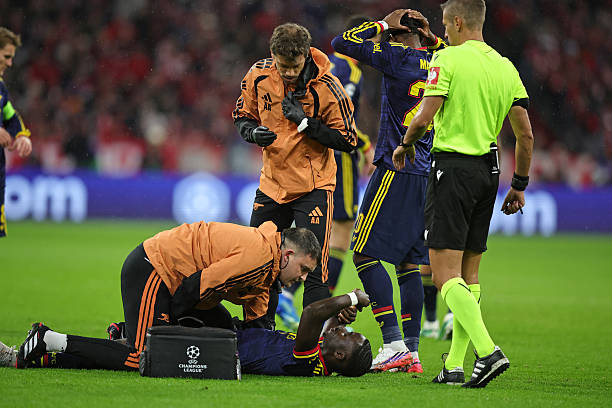
Photo: Getty Images
Arsenal have been dealt another worrying injury setback after Bukayo Saka was forced off early during their 2-2 Champions League draw against Bayern Munich, raising fresh questions about the club's attacking depth and whether reinforcements will be required in January.
The England international lasted less than 10 minutes at the Allianz Arena before going down with an apparent left quadriceps injury. Saka was replaced by Eberechi Eze, who went on to score Arsenal's opening goal in an entertaining draw.
However, the result was overshadowed by the fitness concerns surrounding one of Arsenal's most important players, with manager Mikel Arteta admitting the early signs were not encouraging.
With Christos Tzolis already sidelined and Arsenal having allowed several attacking players to leave during the summer transfer window, Saka's injury could become a significant issue if he faces an extended spell on the sidelines.
The setback also raises an uncomfortable question for the Gunners: have they left themselves short of attacking options in their pursuit of major honours this season?
What did Mikel Arteta say about Bukayo Saka's injury?
Arteta delivered a concerning assessment after Arsenal's draw against Bayern, confirming that the club's medical staff were worried about the winger's condition.
"We lost Bukayo, who actually was having a great game," Arteta said.
"They are a bit concerned. A player that has to come off with a really sharp pain is never good news but we have to wait and see."
The Arsenal manager later described the situation as something that "doesn't look good at all", although he stressed that further assessment would be required before the severity of the injury could be established.
Saka appeared to indicate discomfort around his left thigh before leaving the pitch. The problem was described as a quadriceps injury, but Arsenal had not confirmed a precise recovery timeline in the immediate aftermath of the match.
That uncertainty is particularly concerning given Saka's importance to Arteta's side. The winger has been one of Arsenal's most reliable attacking outlets, regularly providing goals, assists and the individual quality needed to unlock difficult defences.
Losing him for even a short period would force Arteta to reconsider his attacking combinations during a busy stretch of the campaign.
Arsenal's fixture schedule raises fresh workload questions
Saka's injury has also reignited the debate around player workload and the demands placed on elite footballers, especially pertaining to him specifically.
Arsenal are competing across multiple competitions, with Premier League fixtures, European matches and domestic cup commitments placing significant demands on their squad.
Saka had started all seven of Arsenal's Premier League matches this season, as well as two of their first three Champions League fixtures.
That workload highlights how important he has been to Arteta's plans, but it also illustrates the difficulty of maintaining consistency when a team's most influential attackers are regularly required to play.
When asked whether the injury could be connected to the demands of modern football, Arteta pointed to the intensity of matches at the highest level.
"Against Lille he didn't start the game, then he started the game at the weekend," Arteta explained.
He also highlighted the relentless physical demands of elite football, describing matches as contests in which there is little opportunity to recover between actions.
"The level of intensity that these games require is something incredible," he said.
Arteta's comments reflect a wider challenge facing managers: finding the balance between keeping key players available and maintaining the competitive standards required to challenge for major trophies.
Saka's latest injury I suspect came after years of poor load management, meaning his legs are now shot. He went down just from a simple kick. That is the most worrying sign.
Should Arsenal have signed another attacker in the summer?
Saka's injury has placed Arsenal's summer transfer business under renewed scrutiny.
The Gunners strengthened several areas of their squad, but they failed to secure the elite attacking signing they had pursued before the transfer window closed.
Arsenal explored moves for forwards including Julian Alvarez and Vinícius Júnior, but neither deal materialised. The club also allowed Gabriel Martinelli, Leandro Trossard and Gabriel Jesus to leave, while Ethan Nwaneri departed on loan.
Christos Tzolis arrived as an attacking addition, but his own injury problems have complicated Arsenal's options.
The result is a squad in which several players must cover multiple attacking positions.
Eberechi Eze can operate across the forward line and in attacking midfield, while Noni Madueke provides another option on the right. Kai Havertz can also contribute through the middle, depending on his fitness and availability.
Those players offer Arteta flexibility, but versatility is not necessarily the same as depth.
If Saka is unavailable, Arsenal lose a player who consistently threatens defenders one-on-one, creates chances and contributes directly to goals. Replacing those qualities across an extended period is a different challenge from covering a single match.
The problem becomes even more pronounced if further injuries occur. Arsenal's squad last season was great, but clearly lacked another quality forward. The fact nobody was signed could come back to haunt Mikel Arteta.
Why Saka's absence could affect Arsenal's title ambitions
Arsenal's attacking depth could prove decisive as the season progresses.
The club are aiming to compete at the highest level domestically and in Europe, where the schedule can become increasingly demanding as the campaign reaches its decisive stages.
Saka's influence extends beyond his individual statistics. His presence forces opposing defenders to adjust their positioning, creates additional space for teammates and gives Arsenal a reliable outlet when their usual passing combinations are not working.
Without him, Arteta may need to rely more heavily on Madueke, Eze or other attacking players to provide width and creativity.
Eze's performance against Bayern demonstrated the value of having quality alternatives available. His goal after replacing Saka was an encouraging sign, but one strong substitute appearance does not automatically resolve the longer-term question of squad depth.
Arsenal must also consider the possibility of multiple attackers being unavailable simultaneously. With Tzolis already sidelined, another significant injury could leave Arteta with fewer natural options for the wide positions.
That could lead to more rotation between positions, greater reliance on players returning from injury and less opportunity to rest key individuals during congested periods.
For a club hoping to compete for the Premier League title and progress deep into the Champions League, those compromises could become costly.
January transfer window: Arsenal may need to act
The January transfer window could provide Arsenal with an opportunity to address the imbalance in their attacking squad.
However, signing a suitable forward halfway through the season is rarely straightforward. Clubs are often reluctant to sell important players, prices can increase and new arrivals have limited time to settle into a different system.
Arsenal's summer pursuit of a high-profile attacker demonstrated the difficulty of finding the right player.
BBC Sport's Arsenal reporting has indicated that the club remained open to opportunities in the January market, although any move would depend on availability, finances and whether the right target could be secured.
A versatile winger capable of operating on either flank would give Arteta additional protection against injuries and help reduce the burden on Saka.
Alternatively, Arsenal could prioritise a forward who offers a different attacking profile, giving the manager more options when matches require a change of approach.
The club would not necessarily need to make a major signing simply because Saka has suffered an injury. His eventual recovery timeline, the fitness of other attackers and the performances of existing squad members should all influence the decision.
Nevertheless, the situation has strengthened the argument for adding another reliable attacking option if the opportunity presents itself.
As an Arsenal fan, here are some players I think are worthy of serious consideration in January:
Desire Doue (PSG)
Victor Osimhen (Galatasaray)
Kenan Yildiz (Juventus)
Nico Williams (Bilbao)
Rodrygo (Real Madrid)
Julian Alvarez (Atletico Madrid)
Abdessamad Ezzalzouli (Betis)
Antonio Nusa (Leipzig)
Eli Junior Kroupi (Bournemouth)
Endrick (Real Madrid)
Kevin Schade (Brentford)
Rayan (Bournemouth)
Can Uzun (Frankfurt)
Brian Brobbey (Sunderland)
Saïd El Mala (Koln)
William Gomes (Porto)
Assane Diao (Como)
Nicolò Tresoldi (Club Brugge)
Rio Ngumoha (Liverpool)
Joaquin Seys (Club Brugge)
Comments (0)
Sign in to comment, like or dislike.
Loading…